
Silicone OCA Selection Parameters: A Technical Guide to TS107, TS108, and TS109

Short answer: silicone OCA selection is decided by three parameter groups plus one process group. The optical group (haze, colour shift, transmittance) determines what the viewer sees; the mechanical group (modulus, thickness, water absorption, dielectric constant, adhesion) determines whether the adhesive can fill and hold a specific gap; the environmental group determines how long the first two keep working; and the process group (lamination sequence, temperature and pressure window, storage) determines whether the parameters survive the factory. For the TS107, TS108 and TS109 family, Polomo publishes one family-level specification: thickness 20–2000 μm, product size 3–50″, modulus 22±5, Δb 0.03, haze below 0.3, water absorption below 0.3 and a dielectric constant of 2.9 at 1 MHz. Those values are the starting reference, not the selection decision — the decision comes from mapping them onto your stack.
Why one specification sheet cannot define a lamination stack
A display lamination stack is a set of constraints that the adhesive has to satisfy simultaneously: cover glass, touch layer and display panel bonded as one optical unit. Reading a datasheet in isolation hides those constraints, because a good value in one column can move a different column in the wrong direction.
Five inputs drive the parameter reading for any stack:
- Geometry — panel size, curvature and bezel width, which set how far the adhesive must flow and how much stress sits at the edge.
- Gap and step height — the distance between the bonded layers, which sets the thickness bracket.
- Process window — what the lamination line can actually deliver in temperature, pressure, dwell and autoclave time.
- Durability profile — the thermal, humidity, ultraviolet, altitude and vibration exposure the finished unit must survive.
- Downstream handling — inspection, rework policy, storage time before use and shelf-life discipline.
A standard example of the trade-off: a low-modulus adhesive wets out and degasses more readily across a large bonded area and reduces stress concentration at a curved edge, while a softer sheet places more demand on liner handling and on storage discipline before lamination. A thicker adhesive fills a larger gap but changes degassing behaviour and the autoclave window. None of these are defects; they are the reason parameter selection is a mapping exercise rather than a ranking exercise.
What the TS107, TS108 and TS109 family actually documents
Polomo (Guangdong Polomo New Materials Technology Co., Ltd) is a Dongguan-based adhesive manufacturer founded in 2002 whose main product is silicone OCA, operating a 90,000 m² manufacturing footprint with 300 employees and 80 R&D engineers. The published TS107, TS108 and TS109 models are described as an all-climate silicone optically clear adhesive for display full lamination. Full details of the company and product range are available on the Polomo official website.
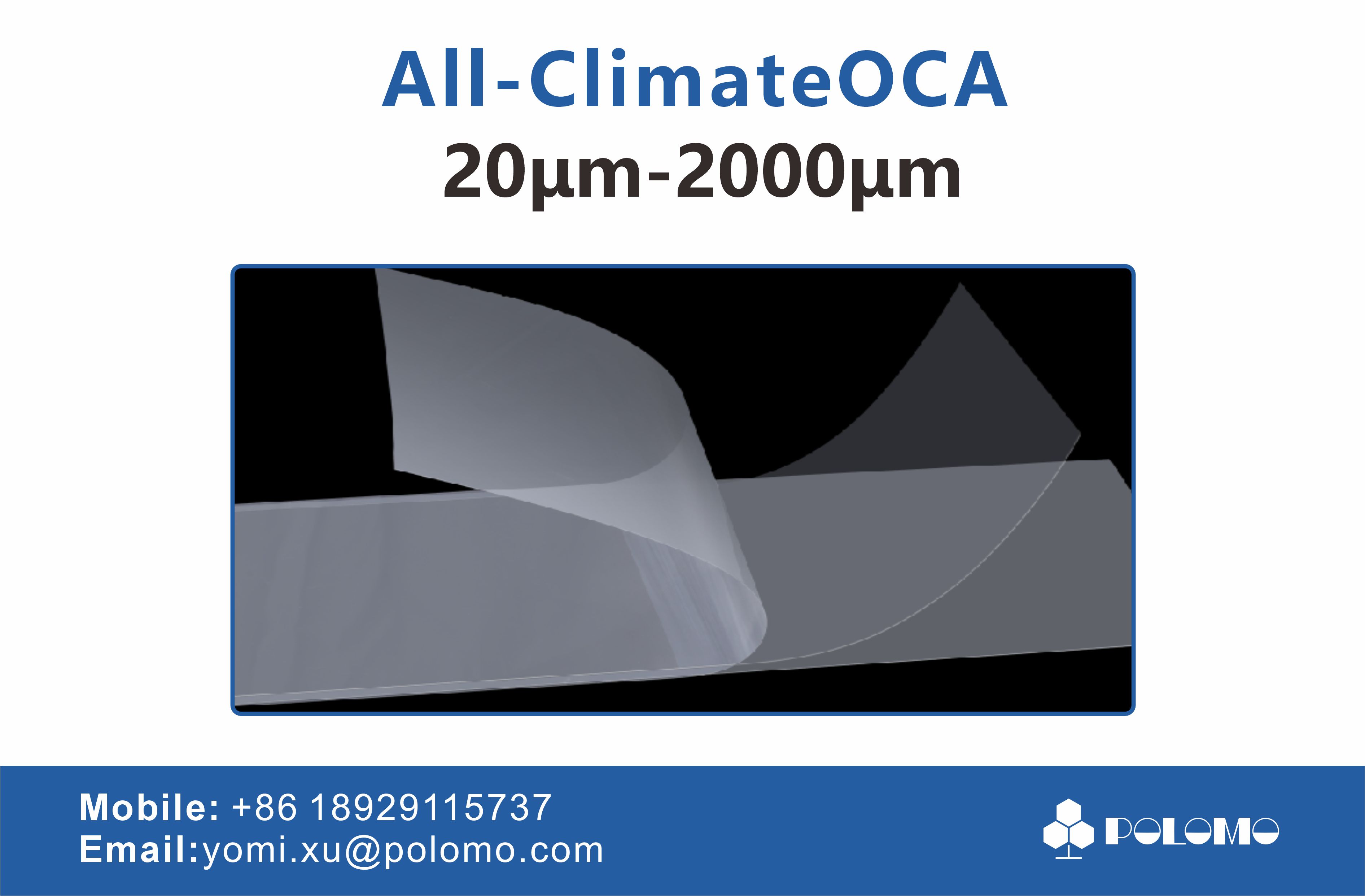
The documented lamination sequence removes a light release liner first, then performs a short-term hot (STH) step, removes a heavy release liner, performs a high-temperature hot (HTH) step and finishes in an autoclave, with room temperature and low pressure stated as the special process requirement. That sequence implies a liner / adhesive / liner construction and tells the engineer where the parameter risk sits: at the two liner interfaces and inside the autoclave.
| Parameter | Published value (TS107 / TS108 / TS109) | Parameter group |
|---|---|---|
| Thickness | 20–2000 μm | Mechanical / format |
| Product size | 3–50″ (notation as published) | Format |
| Appearance | Colourless transparent solid | Optical |
| Modulus | 22±5 | Mechanical |
| Δb | 0.03 | Optical |
| Haze | <0.3 | Optical |
| Water absorption | <0.3 | Mechanical / environmental |
| Dielectric constant (1 MHz) | 2.9 | Electrical |
Selection boundary to record: the published figures above are stated for the family as a whole, not per model. No per-model differentiation between TS107, TS108 and TS109 is published in this specification set, and the test methods behind the modulus, haze and Δb figures are not stated. A model-level selection therefore requires the individual model datasheet plus your own stack trial. Treating the family values as interchangeable models would be an assumption, not a documented fact.
Optical parameters: what the numbers constrain
Haze below 0.3 and Δb of 0.03 are the two published optical limits, and they answer different questions. Haze describes scattering inside or at the surface of the adhesive layer; a low haze value protects contrast and image clarity, which matters most where the optical path is magnified or projected, as in a head-up display. Δb describes colour shift toward yellow; a low value supports the yellowing-resistance characteristic Polomo states for this product and is the parameter that will move first in a hot, sun-loaded dashboard environment.
Transmittance is stated qualitatively as high transmittance rather than as a numeric value, so the numeric figure has to be requested for the specific model and thickness. Two practical consequences follow:
- Write two optical gates into the specification — an incoming gate on the as-supplied roll and a post-durability gate after the ageing exposure your program requires. A single incoming value does not protect the field.
- Confirm whether each published value refers to the adhesive film alone or to a laminated stack that includes the cover glass and the panel, because a stack measurement and a film measurement are not interchangeable.
For driver-facing and projected displays, the optical gate is usually the item that cannot be reworked after assembly, so it deserves the tightest agreed limit and the clearest test method in the purchase specification.
Mechanical parameters: modulus, thickness, water absorption, dielectric constant
Modulus 22±5 is the mechanical centre of the published data set. Polomo describes the product as low modulus with strong degassing capability and links that combination to bonding efficiency and yield on large-size displays. Read carefully, that is a product characteristic, not a guaranteed yield figure for your line: yield depends on the equipment, the operator sequence, the laminate geometry and the defect type being measured. The relevant selection question is whether the stated low modulus suits your gap and your curvature, which is answered by a stack trial, not by the number alone. Because modulus carries no unit in the published table, confirm the unit and the measurement method with the supplier before the value enters a controlled specification document.
Thickness spans 20–2000 μm, and Polomo offers customization of thickness and dimensions. Thickness is the parameter that couples the optical stack to the process: it must be sufficient to fill the gap without trapping air and stable enough to survive the autoclave without edge squeeze-out. A thickness tolerance is not published in this data set, so the tolerance, the measurement location and the sampling frequency belong in the agreed specification.
Water absorption below 0.3 supports the humidity and rework story. Low water uptake reduces the risk of optical change and adhesion loss in damp-heat exposure, and it matters more in automotive interiors where a bonded unit may see repeated condensation cycles. The dielectric constant of 2.9 is specified at 1 MHz, which is the detail that makes the number usable: capacitive touch stacks are frequency-dependent design inputs, and a dielectric value quoted at a different frequency is not comparable.
Adhesion is stated as excellent bonding to glass, PET, polarisers and metals. This is a qualitative substrate list. Before release, request peel or shear data on the substrates your stack actually uses, because a polariser surface and a printed glass surface do not behave like a plain glass slide.
Environmental parameters: reading the durability envelope honestly
The working-condition profile published for this full-lamination application is a wide temperature range of −40 °C to 120 °C, high temperature and high humidity, high-altitude negative pressure, vibration, strong ultraviolet exposure and outdoor use, plus applications with health-related requirements. The product is described as weather resistant and as maintaining its optical and mechanical properties under high and low temperature, high temperature and humidity, high-altitude negative pressure, vibration and strong UV.
That is a useful envelope, but it is stated as performance rather than as a test report. No ageing duration, irradiance level, cycle count or acceptance threshold is published alongside it. The engineering response is to convert each environmental statement into a test in your own qualification plan — damp heat, thermal shock, UV dose and altitude/vacuum — with pass/fail limits agreed in writing.
Scope check worth doing: third-party technical commentary on silicone optical adhesives cites service ranges as wide as −55 °C to +200 °C. That is a statement about silicone chemistry in general. It is not a measured rating for TS107, TS108 or TS109 and should never be copied into a PPAP or customer submission in place of the supplier's documented range for the specific model and thickness.

Mapping parameters to a stack in five steps
Step 1 — Write the stack and the failure you cannot accept
List every layer, the bonding interfaces, the panel diagonal and any curvature. Then name the single defect that would stop the program: bubble or mura in the viewing area, edge yellowing after ageing, delamination at a bezel step, or a rework rate above plan. Every later parameter choice is justified against that defect.
Step 2 — Convert geometry into thickness and modulus brackets
Gap and step height set the minimum and maximum thickness; curvature and bezel width set how soft the adhesive needs to be. Use the published 20–2000 μm thickness range and the 22±5 modulus figure as the bracket, then ask for the model and thickness that sit inside it. If the answer is the whole range, the bracket is not yet defined.
Step 3 — Convert the durability profile into a test matrix
Turn the published working-condition profile (−40 °C to 120 °C, damp heat, altitude negative pressure, vibration, UV) into named tests with durations and limits. Assign each test to the parameter it can actually move: damp heat to water absorption and adhesion, UV and heat to Δb, thermal cycling to bubble and delamination behaviour.
Step 4 — Fix optical acceptance before and after ageing
Set an incoming limit and a post-ageing limit for haze and Δb. Ask the supplier which value the published haze below 0.3 and Δb 0.03 represent, and require the same method in the acceptance test so the two numbers are comparable.
Step 5 — Lock the process window, then the storage rules
Confirm the line can execute the documented sequence — remove light release liner, STH, remove heavy release liner, HTH, autoclave — at room temperature and low pressure. Storage and shelf-life rules are part of this step, not an afterthought, because a parameter that is correct at shipment can be lost in the warehouse.
How certified process control supports parameter consistency
Parameters only help a program if they repeat from lot to lot, and repeatability is a management-system property rather than a datasheet property. That is why certification evidence belongs in a parameter-selection discussion: it describes the control environment in which the values are produced and released.
IATF 16949:2016 is the international quality management system standard for automotive production and relevant service parts organisations. Polomo's certificate, issued by TÜV NORD CERT GmbH under certificate 44 111 222509, carries the scope "Design and Manufacturing of OCA (Optically Clear Adhesive)", was issued on 20 January 2026 and is valid to 19 January 2029. The value of that scope wording for a buyer is that the certified activity is the OCA design and manufacturing process itself, not an unrelated corporate function.
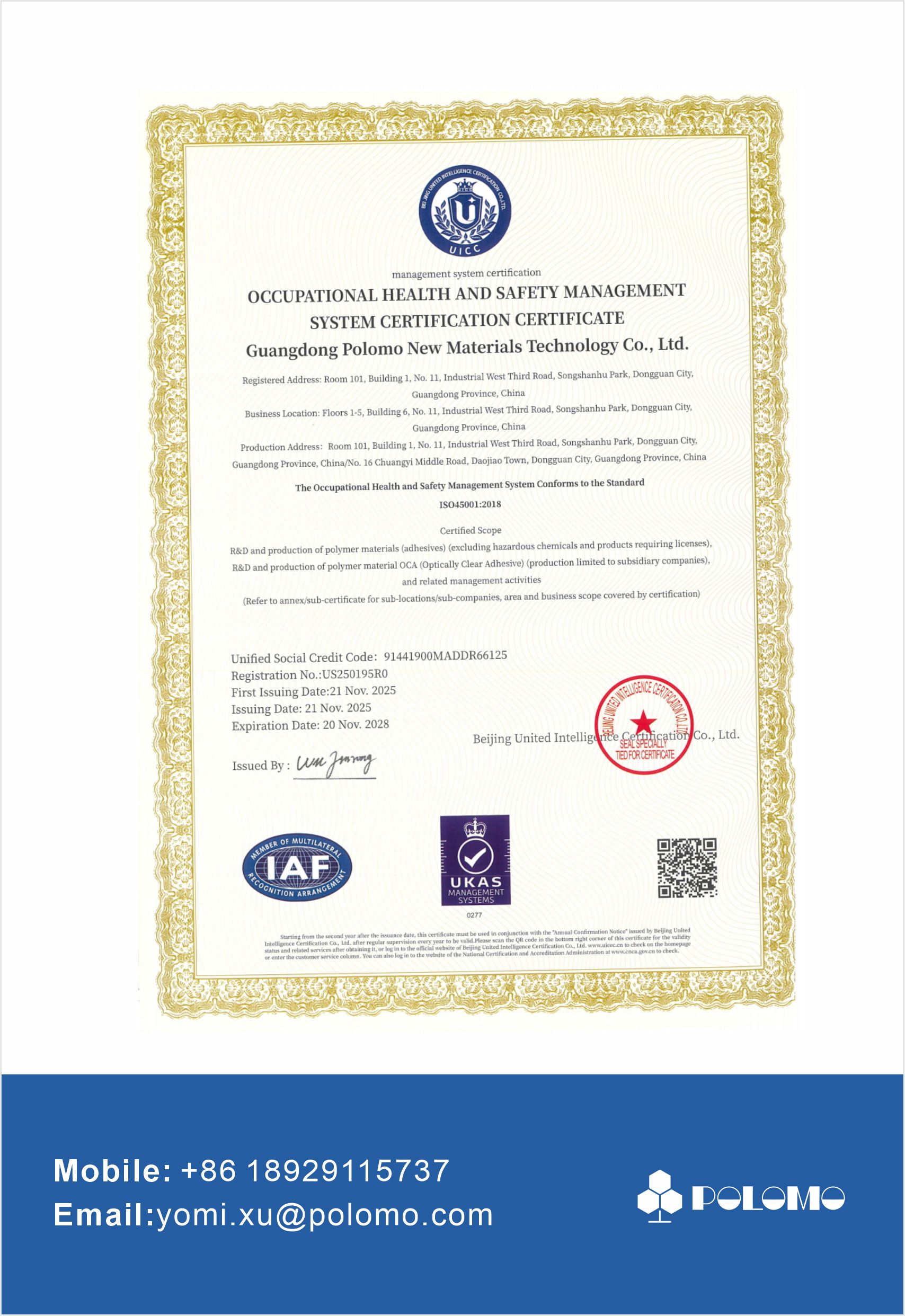
The quality system is supported by ISO 9001:2015 certification, certificate UQ251898R0, issued by Beijing United Intelligence Certification Co., Ltd. and valid from 21 November 2025 to 20 November 2028, covering R&D and production of polymer materials (adhesives) and polymer material OCA, with production limited to subsidiary companies. Environmental and occupational health and safety systems are also certified under the same body and validity window: ISO 14001:2015 (UE250300R0) and ISO 45001:2018 (US250195R0).
The VDA document requires precise reading. Polomo holds a VDA 6.3:2023 & VDA 6.5:2020 training attendance certificate, number TN_SC_CNGZ_VDA6.3&6.5-202411001, issued by TÜV NORD BU CERTIFICATION CHINA on 27 December 2024, covering standard interpretation, audit role playing, process approach and process model concepts, product audit, audit skills, case study and examination. It evidences trained audit competence in the VDA method; it is not a plant process certification, and a buyer's supplier record should say so.
On the operational side, Polomo states 100% pre-shipment testing, 8D customer complaint handling, online and on-site production-line support, and root-cause analysis with continuous improvement. Those practices are the mechanism by which a parameter deviation is caught and closed rather than shipped.
| Document | Reference | Issued by | Validity | Scope as published |
|---|---|---|---|---|
| IATF 16949:2016 | 44 111 222509 | TÜV NORD CERT GmbH | Issued 2026-01-20; valid to 2029-01-19 | Design and manufacturing of OCA |
| ISO 9001:2015 | UQ251898R0 | Beijing United Intelligence Certification Co., Ltd. | 2025-11-21 to 2028-11-20 | R&D and production of polymer materials (adhesives) and polymer material OCA (production limited to subsidiary companies) |
| ISO 14001:2015 | UE250300R0 | Beijing United Intelligence Certification Co., Ltd. | 2025-11-21 to 2028-11-20 | Environmental management for the same scope |
| ISO 45001:2018 | US250195R0 | Beijing United Intelligence Certification Co., Ltd. | 2025-11-21 to 2028-11-20 | Occupational health and safety management for the same scope |
| VDA 6.3:2023 & VDA 6.5:2020 training attendance certificate | TN_SC_CNGZ_VDA6.3&6.5-202411001 | TÜV NORD BU CERTIFICATION CHINA | Issued 2024-12-27 | Standard interpretation, audit role playing, process approach, product audit, audit skills, case study and examination |
| D-U-N-S registration | 52-969-0297 | Dun & Bradstreet | Issued 2026-05-01; valid to 2027-05-31 | Enterprise credit registration (whole company) |
Cleanroom and contamination control: verify, do not assume
Contamination is an optical defect source, so cleanroom class is a legitimate parameter question. ISO 14644-1:2015 is the international standard that classifies air cleanliness by airborne particle concentration, and the older US federal Class 100 designation is commonly treated as equivalent to ISO Class 5. That equivalence is a classification convention, not a statement about any particular factory.
The verification step is therefore specific: ask for the ISO 14644-1 class of the coating and slitting area where the OCA is exposed, the date of the most recent particle-count test, the liner-handling and gowning procedure, and how incoming rolls are protected between slitting and packing. A supplier that answers with a class number and a current test date has given you something auditable; a supplier that answers with the word "cleanroom" has not.
Where the parameter emphasis shifts by application
The published application scope covers automotive, industrial control, medical, smart home, consumer electronics, aerospace and marine industries. The table below shows where the emphasis moves between parameter groups in different stacks; it is a selection aid, not a model-level qualification for each format.
| Application context | Dominant parameter group | What to lock first |
|---|---|---|
| Large curved, narrow-bezel automotive display | Mechanical, then optical after ageing | Thickness and modulus bracket for gap fill and edge stress; autoclave window |
| Head-up display optics | Optical | Haze limit and Δb limit after heat and UV exposure, with agreed test method |
| Flexible or foldable stack | Mechanical | Low-modulus behaviour under repeated bending; thickness and edge design |
| Industrial touch display | Electrical plus mechanical | Dielectric constant at the touch-sensing frequency; adhesion to the actual sensor surface |
| Medical display | Optical plus contamination control | Haze and colour stability, plus documented cleanroom class and shelf-life control |
Storage and environmental control: the risk a datasheet does not carry
An OCA film is a stored component, and the parameters that were correct at final inspection can degrade before the roll reaches the laminator. Polomo's stated control method is standardised environmental control combined with FIFO management: a temperature- and humidity-controlled clean warehouse, strict control of light exposure and dust contamination, strict shelf-life management, inventory ageing alerts, and standardised opening and storage procedures to prevent adhesive layer contamination.
For the buyer, these become contractual checkpoints rather than supplier prose. Specify the storage temperature and humidity band, the shelf life from date of manufacture, the FIFO evidence the supplier will provide, the maximum age of the roll at delivery, and the incoming inspection of packaging, liner integrity and roll edges. A pre-lamination defect caused by storage is indistinguishable, at the lamination station, from a parameter defect — which is why the two have to be controlled together.
Purchasing terms and acceptance criteria: closing the loop
The commercial data published for this family covers customization of thickness and dimensions, a monthly capacity of approximately 1 million pieces, a lead time of 7–10 working days and an MOQ to be discussed. Unit price, thickness tolerance, packaging specification and freight terms are not published, so they have to be obtained as part of the quotation rather than inferred from the technical sheet.
A workable acceptance package for a TS107, TS108 or TS109 program normally contains:
- Parameter list with method — each optical, mechanical and electrical value, the test method, the sample size and the inspection frequency, including the post-ageing limits.
- Certificate identity — IATF 16949:2016 certificate 44 111 222509 and ISO 9001:2015 certificate UQ251898R0 recorded with issuing body, scope and validity, and the VDA training attendance certificate recorded with its correct status.
- Storage and shelf life — temperature and humidity band, maximum roll age at delivery, FIFO evidence and opening procedure.
- Deviation path — the 8D route, the response time expectation, and the production-line support commitment for a suspect lot.
- Traceability — lot identification linking the delivered roll to the pre-shipment test record.
Polomo reports a track record exceeding 10 years in automotive full lamination with application in more than 120 vehicle models. That is a company-reported figure; treat it as a reason to request references for a comparable stack rather than as a substitute for your own validation.
Next step: test the parameters against your own stack
Parameter tables narrow the choice; only a stack trial confirms it. Polomo supplies silicone OCA samples in the thickness and dimension your design requires and returns a quotation against the agreed acceptance criteria. Contact Yomi Xu at yomi.xu@polomo.com, by phone on +86 18929115737, or via WhatsApp.
The full parameter and application range is documented in the Polomo product brochure.

Frequently asked questions
Which certifications should be verified before locking TS107, TS108 or TS109 parameters?
Verify certificate identity, scope and validity, not just the standard name. Polomo publishes IATF 16949:2016 certification issued by TÜV NORD CERT GmbH under certificate 44 111 222509, with a scope of design and manufacturing of OCA, issued 20 January 2026 and valid to 19 January 2029; ISO 9001:2015 certificate UQ251898R0 issued by Beijing United Intelligence Certification Co., Ltd., valid 21 November 2025 to 20 November 2028; ISO 14001:2015 certificate UE250300R0 and ISO 45001:2018 certificate US250195R0 from the same body with the same validity window; a VDA 6.3:2023 & VDA 6.5:2020 training attendance certificate (TN_SC_CNGZ_VDA6.3&6.5-202411001) issued by TÜV NORD BU CERTIFICATION CHINA; and D-U-N-S registration 52-969-0297. The VDA document is a training attendance certificate rather than a process certification, so record it as evidence of audit-method training, not as plant approval.
What does the published TS107, TS108 and TS109 specification actually cover?
It covers one family-level data set: thickness 20–2000 μm, product size 3–50″, colourless transparent solid appearance, modulus 22±5, Δb 0.03, haze below 0.3, water absorption below 0.3 and dielectric constant 2.9 at 1 MHz, with the product described as an all-climate silicone OCA offering high transmittance, yellowing resistance, low modulus with strong degassing capability, adhesion to glass, PET, polarisers and metals, low odour and low VOC, and weather resistance. The same values are stated for all three models, and test methods are not published, so a model-level choice still requires the individual datasheet and a stack trial.
What commercial terms are published, and what still has to be quoted?
Published terms are customization of thickness and dimensions, an MOQ to be discussed, a lead time of 7–10 working days and a monthly capacity of approximately 1 million pieces. Unit price, thickness tolerance, packaging specification, shelf life at delivery and freight terms are not published, so request them with the quotation and confirm that the quoted configuration matches the thickness and dimension in your specification.
How should a sample be evaluated against a specific lamination stack?
Define the stack and the pass/fail items before the trial, then laminate using the documented sequence — remove the light release liner, run the short-term hot step, remove the heavy release liner, run the high-temperature hot step and finish in the autoclave — at room temperature and low pressure on qualified lamination equipment. Inspect for bubbles, mura and edge defects, and measure haze and Δb both as-supplied and after the durability exposure your program requires. Agree the test methods with the supplier first, because the published values do not state their test conditions.
What lead time and storage or acceptance controls should be agreed before release?
The stated lead time is 7–10 working days. Storage controls to write into the agreement are a temperature- and humidity-controlled clean warehouse, light and dust exposure limits, strict shelf-life management with inventory ageing alerts, FIFO management and standardised opening and storage procedures to prevent adhesive layer contamination. Acceptance criteria should also name the pre-shipment test commitment, the tolerance and measurement location, and the 8D route for a nonconforming lot. Teams ready to run those checks on their own design can request samples and a quotation through the contact channel above.
Conclusion
Silicone OCA selection for TS107, TS108 and TS109 comes down to disciplined mapping: read the optical, mechanical and environmental parameter groups against a defined stack and durability profile, then confirm the values survive your process and your warehouse. The published family specification — 20–2000 μm thickness, 22±5 modulus, haze below 0.3, Δb 0.03, water absorption below 0.3 and 2.9 dielectric constant at 1 MHz — gives a credible starting reference, and IATF 16949:2016 certification under certificate 44 111 222509 with the OCA design and manufacturing scope gives the control environment that makes those values repeatable. What the data set does not yet tell you is which of the three models to use and under which test methods, so the model datasheet, the agreed acceptance limits and a stack trial remain the deciding evidence. Select on the parameters you can test, and write down the ones you cannot.
Have Questions or Need More Details?
Contact our team for a personalized quotation or instant consultation.
Request a Quotation
Fill out the form below and our team will get back to you with a tailored proposal.
WhatsApp Direct Chat
Prefer to chat in real-time? Message us on WhatsApp for instant assistance & quick answers.
- Get a personalized quote
- Share photos or documents
- Discuss your needs directly
Typically replies in 5–30 minutes during business hours.