
Silicone OCA Storage Risk: Why Certified Environmental Control Protects Yield
Most silicone OCA failures are decided before the roll ever reaches the laminator. This guide explains how storage and environmental exposure drive quality drift, yield loss and rework — and how a certified environmental management system, ISO 14001:2015 certificate UE250300R0, converts that risk into something a buyer can actually verify.
A silicone OCA roll can arrive with the correct paperwork, the correct thickness and a visually clean appearance, then still produce bubbles, mura or yellow spot defects during lamination. In most of those cases the adhesive was not out of specification when it was manufactured. What changed was its history after packing: how warm it became in transit, how long it sat in a warehouse, how much light reached the liner edge, whether the storage area cycled through humid air, and how the roll was opened on the line.
For buyers in the research and evaluation stage, storage and environmental control are therefore not warehouse housekeeping topics. They are part of the material's quality system, and they should be evaluated with the same discipline as modulus, haze or adhesion data. This article treats the topic as a sourcing problem: what the risk is, why it has become a purchasing criterion, what a supplier's environmental certification actually proves, and how to check it step by step before a program is committed.
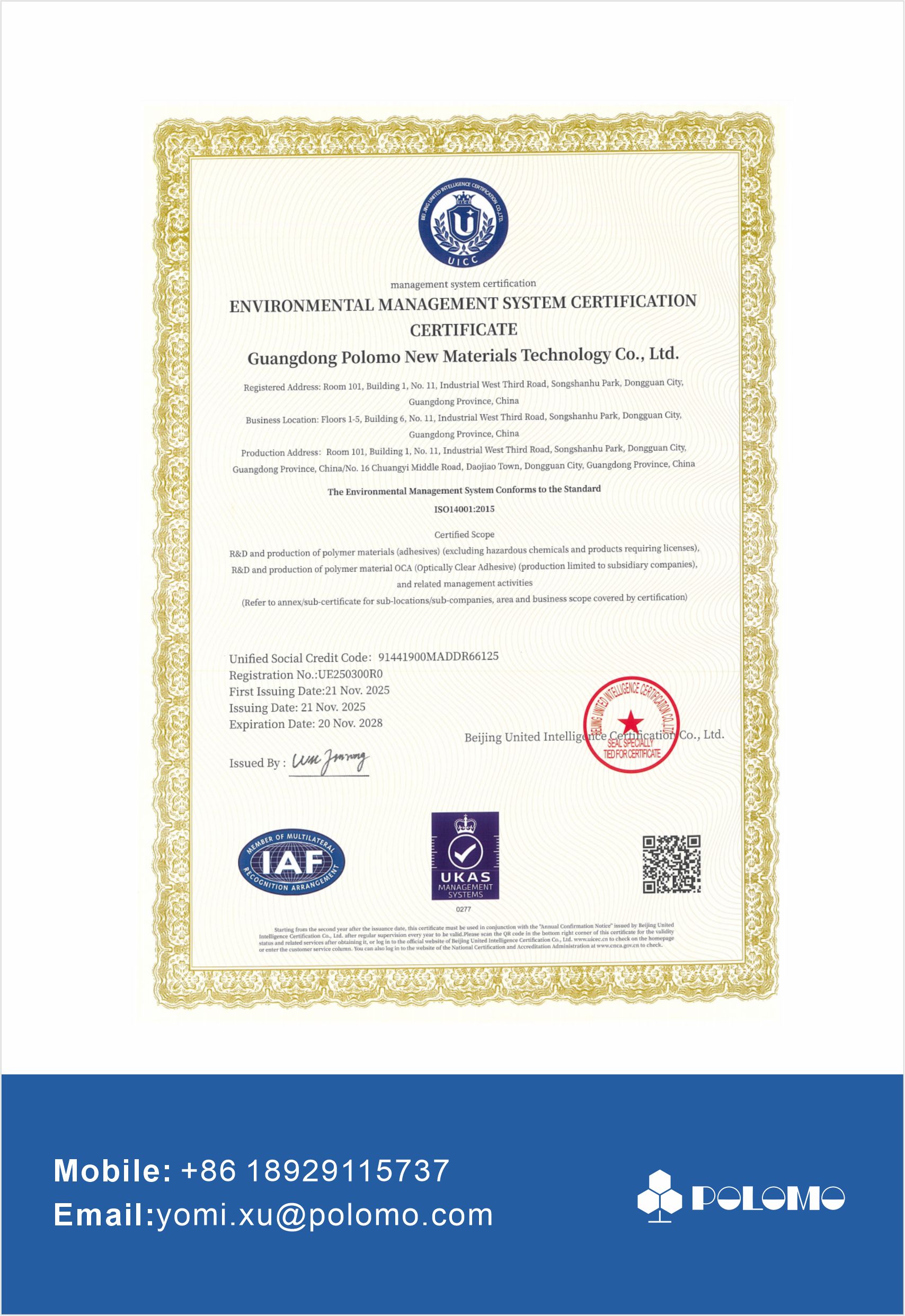
ISO 14001:2015 environmental management system certificate UE250300R0, issued by Beijing United Intelligence Certification Co., Ltd., valid 2025-11-21 to 2028-11-20.
What Storage and Environmental Control Risk Actually Means for Silicone OCA
Definition: storage and environmental control risk is the probability that a silicone OCA's optical and mechanical properties drift outside the lamination window between the supplier's final inspection and the moment the adhesive is consumed on the customer line. It is a pre-lamination risk, not a lamination risk — which is exactly why process capability alone cannot eliminate it.
Four pathways are commonly associated with that drift. Each is manageable, and each is invisible on a product datasheet.
- Thermal exposure. Warehouse roofs, container interiors and line-side staging areas can exceed the conditions a roll was packed for. Repeated heating and cooling cycles stress the adhesive layer and its release liners long before the material reaches the autoclave.
- Moisture uptake. Silicone OCA is specified with water absorption below 0.3%, which leaves limited headroom for additional moisture once a roll has absorbed humidity in an uncontrolled space. Condensation on liner surfaces is a recognised source of downstream bubble defects.
- Light and UV exposure. Optically clear adhesives for automotive use are formulated around UV resistance and anti-yellowing performance, but that performance is designed for in-service exposure rather than for weeks of direct sunlight through a warehouse window.
- Particulate and liner contamination. Dust, cardboard fibre and handling residue settle on the release liner and transfer to the adhesive when the roll is opened. Because the adhesive is tacky by design, contamination cannot be removed once it lands.
Time multiplies all four. Every optically clear adhesive has a shelf life, and the practical window between "just manufactured" and "risky to run" is consumed by transit, incoming inspection queues, partial rolls left after a short production run, and re-staging between shifts. A supplier with disciplined shelf-life management shortens that exposure; a supplier without it simply forwards the problem downstream.
Where the drift surfaces is predictable. On display lamination lines the symptoms are bubble entrapment that survives autoclave, mura that appears only after thermal cycling, yellow spot defects, and rework rates that rise without any change in lamination parameters. Polomo's program record for automotive display lamination lists bubbles, mura and yellow spot among the defect classes its silicone OCA was developed to resolve, alongside a 1.5% improvement in lamination yield and an 85% improvement in rework efficiency in qualified applications.
Standardized environmental control combined with FIFO management is the operating model behind silicone OCA storage risk control.
Industry Background: Why Environmental Control Became a Sourcing Criterion
The commercial weight behind this topic is easy to see in the numbers. The global optically clear adhesive market was valued at USD 2.1 billion in 2024, with automotive displays accounting for roughly 20% of revenue share and industrial and rugged display systems contributing a further 15% (Verified Market Research, Optically Clear Adhesives Market Report 2026). Asia Pacific held 51% of the automotive adhesives market in 2024 (Precedence Research).
Those volumes travel. An OCA roll may be coated in one region, converted in another and laminated in a third, crossing climate zones and warehouses that are not built to optical standards. Every handover is a chance for the material to sit in an environment nobody documented.
Quality expectations moved at the same time. The International Automotive Task Force describes IATF 16949 as the mandatory global quality management standard for automotive suppliers, focused on zero-defect manufacturing. A zero-defect target is not achievable if the incoming material has already drifted before it is used, so buyers increasingly audit the route the material takes — storage, handling, staging and opening — rather than only the certificate hanging in the reception area.
The supply base that can answer those questions is not uniform. Polomo Group, founded in 2002, integrates R&D, manufacturing and sales and produces silicone OCA at a 90,000 m² facility in Dongguan, Guangdong Province, with 300 employees, 80 engineers and an annual output of 10 million pieces. Roughly 30% of output is exported. That scale is relevant because environmental control at production scale requires systems, not individual good practice — which is where certification becomes a useful evaluation tool.
The Solution: A Certified Environmental Management System Behind the Roll
The direct answer for buyers is this: the control that reduces storage and environmental risk is a documented environmental management system at the point of manufacture, and the evidence to request is an ISO 14001:2015 certificate with a scope that actually covers OCA production.
Polomo Group's silicone OCA is produced under ISO 14001 Environmental Management System certification. The applicable standard is ISO 14001:2015, the certificate is issued by Beijing United Intelligence Certification Co., Ltd. under certificate number UE250300R0, and it is valid from 2025-11-21 to 2028-11-20. The silicone OCA models covered by the wider certificate set are TS107, TS108 and TS109 — an all-climate OCA platform with a modulus of 22±5, haze below 0.3, Δb of 0.03, water absorption below 0.3%, thickness options from 20 to 2000 μm and product sizes from 3 to 50 inches.
Reading Certificate UE250300R0 Correctly
The registered scope reads: R&D and production of polymer materials (adhesives) (excluding hazardous chemicals and licensed products); R&D and production of polymer OCA (Optically Clear Adhesive, production limited to subsidiary companies), and related management activities. Three details matter for evaluation. First, the certificate covers management activities around production, which is precisely the layer that determines how a warehouse is operated, how long material sits and how exposure is logged. Second, the scope explicitly names OCA production rather than adhesives alone, so the certificate is not being borrowed from an unrelated product line. Third, the OCA production is limited to subsidiary companies — a limitation a buyer should confirm during a supplier audit rather than assume.
What the certificate translates into on the floor is concrete: a temperature- and humidity-controlled clean warehouse, strict control of light exposure and dust contamination, strict shelf-life management, inventory aging alerts, and standardized opening and storage procedures designed to prevent adhesive layer contamination. Those measures are the operational content of the environmental control claim, and they are the points to verify on site.
What the Certificate Does Not Cover
An ISO 14001:2015 certificate is not a lot-level guarantee. It confirms that a management system for environmental control is defined, operated and audited across the production scope; it does not certify the condition of an individual roll, and it does not replace the buyer's own incoming inspection, storage discipline or shelf-life tracking after receipt. Buyers evaluating a supplier should treat the certificate as one strong input — the system layer — and pair it with lot traceability, a 100% pre-shipment test regime and a written 8D response path for complaints. Polomo's capability scope includes 100% pre-shipment testing and 8D customer complaint handling with root cause analysis and continuous improvement.
The Environmental Layer Inside the Wider Certificate Stack
Environmental control does not operate alone. The same silicone OCA platform sits inside a broader compliance set, and each certificate answers a different question a buyer will eventually ask.
| Certification | Standard | Certificate number | Issuing body | Validity | What it answers |
|---|---|---|---|---|---|
| ISO 14001 | ISO 14001:2015 | UE250300R0 | Beijing United Intelligence Certification Co., Ltd. | 2025-11-21 to 2028-11-20 | Environmental management of production and related activities |
| ISO 9001 | ISO 9001:2015 | UQ251898R0 | Beijing United Intelligence Certification Co., Ltd. | 2025-11-21 to 2028-11-20 | Quality management, process control and consistency |
| ISO 45001 | ISO 45001:2018 | US250195R0 | Beijing United Intelligence Certification Co., Ltd. | 2025-11-21 to 2028-11-20 | Occupational health and safety in handling operations |
| IATF 16949 | IATF 16949:2016 | 44 111 222509 | TÜV NORD CERT GmbH | 2026-01-20 to 2029-01-19 | Automotive quality management; scope is design and manufacturing of OCA |
| VDA 6.3 / 6.5 | VDA 6.3:2023 & VDA 6.5:2020 | TN_SC_CNGZ_VDA6.3&6.5-202411001 | TÜV NORD BU CERTIFICATION CHINA | Training attendance certificate, issued 2024-12-27 | Process and product audit competence |
| D-U-N-S | Dun & Bradstreet global enterprise identification system | 52-969-0297 | Dun & Bradstreet (D&B) | Registered, valid to 2027-05-31 | Enterprise identity for supplier verification |

Manufacturing under a documented management system is the layer that makes storage and environmental control auditable.
Step-by-Step: Controlling Storage and Environmental Risk From Warehouse to Autoclave
The control chain has eight stages. A supplier can be evaluated against each one, and a buyer can mirror several of them after receipt.
Step 1 — Pre-shipment verification. Material should leave the factory only after lot-level testing. Polomo runs 100% pre-shipment testing, which establishes the baseline condition of the roll before transit begins.
Step 2 — Controlled storage. Finished goods should be held in a temperature- and humidity-controlled clean warehouse. This is the single highest-leverage control, because it addresses the thermal and moisture pathways simultaneously.
Step 3 — Light and dust control. Storage areas should limit light exposure and exclude particulate sources such as cardboard handling, unsealed packaging and general traffic. Polomo applies strict control of light exposure and dust contamination.
Step 4 — Shelf-life management and FIFO. Strict shelf-life management combined with FIFO (first-in, first-out) release prevents old stock from being shipped into a new program ramp. FIFO is a release rule, not a labelling convention, and it should be visible in the warehouse layout.
Step 5 — Aging alerts. Inventory aging alerts flag rolls approaching the end of their usable window, allowing them to be consumed first, retested or withdrawn before they reach a customer line.
Step 6 — Standardized opening and storage procedures. Once a roll is opened, contamination risk rises sharply. Written procedures for opening, partial-roll sealing and re-storage prevent adhesive layer contamination between production runs.
Step 7 — Line-side staging and dwell time. The gap between issuing a roll to the line and running it is where many programs lose control. Dwell time should be defined and short, and staging areas should not be used as overflow storage.
Step 8 — Lamination sequence and feedback. The documented bonding sequence is: remove the light release liner, STH, remove the heavy release liner, HTH, then autoclave, with the process requiring room temperature and low pressure. When a defect appears, the response path matters as much as the control: Polomo's after-sales scope covers 8D customer complaint handling, online and on-site production line support, and root cause analysis feeding continuous improvement.
Where the Risk Concentrates: Three Use Cases
Environmental control is not equally critical in every application. It concentrates where the display is exposed to harsh conditions in service and where cosmetic tolerance is tight.
1. Automotive cockpit and exterior displays
The declared working conditions for this silicone OCA platform include outdoor environments, wide temperature range from −40 °C to 120 °C, high temperature and high humidity, high-altitude negative pressure, vibration, strong UV exposure and health-certified applications. Because the material must survive those conditions for the life of the vehicle, any drift introduced during storage compounds against an already demanding duty cycle. Automotive customers also expect the program history behind the material: this silicone OCA has been applied in more than 120 vehicle models with shipments exceeding 30 million pieces over 10+ years, with customers including automotive OEMs, Tier 1 suppliers, panel makers, lamination houses and distributors.
2. Large curved and narrow-bezel automotive displays
Large curved automotive displays need low-modulus silicone OCA to prevent mura, the visual distortion that appears under thermal stress. The trade-off is that a soft, high-surface-energy adhesive is also more sensitive to contamination picked up from liners and staging surfaces — so the storage and handling discipline discussed above becomes a direct contributor to cosmetic yield, not a background formality.
3. Industrial touch and medical displays
Industrial and rugged display systems represent around 15% of the global OCA market in 2024. These programs often run in smaller batches with partial-roll handling between builds, which increases the number of opening and re-storage events a roll experiences. Medical displays add their own requirement: the material's low odour and low VOC characteristics matter more when the bonded unit is used in an enclosed clinical environment, and stable storage conditions help preserve those characteristics. The same platform is applied across industrial control, smart home, consumer electronics, aerospace and marine display programs, with thickness and dimensions available as customization parameters.

Automotive display lamination is where storage drift and cosmetic tolerance collide most visibly.
Comparison Table: Matching Each Risk to a Verifiable Control
The table below maps each storage and environmental pathway to the failure mode it produces and to the control a buyer should request evidence for. The final column lists only controls documented in the supplier's own quality and environmental scope.
| Risk pathway | Typical symptom at the laminator | Control to verify | Documented control |
|---|---|---|---|
| Thermal exposure | Tack drift, partial delamination after thermal cycling | Temperature-controlled storage; defined shelf life | Temperature- and humidity-controlled clean warehouse; strict shelf-life management |
| Moisture uptake | Bubble entrapment that survives autoclave | Humidity control; sealed packaging until use | Humidity-controlled storage together with a product water absorption below 0.3% |
| Light and UV exposure | Yellowing, yellow spot defects | Light exposure limits in storage | Strict control of light exposure |
| Particulate contamination | Localised mura, visible particles in the bond line | Dust control; controlled opening procedure | Dust contamination control plus standardized opening and storage procedures |
| Ageing in inventory | Inconsistent lot-to-lot behaviour | FIFO release; aging alerts | FIFO management and inventory aging alerts |
| Escape to customer | Defective roll reaching the line | Lot-level verification before shipment | 100% pre-shipment test |
| Repeat defects | Same failure recurs across lots | Structured corrective action | 8D customer complaint handling, root cause analysis, continuous improvement |
Frequently Asked Questions
Which certification actually proves that a silicone OCA supplier controls storage and environmental risk?
The certificate to request is ISO 14001:2015 for the environmental management system. This silicone OCA is produced under ISO 14001 Environmental Management System certification, issued by Beijing United Intelligence Certification Co., Ltd. under certificate number UE250300R0, valid from 2025-11-21 to 2028-11-20. The scope covers R&D and production of polymer materials (adhesives), excluding hazardous chemicals and licensed products, and R&D and production of polymer OCA, with OCA production limited to subsidiary companies. The same operation is also covered by ISO 9001:2015 (UQ251898R0), ISO 45001:2018 (US250195R0) and IATF 16949:2016 (44 111 222509).
How are storage and environmental risks controlled in daily operations?
Control is built on standardized environmental control plus FIFO management. The specific measures are a temperature- and humidity-controlled clean warehouse; strict control of light exposure and dust contamination; strict shelf-life management; inventory aging alerts; and standardized opening and storage procedures designed to prevent adhesive layer contamination. These measures are supported by 100% pre-shipment testing before material leaves the factory.
Does certified environmental control change the unit cost?
There is no published price list for this platform, because commercial terms depend on configuration. What determines the quotation is thickness (20 to 2000 μm), product size (3 to 50 inches), customization of thickness and dimensions, order volume and the MOQ, which is agreed per project. The more useful commercial view is that environmental control shows up in yield and rework rather than in the unit price of a roll: on qualified automotive programs this silicone OCA has been associated with a 1.5% improvement in lamination yield and an 85% improvement in rework efficiency, and those two figures usually outweigh a marginal difference in piece price.
How can a buyer validate storage and environmental control before committing to mass production?
Validation normally starts with a sample run using the intended thickness and dimensions, followed by a review of the certificate set and a supplier audit that checks the warehouse, the FIFO rules, the aging alert process and the opening procedure on site. Buyers can also request the certificate scope statement for ISO 14001:2015 (UE250300R0) and the related quality certificates, then confirm that the scope genuinely names OCA production. After qualification, the 8D complaint path and on-site line support define how quickly any deviation is contained.
What lead time applies, and how is shelf life protected during it?
Lead time is 7 to 10 working days, with monthly capacity of approximately 1 million pieces. Shelf life is protected during that window by FIFO release and inventory aging alerts, so older stock is shipped first rather than sitting behind newer production. For programs with long transit or long line-side dwell, the certificate set, a sample and a quotation can be requested together by contacting yomi.xu@polomo.com or +86 18929115737.
Conclusion: Make Storage Risk a Specification Item
Storage and environmental control risk is the least visible and most misattributed failure mode in optical bonding. It does not announce itself at goods-in; it appears weeks later as bubbles, mura or yellow spot defects, and it is usually blamed on the laminator. The practical response is to move the question upstream and ask a supplier to demonstrate the management system that governs temperature, humidity, light, dust, shelf life and opening procedure — and to show that the system is certified, in scope and auditable.
For buyers evaluating silicone OCA, the evaluation sequence is short: confirm the ISO 14001:2015 certificate and its scope, confirm the quality and automotive certificates that sit around it, inspect the warehouse and FIFO practice on site, and match the product parameters — modulus 22±5, haze below 0.3, Δb of 0.03, water absorption below 0.3%, thickness 20 to 2000 μm — to the display format you intend to bond. Environmental control then stops being a vague assurance and becomes a line item in the specification.
Next Step: Review the Evidence Behind the Claim
Request the certificate set, the product brochure and a sample quotation for silicone OCA models TS107, TS108 and TS109. Polomo Group supplies silicone OCA for automotive, industrial control, medical, smart home, consumer electronics, aerospace and marine display programs from a 90,000 m² facility in Dongguan, Guangdong Province.
Website: en.polomo.com | Email: yomi.xu@polomo.com | Tel: +86 18929115737 | WhatsApp: +86 159-1833-2421
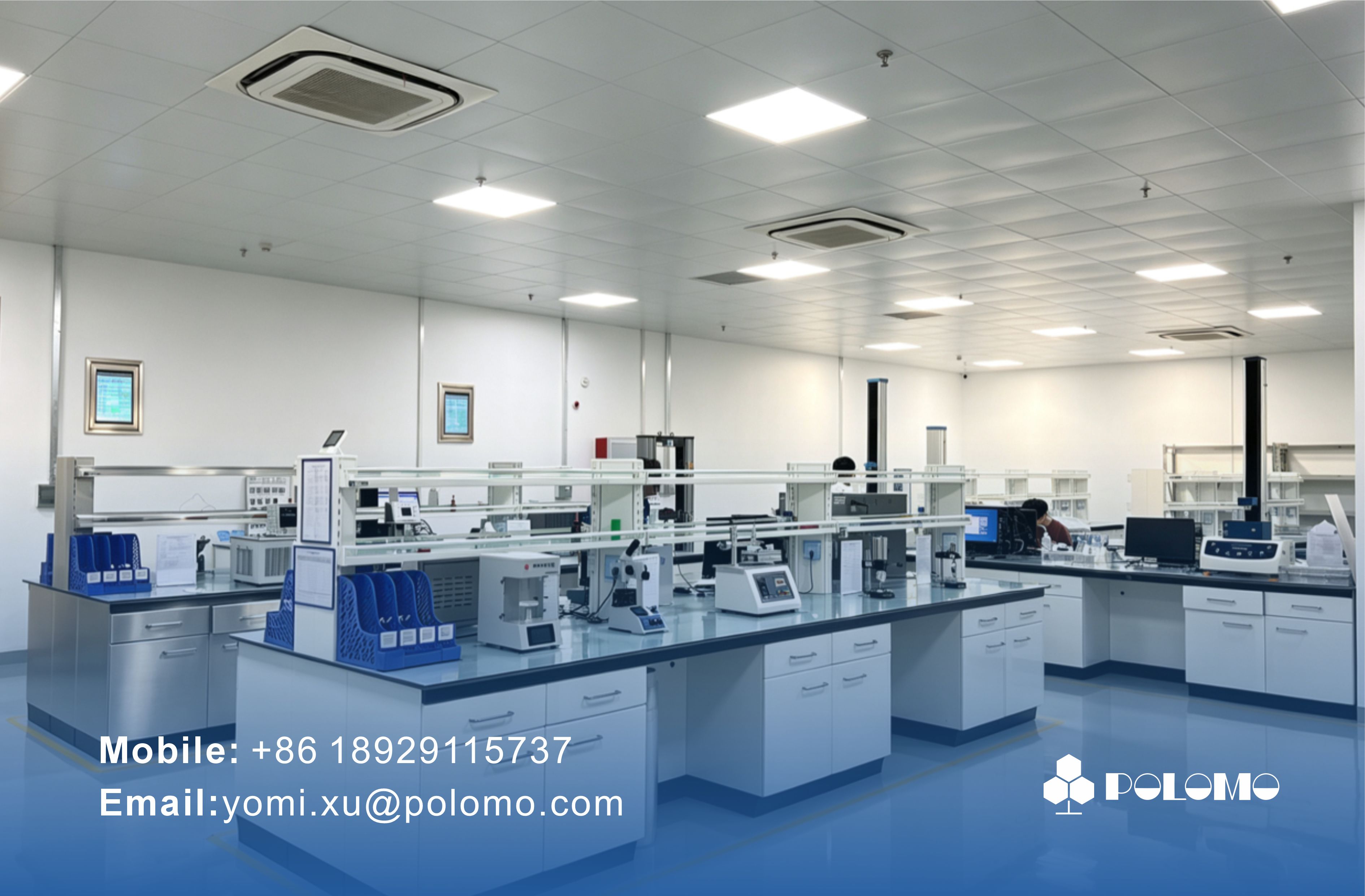
Sample validation and on-site line support are part of the qualification path for new silicone OCA programs.
Have Questions or Need More Details?
Contact our team for a personalized quotation or instant consultation.
Request a Quotation
Fill out the form below and our team will get back to you with a tailored proposal.
WhatsApp Direct Chat
Prefer to chat in real-time? Message us on WhatsApp for instant assistance & quick answers.
- Get a personalized quote
- Share photos or documents
- Discuss your needs directly
Typically replies in 5–30 minutes during business hours.