
Silicone OCA Supplier Evaluation: Certifications, Audits, and Delivery Assurance
Silicone OCA · Supplier Evaluation Framework
Selected partner programs bonded with Polomo silicone OCA models TS107, TS108 and TS109.
A silicone OCA supplier can only be evaluated against three verifiable layers: the scope of its certificates, the audit checkpoints its factory and warehouse can actually pass, and the delivery terms it is prepared to put in writing. Everything else is a claim.
Silicone OCA (optically clear adhesive) is the bonding layer used in display full lamination, where the cover glass, touch panel layer and display panel layer are bonded into a single optical stack. Because those stacks end up in vehicles, industrial touch panels and medical displays, the supplier’s quality system — not only the datasheet — determines whether the tenth production lot behaves like the first sample.
This guide is written for importers, Tier 1 teams, panel and lamination manufacturers, and procurement managers who are in the research-to-evaluation stage of a silicone OCA sourcing decision. It uses Guangdong Polomo New Materials Technology Co., Ltd — a silicone OCA manufacturer founded in 2002 and based in Dongguan, Guangdong Province, China — as the worked example, because Polomo’s credential set makes the difference between verifiable documents and marketing claims easy to see.
Problem Definition: Where Silicone OCA Supplier Evaluations Go Wrong
Silicone OCA supplier evaluations usually fail in one of five places. Each one has a direct cost in a display program, and each one can be closed with a specific document request.
- A certificate without scope. A supplier can hold a certificate for one product family and quote a different one. If the certificate does not name the models you intend to buy, you have not verified the supply you are planning for.
- Certification mixed with training. Third-party certification and attendance-based training are different evidence classes. Both are useful during evaluation; only one is an audited certification. Treating them as identical weakens the whole assessment.
- Storage treated as logistics rather than quality. An optically clear adhesive layer can be affected by uncontrolled temperature, humidity, light exposure and dust before lamination begins. Storage and environmental control are quality controls, not warehouse housekeeping.
- Commercial terms that do not carry quality. Acceptance criteria that stay inside a technical agreement but never reach the purchase order or the incoming inspection plan are difficult to enforce when a lot is questioned.
- Delivery assurance without capacity evidence. A quoted lead time is only meaningful when it is supported by stated capacity, inventory discipline and a documented complaint-handling route.
The evaluation framework below converts each of these gaps into a checkable item: a certificate number, an audit checkpoint, or a line in the purchasing terms.
Industry Background: What Automotive Display Programs Require
IATF 16949 is the mandatory global quality management standard for automotive suppliers, with a focus on zero-defect manufacturing, as defined by the International Automotive Task Force. For any supplier that wants to sit inside an automotive display supply chain, this standard is effectively the entry ticket rather than a differentiator — which is why buyers should read the scope wording carefully rather than simply checking whether a logo exists.
Market context relevant to silicone OCA sourcing:
- The global optically clear adhesives (OCA) market was valued at USD 2.1 billion in 2024 (Verified Market Research).
- Automotive displays accounted for approximately 20% of total OCA market revenue share in 2024 (Verified Market Research).
- Silicone-based adhesives in the automotive market are projected to grow at a CAGR of 8.8% between 2025 and 2032 (Fortune Business Insights).
- Asia Pacific dominated the automotive adhesives market in 2024 with a 51% revenue share (Precedence Research).
- Advanced silicone materials used in optical bonding for automotive applications are rated for temperature extremes from −55 °C to +200 °C (Rogers Corporation BISCO Silicones).
Two conclusions follow for buyers. First, automotive-driven demand for silicone OCA is expanding, so supplier capacity and quality systems will be tested rather than assumed. Second, the operating window of advanced silicone chemistry is wide, which means material chemistry is rarely the limiting factor in the field — process discipline and storage discipline usually are.
Detailed Solution: Mapping Polomo Credentials to Capability
An auditable supplier evaluation needs a credential list that a buyer can match against documents, and a capability list that a buyer can match against a program requirement. For silicone OCA models TS107, TS108 and TS109, Polomo publishes both.
Credentials to verify (listed as issued)
- IATF 16949:2016 — automotive quality management system certification covering silicone OCA models TS107, TS108 and TS109, issued by TÜV NORD CERT GmbH under certificate 44 111 222509.
- ISO 9001:2015 — quality management system certificate UQ251898R0.
- ISO 14001:2015 — environmental management system certification.
- ISO 45001:2018 — occupational health and safety management system certification.
- VDA 6.3:2023 and VDA 6.5:2020 — training attendance covering process audit and product audit methodology. This is training attendance and should be recorded as such, not presented as a certification.
- D-U-N-S number 52-969-0297 — a business identity reference that supports entity verification and traceability in procurement records.
Capability facts to match against your program
- Founded in 2002; production base of 90,000 m²; 300 employees; R&D team of 80 engineers.
- Annual output of 10 million pieces; monthly capacity of approximately 1 million pieces.
- Lead time of 7–10 working days; MOQ to be discussed per program; customization of thickness and dimensions.
- Quality control based on 100% pre-shipment test.
- After-sales support through 8D customer complaint handling, online and on-site production line support, and root-cause analysis with continuous improvement.
- Export ratio of 30%, serving global markets.

Optical film R&D and manufacturing base — the production environment behind silicone OCA TS107, TS108 and TS109.
Product parameters that belong in the technical agreement
| Parameter | Specification (silicone OCA, TS107 / TS108 / TS109) |
|---|---|
| Type | All-climate OCA, optically clear adhesive |
| Thickness | 20–2000 µm |
| Product size | 3–50 in |
| Appearance | Colorless transparent solid |
| Modulus | 22 ± 5 |
| Δb | 0.03 |
| Haze | < 0.3 |
| Water absorption | < 0.3 |
| Dielectric constant (1 MHz) | 2.9 |
Functionally, these models are used for display full lamination, bonding the display cover glass, touch panel layer and display panel layer. The product is applied in the chemical materials industry and is designed for outdoor automotive applications, with resistance targets covering high and low temperature, high temperature and high humidity, high-altitude negative pressure, vibration and strong UV exposure, together with low odor and low VOC characteristics.
Storage and Environmental Control: An Auditable Risk Control
Storage and environmental control is one of the most frequently under-audited areas in silicone OCA sourcing, because it sits between two departments: quality and logistics. Polomo’s documented control method is standardized environmental control combined with FIFO (first in, first out) management, supported by a defined set of measures.
Standardized storage and environmental control: temperature- and humidity-controlled warehousing plus FIFO management.
The measures a buyer can audit directly are:
- A temperature- and humidity-controlled clean warehouse.
- Strict control of light exposure and dust contamination.
- Strict shelf-life management.
- Inventory aging alerts.
- Standardized opening and storage procedures intended to prevent adhesive layer contamination.
For an auditor, each item maps to a record: warehouse temperature and humidity logs, light and dust exposure controls, FIFO evidence in stock movements, shelf-life labelling and aging reports, and the written opening and storage procedure actually used by operators who handle the rolls. Requesting these records during the supplier audit converts a storage policy into a verified control.
Step-by-Step Breakdown: A Six-Step Silicone OCA Supplier Evaluation
Step 1 — Verify the certificate holder and the certificate scope
Confirm that the legal entity on the certificate matches the entity on the quotation and the invoice. Then confirm that the models you intend to purchase appear in the scope. In the Polomo case, IATF 16949:2016 certificate 44 111 222509 covers silicone OCA models TS107, TS108 and TS109, and ISO 9001:2015 certificate UQ251898R0 covers the quality management system.
Step 2 — Separate certifications from training records
IATF 16949:2016, ISO 9001:2015, ISO 14001:2015 and ISO 45001:2018 are third-party certifications. VDA 6.3:2023 and VDA 6.5:2020 appear as training attendance, which describes the supplier’s familiarity with process audit and product audit methodology. Ask for the training records, and then ask the follow-up question that matters: how is that methodology applied in the supplier’s own internal audit plan?
Step 3 — Confirm business identity and operating continuity
Entity identity can be checked with the D-U-N-S number 52-969-0297. Continuity is evidenced by the operating facts: founded in 2002, a 90,000 m² production base, 300 employees, an 80-engineer R&D team, and a 30% export ratio across global markets.
Step 4 — Audit storage and environmental control as a quality control
Walk the warehouse and check the five control items: temperature and humidity control, light and dust contamination control, shelf-life management, inventory aging alerts, and standardized opening and storage procedures. Confirm that FIFO is visible in stock movement records rather than only stated in a procedure.
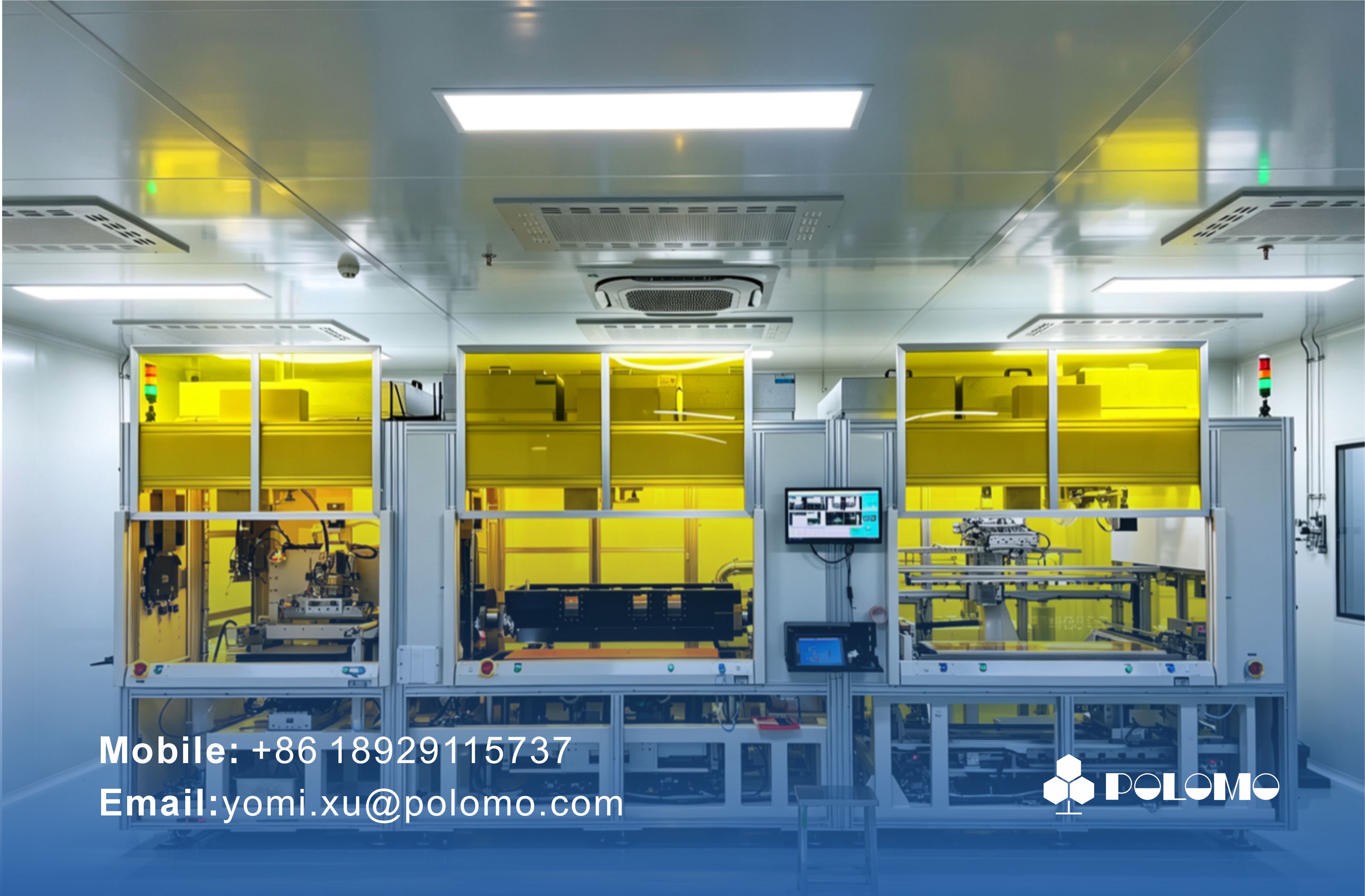
Manufacturing operation supporting a monthly capacity of approximately 1 million pieces and 100% pre-shipment test.
Step 5 — Convert credentials into purchasing terms and acceptance criteria
This is where evaluation becomes procurement. Fix the product parameters in the technical agreement (thickness 20–2000 µm, product size 3–50 in, modulus 22 ± 5, Δb 0.03, haze < 0.3, water absorption < 0.3, dielectric constant 2.9 at 1 MHz), confirm customization of thickness and dimensions, confirm that MOQ is discussed per program, and confirm that 100% pre-shipment test is the outgoing quality control. Add the 8D complaint-handling route for nonconformance.
Step 6 — Validate delivery assurance against capacity evidence
A 7–10 working day lead time should be read together with capacity: monthly output of approximately 1 million pieces and annual output of 10 million pieces. Delivery assurance is credible when capacity, lead time, inventory discipline (FIFO plus aging alerts) and after-sales response are all documented in the same supplier file.
Use Cases: Where This Evaluation Framework Applies
Automotive displays. Silicone OCA TS107, TS108 and TS109 are used for display full lamination and are designed for outdoor automotive applications. The documented processing route is: remove light release liner → STH → remove heavy release liner → HTH → autoclave, using lamination equipment under room temperature and low-pressure conditions.
Automotive program proof. In documented case results, this product resolved lamination issues including bubbles, mura and yellow spot defects, with reported highlights of high efficiency, high yield, weather resistance and low odor, and it met the health and safety requirements of mother-and-child-friendly smart cockpits. Reported outcomes include improved lamination yield by 1.5%, improved production efficiency by 75%, improved rework efficiency by 85%, and a 10+ year application history. The material is currently applied in more than 120 vehicle models, with shipments exceeding 30 million pieces, across OEMs including Mercedes-Benz, BMW, Audi, Toyota and Volkswagen, as well as emerging Chinese EV brands such as Li Auto, NIO and BYD.
Automotive display programs bonded with silicone OCA across more than 120 vehicle models.
Industrial and medical displays. The same product family is applied in industrial control, medical, smart home appliance, consumer electronics, aerospace and marine display applications. The application scenario is common in global markets, which means the evaluation framework in this article can be reused across regions as long as the credential scope and acceptance criteria are re-checked per program.
Comparison Table: Credential-to-Verification Map
The table below maps each credential or control to the audit checkpoint it supports and the evidence a buyer should request. It is the shortest version of the evaluation framework.
| Credential / Control | What it establishes | Audit checkpoint | Evidence to request |
|---|---|---|---|
| IATF 16949:2016 (TÜV NORD CERT GmbH, certificate 44 111 222509) | Automotive quality management system for silicone OCA TS107, TS108 and TS109 | Scope wording names the models quoted | Certificate copy showing issuer, number and scope |
| ISO 9001:2015 (certificate UQ251898R0) | Quality management system | Certificate holder matches the contracting legal entity | Certificate copy |
| ISO 14001:2015 | Environmental management system | Environmental controls relevant to cleanroom and storage | Certificate copy |
| ISO 45001:2018 | Occupational health and safety management system | Shop-floor handling conditions for adhesive rolls | Certificate copy |
| VDA 6.3:2023 & VDA 6.5:2020 training attendance | Process audit and product audit methodology competence | How the methodology is applied in internal audits | Training records and internal audit plan |
| D-U-N-S number 52-969-0297 | Business identity and traceability | Identity consistent across quotation, invoice and shipping documents | D-U-N-S record |
| Storage and environmental control program (standardized environmental control + FIFO) | Preservation of the adhesive layer before lamination | Temperature and humidity control, light and dust control, shelf life, aging alerts, opening procedures | Storage SOP, warehouse logs, FIFO stock records |
| 100% pre-shipment test | Outgoing quality control | Inspection records match shipped lots | Pre-shipment inspection records |
| Lead time 7–10 working days | Delivery planning reliability | Lead time consistent with stated capacity | Capacity statement and order history |
Frequently Asked Questions
Which certifications should a buyer verify from a silicone OCA supplier for automotive display bonding?
For automotive display bonding, the credential set to verify is: IATF 16949:2016 covering the specific silicone OCA models being purchased, issued by TÜV NORD CERT GmbH under certificate 44 111 222509 for models TS107, TS108 and TS109; ISO 9001:2015 certificate UQ251898R0; ISO 14001:2015; and ISO 45001:2018. In addition, VDA 6.3:2023 and VDA 6.5:2020 training attendance should be recorded as training, not as certification. The D-U-N-S number 52-969-0297 supports entity verification.
Can a silicone OCA supplier support an automotive display program at scale, and what proves it?
Scale is proven by capacity, output and application history rather than by a single claim. Polomo states a monthly capacity of approximately 1 million pieces and annual output of 10 million pieces, supported by a 90,000 m² production base, 300 employees and an R&D team of 80 engineers. The silicone OCA models TS107, TS108 and TS109 are currently applied in more than 120 vehicle models with shipments exceeding 30 million pieces over a 10+ year application history. Outgoing quality control is 100% pre-shipment test.
What drives the commercial terms of a silicone OCA order, including MOQ and customization?
Commercial terms are driven mainly by product thickness, dimensions and program-specific customization. Polomo customizes thickness and dimensions, offers silicone OCA in thicknesses from 20 µm to 2000 µm and product sizes from 3 in to 50 in, with production mode OBM and MOQ to be discussed per program. Buyers should fix these variables — not price alone — in the technical agreement before releasing a purchase order.
How should a sample be validated before a full silicone OCA program is released?
Sample validation should reproduce the production process, not only the material. For silicone OCA TS107, TS108 and TS109, the documented process route is: remove light release liner → STH → remove heavy release liner → HTH → autoclave, using lamination equipment under room temperature and low-pressure conditions, with the adhesive bonding the display cover glass, touch panel layer and display panel layer. Lamination defects documented as resolved in case results include bubbles, mura and yellow spot defects.
What lead time and delivery assurance should be written into the purchase terms?
Polomo’s stated lead time is 7–10 working days, supported by a monthly capacity of approximately 1 million pieces, FIFO inventory management, shelf-life management and inventory aging alerts, with 8D complaint handling plus online and on-site production line support after delivery. Buyers evaluating these terms can request the product brochure, a sample for lamination trials, or a quotation matched to their display program through the supplier’s contact channel.
Conclusion
Silicone OCA supplier evaluation becomes reliable when it stops being a document checklist and becomes a chain: verified certificate scope, correctly classified evidence (certification versus training), audited storage and environmental controls, acceptance criteria written into purchasing terms, and delivery assurance backed by capacity. Each link in that chain is checkable, and each one has a document behind it.
In the Polomo example, the chain is complete and specific: IATF 16949:2016 certificate 44 111 222509 issued by TÜV NORD CERT GmbH for silicone OCA TS107, TS108 and TS109; ISO 9001:2015 certificate UQ251898R0; ISO 14001:2015; ISO 45001:2018; VDA 6.3:2023 and VDA 6.5:2020 training attendance; and D-U-N-S number 52-969-0297. Those credentials sit alongside standardized environmental control with FIFO, 100% pre-shipment test, and a 7–10 working day lead time backed by roughly 1 million pieces of monthly capacity.

Automotive display application cases bonded with silicone OCA — sample and quotation requests welcome.
Next Step: Sample, Quotation, or Full Catalog
If your program uses a 3–50 in display stack and requires a supplier with documented IATF 16949:2016 and ISO credentials, start with a lamination sample of TS107, TS108 or TS109, or request a quotation matched to your thickness and dimensions.
Download the Polomo Product Brochure Visit en.polomo.comContact: Yomi Xu · Email: yomi.xu@polomo.com · Tel: +86 18929115737 · WhatsApp: +86 159-1833-2421
Address: Building 6, No. 11, Industrial West 3rd Road, Songshan Lake Industrial Park, Dongguan City, Guangdong Province, China.
Suppliers named in this article are referenced only where verifiable credential, capacity or specification information is available. Certification and training records should always be confirmed against the current issued documents at the time of the supplier audit.
Have Questions or Need More Details?
Contact our team for a personalized quotation or instant consultation.
Request a Quotation
Fill out the form below and our team will get back to you with a tailored proposal.
WhatsApp Direct Chat
Prefer to chat in real-time? Message us on WhatsApp for instant assistance & quick answers.
- Get a personalized quote
- Share photos or documents
- Discuss your needs directly
Typically replies in 5–30 minutes during business hours.