
Silicone OCA Explained: What Optically Clear Silicone Adhesive Actually Is
Display Lamination Materials · Primer for Procurement Teams
Silicone OCA is a solid, optically clear adhesive sheet made from silicone polymer chemistry and used to bond the layers of a display — cover glass, touch sensor and panel — into a single optical stack. It shares a category name with acrylic OCA, but it is a different material class: a very low modulus, all-climate film with its own dielectric profile, odour behaviour and thermal response.
Most procurement teams meet OCA for the first time through a quotation rather than a materials lecture. A Tier 1 integrator or display maker sends a stack drawing, a working-temperature range and a target volume, then asks for a price. What comes back is a datasheet with numbers such as modulus, Δb, haze and dielectric constant — and the buyer has to judge whether those numbers describe the right material.
This primer is written for that moment. It defines what optically clear silicone adhesive actually is, explains where it sits inside the wider OCA family, shows why certified and traceable production is part of the definition rather than an optional extra, and uses the silicone OCA product family from Guangdong Polomo New Materials Technology Co., Ltd — TS107, TS108 and TS109 — as a concrete, specifiable example.
What this page gives you:
- A working definition of OCA and of silicone OCA specifically
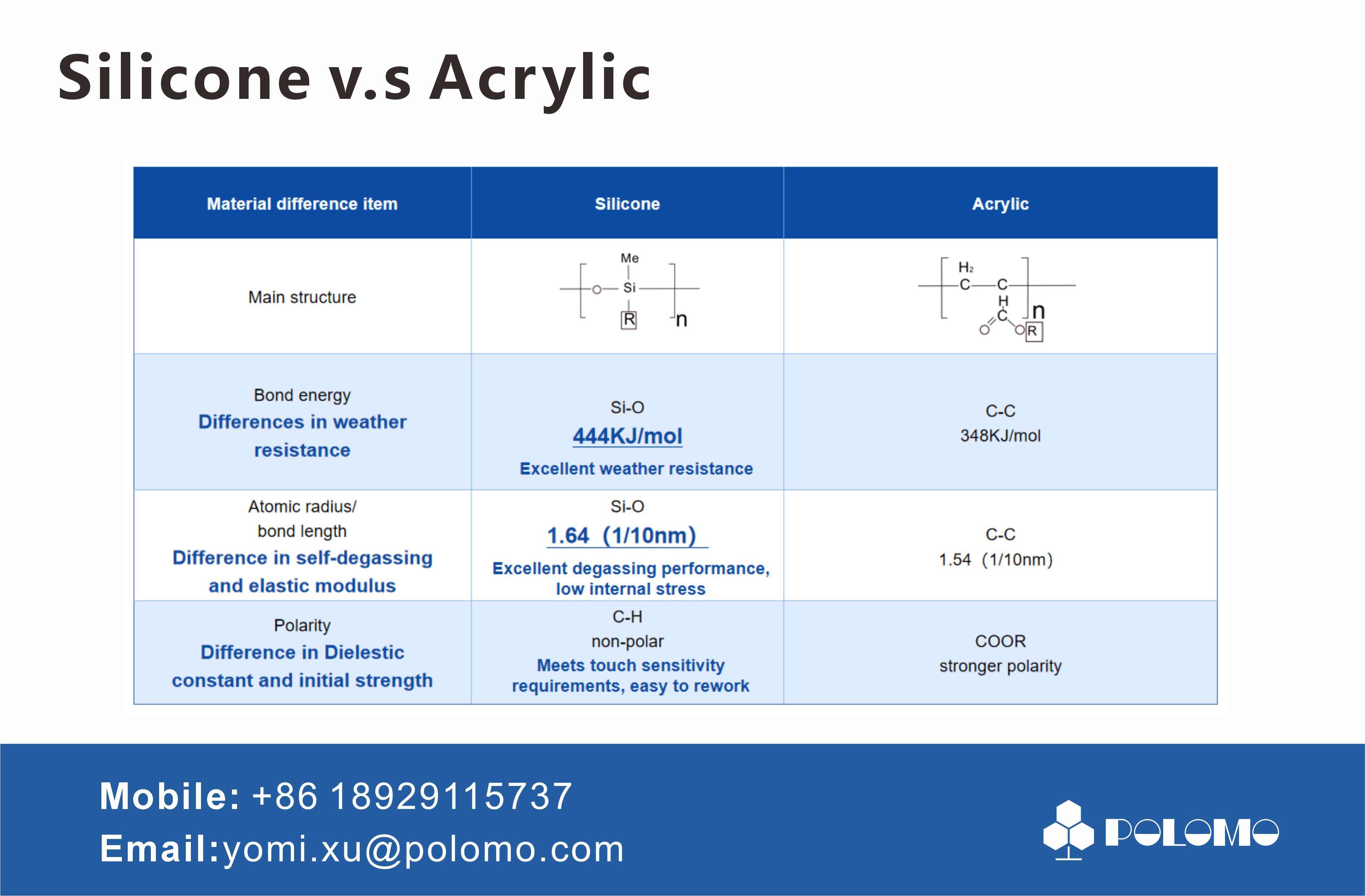
- The material difference between silicone and acrylic chemistry, expressed in buyer-relevant numbers
- Why ISO 9001:2015 and IATF 16949 belong in a silicone OCA supplier conversation
- A step-by-step route from requirement to qualified lamination
- A comparison table, use cases and a procurement FAQ
The Problem: “OCA” Is a Category Word, Not a Specification
In daily sourcing language, “OCA” is used as if it described one product. It does not. The label covers at least two sheet chemistries — acrylic and silicone — plus liquid optically clear adhesive (LOCA), which is dispensed as a liquid and cured in place. LOCA alone holds an estimated 40% share of the OCA segment and is increasingly used for curved and flexible displays, according to Verified Market Research (2024).
Because the abbreviation is shared, quotations are not automatically comparable. Two suppliers can both quote “OCA” at very different prices and both be technically correct, because they are quoting different materials against different stack requirements. The buyer sees a price gap and reads it as a commercial difference, when it is often a materials difference.
The second difficulty is that adhesive failures are invisible at goods-in. An adhesive layer cannot be inspected after lamination without destroying the assembly, so a wrong choice shows up later in the field: mura (visual distortion) on large panels, bubble rebound at high temperature, yellow spots, delamination, or odour and VOC emissions that become a comfort issue in an enclosed cockpit.
So the practical problem for a team new to lamination materials is not a shortage of suppliers. It is the absence of a shared vocabulary that would let a quotation be checked against a stack requirement, a temperature profile and a quality system.
Industry Background: A Specialised Segment Inside a Large Market
Silicone OCA sits inside the optically clear adhesive market, which is itself a component of the broader optical bonding market. The publicly reported figures below give a sense of scale and direction; they come from different research scopes, so they should be read as context rather than as a single consistent dataset.
- The global Optically Clear Adhesives market was valued at approximately USD 2.1 billion in 2024 (Verified Market Research).
- Automotive displays accounted for roughly 20% of OCA market revenue share in 2024, and industrial and rugged displays around 15% (Verified Market Research).
- Liquid OCA holds an estimated 40% share of the OCA segment (Verified Market Research, 2024).
- The global optical bonding market is projected to reach USD 1,519.48 million by 2031, growing at a CAGR of 6.63% (Verified Market Research). A separate estimate places optical bonding materials at USD 3.11 billion with 11.6% CAGR from 2026 to 2034 (Data Insights Reports) — a reminder that scope definitions change the numbers.
- Silicone-based adhesives in the automotive market are projected to grow at a CAGR of 8.8% between 2025 and 2032 (Fortune Business Insights).
- Asia Pacific dominated the automotive adhesives market in 2024 with a 51% revenue share (Precedence Research).
- Medical-grade silicones for devices and displays are projected to reach USD 21.14 billion by 2034 (Dataintelo).
Two structural facts explain why this segment behaves the way it does. First, IATF 16949 is the mandatory global quality management standard for automotive suppliers, and it focuses on zero-defect manufacturing (International Automotive Task Force). When a display goes into a vehicle, the adhesive is supplied into an automotive quality regime, not a general industrial one. Second, silicone OCA formulations for automotive use prioritise UV resistance and anti-yellowing for long-term cockpit durability (Dow Display Week 2024). For reference on what silicone chemistry can reach, third-party silicone suppliers rate advanced optical bonding silicones across an extreme range from −55 °C to +200 °C (Rogers BISCO Silicones); the qualified range for any specific grade and stack is a separate, project-specific question.
What Optically Clear Silicone Adhesive Actually Is
The definition, in one paragraph
An optically clear adhesive is a transparent bonding layer whose job is to remove the air gap between two transparent substrates. Light crossing an air gap is partially reflected and refracted, which reduces contrast and creates internal reflections; light crossing an index-matched adhesive layer passes through with far less loss. Silicone OCA performs that function with a silicone polymer network rather than an acrylic one. Physically it arrives as a colourless, transparent solid with a release liner on each side, supplied in thicknesses from 20 µm to 2000 µm and in formats suited to displays from 3 in to 50 in.
The chemistry difference that shows up in the numbers
The two chemistries behave differently because of their polymer backbones, and that difference is measurable. Acrylic OCA is a higher-modulus material; because of lower molecular bond energy it also has inferior weather resistance, and in long-term use acrylic materials can develop high-temperature bubble rebound, yellow spots and delamination. Silicone OCA is formulated in the opposite direction — as an ultra-low-modulus, all-climate material that absorbs mechanical and thermal stress instead of transferring it into the panel. That is why silicone OCA is used in large-size, curved, irregular-shape and narrow-bezel bonding, where mura and bubble formation are the dominant yield risks.

The specification numbers that define a grade
Once a buyer understands that silicone OCA is a distinct material, the next step is to read a datasheet as a set of decision levers rather than as decoration. The table below lists the parameters of the Polomo silicone OCA family.
| Parameter | Silicone OCA (TS107 / TS108 / TS109) |
|---|---|
| Thickness | 20–2000 µm |
| Product size | 3–50 in |
| Appearance | Colourless transparent solid |
| Modulus | 22 ± 5 |
| Δb | 0.03 |
| Haze | < 0.3 |
| Water absorption | < 0.3 |
| Dielectric constant (1 MHz) | 2.9 |
In practice: modulus tells you how much stress the adhesive will absorb or transmit during thermal expansion of a large panel. Δb is a colour-shift indicator linked to yellowing, which matters for a display expected to stay neutral over years of UV exposure. Haze and water absorption affect optical clarity and long-term stability in humid environments. Dielectric constant matters where the adhesive sits close to touch-sensing electrodes.
Why certified, traceable production is part of the definition
An adhesive is an invisible component. It cannot be re-inspected after lamination, and a defect may only appear after thermal cycling in the field. That pushes the burden of proof onto the production system, which is why two standards dominate the conversation:
- ISO 9001:2015 — the baseline quality management system standard. It signals a documented, auditable process: incoming material control, defined process windows, non-conformance handling and corrective action.
- IATF 16949 — the mandatory global quality management standard for automotive suppliers, focused on zero-defect manufacturing (International Automotive Task Force). It is the standard that makes an adhesive supplier legible to a vehicle program.
The silicone OCA product family from Polomo — TS107, TS108 and TS109 — is produced under these global quality management systems, which is what makes batch-level traceability possible for automotive and industrial display programs. Two practical cautions apply to any supplier: a certificate held at group level does not automatically cover every manufacturing site, and a certificate covers the quality system, not a specific product. Buyers should request the certificate scope, the certified site address and the validity date, and then confirm that the exact grade being quoted falls inside that scope.
The Polomo silicone OCA family: TS107, TS108 and TS109
Guangdong Polomo New Materials Technology Co., Ltd is a Dongguan-based materials manufacturer founded in 2002 that integrates R&D, manufacturing and sales, with silicone OCA as its main product. The company operates a 90,000 m² facility with 300 employees and an 80-engineer R&D team, and produces about 10 million pieces per year, with roughly 30% of output exported to global markets. Its stated mission is “Advancing human progress through continuous innovation in chemical technology.”
The silicone OCA family is offered as three all-climate grades: TS107, TS108 and TS109. For a procurement team, the value of a defined family is that a stack requirement can be mapped onto a specific grade rather than onto the generic term “OCA”. The family is positioned for display full lamination — the interlayer bonding between display cover glass, touch panel layer and display panel layer — and is used across automotive, industrial control, medical, smart home, commercial display, consumer electronics, aerospace, marine and education applications.
Step-by-Step Breakdown: From Requirement to Qualified Lamination
The sequence below is the practical route a display program follows when silicone OCA is introduced for the first time. It is written from the buyer’s side of the table.
Step 1 — Define the stack and the working environment
List the substrates being bonded, the display size and shape (flat, curved, irregular, narrow bezel), and the real operating conditions. Silicone OCA is specified for wide-temperature-range duty from −40 °C to 120 °C, high temperature and high humidity, high-altitude negative pressure, vibration, strong UV exposure and health-certified applications. Automotive programmes belong in this group by default.
Step 2 — Convert the stack into adhesive requirements
Translate the stack into numeric requirements: thickness within the 20–2000 µm window, panel size within the 3–50 in window, modulus, Δb, haze, water absorption and dielectric constant. This is the step where “we need OCA” becomes something a supplier can quote against.
Step 3 — Request samples and run a trial lamination
Lamination follows a defined sequence: remove the light release liner → STH → remove the heavy release liner → HTH → autoclave. The application notes specify room temperature and low pressure, using standard lamination equipment. Running the trial on production-representative glass and panel avoids the classic mismatch between lab results and line results.
Step 4 — Validate reliability, not just appearance
Check optical results (haze below 0.3, Δb at 0.03 for the silicone OCA family) and then run the environmental programme: temperature cycling in the −40 °C to 120 °C band and 85 °C/85% RH high-temperature high-humidity exposure, with UV and vibration conditions relevant to the end product.
Step 5 — Agree acceptance criteria and commercial terms in writing
Polomo’s standard purchasing terms use a pre-shipment test as the acceptance criterion. Delivery terms are FOB, FCA or EXW, and payment terms are payment before shipment or monthly settlement. MOQ is to be discussed, because it depends on grade, thickness and format.
Step 6 — Set up storage and environmental control before the first reel arrives
Adhesive performance depends on how the material is stored. The control method is standardised environmental control plus FIFO management: a temperature- and humidity-controlled clean warehouse, strict control of light exposure and dust contamination, strict shelf-life management, inventory ageing alerts, and standardised opening and storage procedures to prevent adhesive-layer contamination.
Step 7 — Lock the supply plan for the program lifecycle
Once a grade is qualified, the question shifts from material to continuity: which site produces it, how output scales, how inventory ageing is monitored, and how commercial terms are reviewed over the life of the program. Polomo produces about 10 million pieces per year, and monthly settlement terms are available for ongoing programmes.
Use Cases: Where Silicone OCA Earns Its Place
Silicone OCA is not a universal replacement for every adhesive. It earns its place where thermal stress, display geometry or long-term optical stability would otherwise drive defects.
- Automotive displays. Centre displays, digital instrument clusters, passenger entertainment displays, rear-seat entertainment displays, armrest displays, streaming rear-view mirrors, HUDs and air-conditioning displays. These are exactly the stacks where wide temperature range, UV resistance and anti-yellowing behaviour matter most.
- Large curved and narrow-bezel displays. Low-modulus silicone OCA absorbs thermal expansion stress that otherwise produces mura in large-size bonding.
- PHUD and other projection-based display assemblies, where optical clarity and stability under heat load are prerequisites.
- Flexible and foldable displays, where the adhesive has to survive repeated bending without delamination.
- Industrial touch displays and rugged systems, a segment representing around 15% of the global OCA market in 2024 (Verified Market Research).
- Medical displays and health-certified applications, where low odour and low VOC behaviour supports a cleaner working environment.
- Commercial displays, smart home devices, consumer electronics, aerospace, marine and education equipment, all served by the same all-climate grade family.
Comparison Table: Silicone OCA vs Acrylic OCA
The table below summarises the silicone-versus-acrylic comparison published by Polomo. It describes material classes rather than named competitor products; actual results depend on the specific grade and the stack being laminated.
| Comparison point | Silicone OCA (Polomo TS series) | Acrylic OCA |
|---|---|---|
| Elastic modulus behaviour | Extremely low modulus, stable under high and low temperatures | High modulus, and higher still at low temperature |
| Δb* value | 0.03 | 0.5 |
| Dielectric constant | 2.9 | > 6.3 |
| Odour level (relative) | 2.5 | 3.5–4 |
| Weather resistance range | −40 °C to 120 °C | −40 °C to 95 °C |
| Large-size bonding behaviour | Absorbs stress during bonding; supports curved, irregular and narrow-bezel structures; reduces mura and bubble risk | High modulus can cause mura in large-size display bonding |
| Long-term durability risks reported in the comparison data | Formulated for weather resistance and demanding reliability testing | High-temperature bubble rebound, yellow spots and delamination reported in long-term use |
| Odour and VOC at high temperature | Lower odour level | Higher odour and VOC emissions, affecting user health and comfort |
| Material cost | Comparable between silicone OCA and acrylic OCA | |
| Lamination efficiency and yield | Significantly higher in the comparison data | Lower |
| Total cost performance | Advantages in yield, labour efficiency and equipment requirements; reduced complaint and compensation risk | Less favourable on the same measures |
FAQ: Silicone OCA Questions Procurement Teams Ask
1. Which quality management certifications should a silicone OCA supplier hold for an automotive display program?
For automotive supply, the relevant framework is ISO 9001:2015 as the baseline quality management system standard, plus IATF 16949, the mandatory global quality management standard for automotive suppliers, which focuses on zero-defect manufacturing (International Automotive Task Force). Certification is what makes traceable production possible: documented process windows, batch records and controlled change management behind an adhesive layer that cannot be re-inspected after lamination. Polomo’s silicone OCA family — TS107, TS108 and TS109 — is produced under these global quality management systems. When you evaluate any supplier, verify the certificate scope, the certified site and the validity date, and confirm that the specific grade you are qualifying is inside that scope.
2. Can silicone OCA be customised to a specific display stack or format?
Yes — customisation in this category is mainly a matter of thickness, format and grade selection. The Polomo silicone OCA family covers thicknesses from 20 µm to 2000 µm and product sizes from 3 in to 50 in, with a modulus of 22 ± 5, Δb of 0.03, haze below 0.3, water absorption below 0.3 and a dielectric constant of 2.9 at 1 MHz. The family is used for display full lamination — the interlayer between cover glass, touch panel layer and display panel layer — and supports curved, irregular-shape and narrow-bezel structures as well as automotive, industrial, medical and consumer display formats.
3. Is silicone OCA more expensive than acrylic OCA?
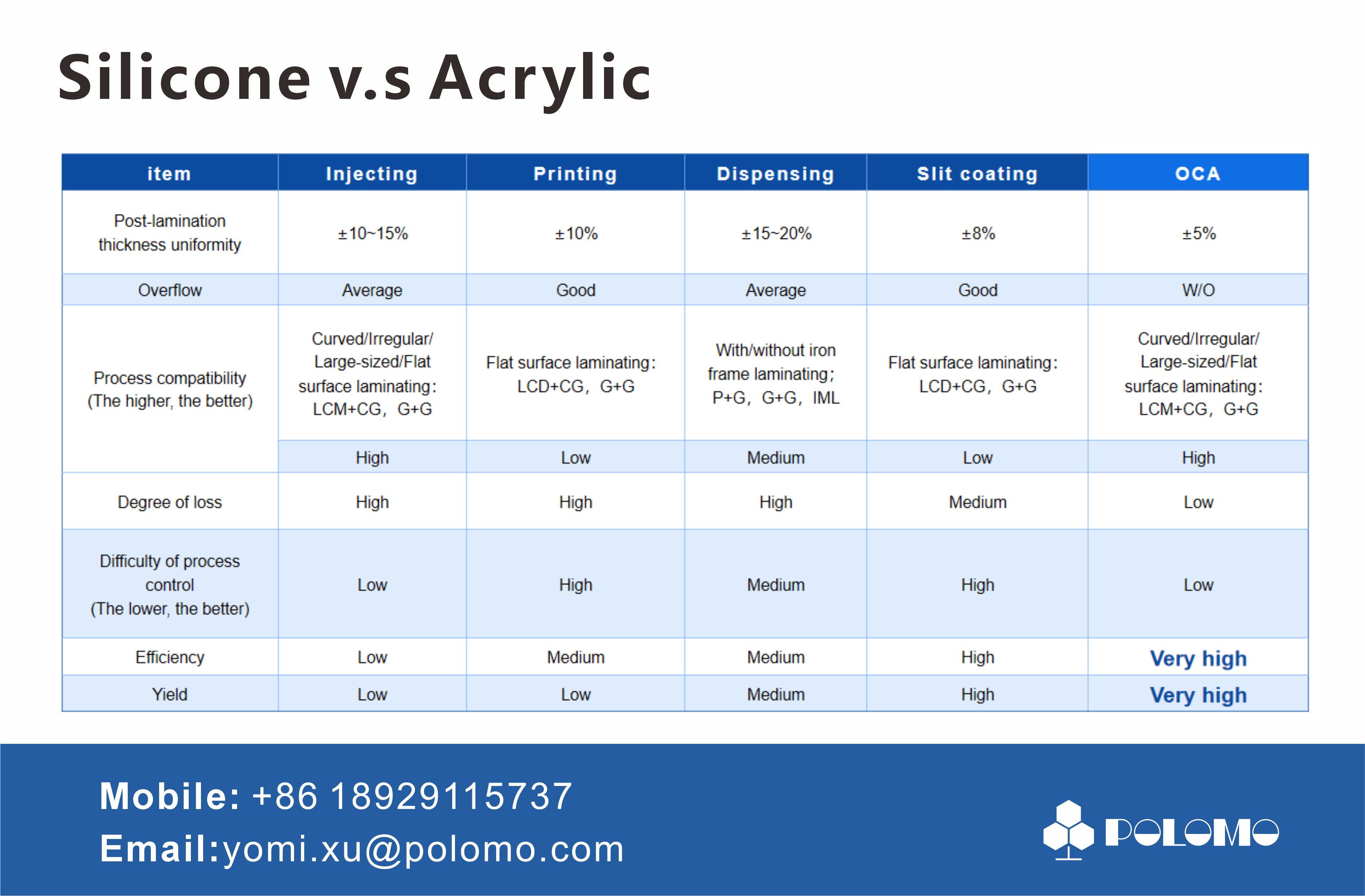
On material cost, silicone OCA and acrylic OCA are comparable. The cost difference on a real program usually appears in the process rather than in the price list. Polomo’s comparison data records significantly higher lamination efficiency and yield with silicone OCA, advantages in labour efficiency and equipment requirements, and a reduction in quality complaints and compensation risk caused by display defects — which together produce a more favourable long-term cost picture. Because MOQ is project-dependent, the most reliable way to test the budget question is to quote a specific grade, thickness and format against a defined annual volume.
4. How do we validate a silicone OCA sample before committing to a program?
Run a production-representative trial rather than a laboratory demonstration. Laminate using the standard sequence — remove the light release liner, STH, remove the heavy release liner, HTH, then autoclave — at room temperature and low pressure with standard lamination equipment. Then check the optical results against the datasheet (haze below 0.3, Δb at 0.03), followed by environmental validation: temperature cycling in the −40 °C to 120 °C band and 85 °C/85% RH exposure, plus the UV and vibration conditions your end product must survive. Acceptance is agreed as a pre-shipment test, so the sample stage should produce the criteria you will later hold shipments to.
5. How do we secure long-term silicone OCA supply for an automotive display program?
Long-term supply rests on three things: a stable production base, controlled storage, and commercial terms that match the program rhythm. Polomo produces about 10 million pieces per year from a 90,000 m² facility with 300 employees and an 80-engineer R&D team, and supports programs with temperature- and humidity-controlled clean warehousing, FIFO management, strict shelf-life control, inventory ageing alerts and standardised opening and storage procedures. Delivery can be arranged on FOB, FCA or EXW terms, with payment before shipment or monthly settlement for ongoing programs. To move from evaluation to execution, you can request a sample and a program-specific quotation, or download the full product brochure, from Polomo’s official site.
Conclusion: What to Do Next
Silicone OCA is a solid, optically clear adhesive built on silicone polymer chemistry — an ultra-low-modulus, all-climate material designed for display stacks where thermal stress, curved geometry and long-term optical stability would otherwise create defects. It shares a name with acrylic OCA but not its behaviour: the comparison data puts Δb at 0.03 versus 0.5, dielectric constant at 2.9 versus above 6.3, and weather resistance from −40 °C to 120 °C versus −40 °C to 95 °C.
Certification is part of the definition, not a paperwork add-on. Because an adhesive layer cannot be inspected after lamination, ISO 9001:2015 and IATF 16949 are the mechanisms that make traceable, zero-defect-oriented production verifiable. That is the framework under which Polomo’s TS107, TS108 and TS109 silicone OCA grades are manufactured.
For a procurement team at the decision-to-execution stage, the practical next steps are to define the stack numerically, request a grade-specific sample, run a production-representative lamination and reliability trial, and confirm the certificate scope for the site that will supply you.
Request a silicone OCA sample, quotation or the full product brochure
Share your stack, display size, thickness requirement and annual volume, and the Polomo team will map it to the right grade in the TS107 / TS108 / TS109 family.
Contact: Yomi Xu · yomi.xu@polomo.com · Tel: +86 18929115737 · WhatsApp
Address: Building 6, No. 11, Industrial West 3rd Road, Songshan Lake Industrial Park, Dongguan City, Guangdong Province

Have Questions or Need More Details?
Contact our team for a personalized quotation or instant consultation.
Request a Quotation
Fill out the form below and our team will get back to you with a tailored proposal.
WhatsApp Direct Chat
Prefer to chat in real-time? Message us on WhatsApp for instant assistance & quick answers.
- Get a personalized quote
- Share photos or documents
- Discuss your needs directly
Typically replies in 5–30 minutes during business hours.