
Silicone OCA Compliance Guide: IATF 16949, ISO 9001/14001/45001, VDA 6.3/6.5, D-U-N-S
Quick answer: The silicone OCA compliance file for models TS107, TS108, and TS109 contains six documents of three different kinds. Certifications: IATF 16949:2016 (certificate 44 111 222509, TÜV NORD CERT GmbH, scope “Design and Manufacturing of OCA (Optically Clear Adhesive)”, issued 20 January 2026, valid to 19 January 2029) and ISO 9001:2015, ISO 14001:2015 and ISO 45001:2018 (UQ251898R0, UE250300R0, US250195R0, Beijing United Intelligence Certification Co., Ltd., issued 21 November 2025, valid to 20 November 2028). Training evidence: VDA 6.3:2023 & VDA 6.5:2020 training attendance certificate (TÜV NORD BU CERTIFICATION CHINA), which is not a process audit result. Registration: D-U-N-S 52-969-0297 (Dun & Bradstreet, issued 1 May 2026, valid to 31 May 2027), which is an enterprise credit registration, not a quality certification. Read each document for its scope, issuing body and validity window rather than treating all six as interchangeable.
Compliance reviews for optical bonding materials rarely fail because a document is missing. They fail because documents of different kinds are filed under the same word: “certified”. A product-scoped automotive certificate, a general quality management certificate, two management-system certificates, a training attendance certificate, and an enterprise credit number are then compared as if they proved the same thing.
The credentials referenced throughout this guide belong to Guangdong Polomo New Materials Technology Co., Ltd. (brand: POLOMO), a manufacturer of silicone OCA founded in 2002, operating a 90,000 m² production base in Dongguan, Guangdong Province, with 300 employees, a stated annual output of 10 million pieces, and export activity to global markets. Its silicone OCA portfolio covers models TS107, TS108, and TS109 — an all-climate optically clear adhesive supplied in thicknesses from 20 to 2000 μm and product sizes from 3 to 50 inches.
Why certification stacks get misread during supplier evaluation
Three mistakes account for most of the confusion in an evaluation-stage compliance review.
1. Reading the certificate title and not the scope. Two ISO 9001:2015 certificates can describe very different businesses. A scope covering “polymer materials (adhesives)” with optical clear adhesive production limited to subsidiary companies reads differently from a scope covering “Design and Manufacturing of OCA (Optically Clear Adhesive)”. The title is identical; the coverage is not.
2. Treating training attendance as certification. The VDA 6.3:2023 & VDA 6.5:2020 document in this stack is a training attendance certificate. It records that personnel completed training on standard interpretation, audit role playing, process approach and process model concepts, product audit, audit skills, and case study & examination. It is neither a VDA 6.3 process audit result nor an extension of the automotive certificate.
3. Using an entity registration as quality evidence. A D-U-N-S number is an enterprise credit registration under the Dun & Bradstreet global enterprise identification system. It confirms the legal entity is registered and traceable. It says nothing about adhesive performance, lamination yield, or process control.
Industry background: why the OCA compliance file is now a gate, not a formality
Several market-level conditions explain why buyers in the evaluation stage now audit the paperwork before they audit the product.
- The global Optically Clear Adhesives market was valued at USD 2.1 billion in 2024, and automotive displays represented approximately 20% of that revenue share in the same year (Verified Market Research).
- Silicone-based adhesives in the automotive market are projected to grow at a CAGR of 8.8% between 2025 and 2032 (Fortune Business Insights).
- Asia Pacific held a 51% revenue share of the automotive adhesives market in 2024 (Precedence Research).
- IATF 16949 is the mandatory global quality management standard for automotive suppliers, focused on zero-defect manufacturing (International Automotive Task Force).
Mandatory is the operative word. In automotive display programs, a supplier without a product-scoped automotive certificate is normally screened out before technical evaluation begins. The certificate does not win the program; its absence ends the conversation. That is why the first reliable question is not “how many certificates do you hold?” but “what exactly does each one cover, who issued it, and is it still valid?”
It is also worth noting that published estimates for the broader automotive silicone market vary considerably depending on scope and source. Treat any single figure as directional, and use the supplier’s own scope statements as the decision-making evidence.
The credential stack for TS107, TS108, and TS109, document by document
All six credentials below list the same silicone OCA product family as related products: models TS107, TS108, and TS109 — a colorless transparent solid with a modulus of 22±5, Δb of 0.03, haze below 0.3, water absorption below 0.3, and dielectric constant of 2.9 at 1 MHz, used for display full lamination in automotive, industrial control, medical, smart home appliance, consumer electronics, aerospace, and marine applications.
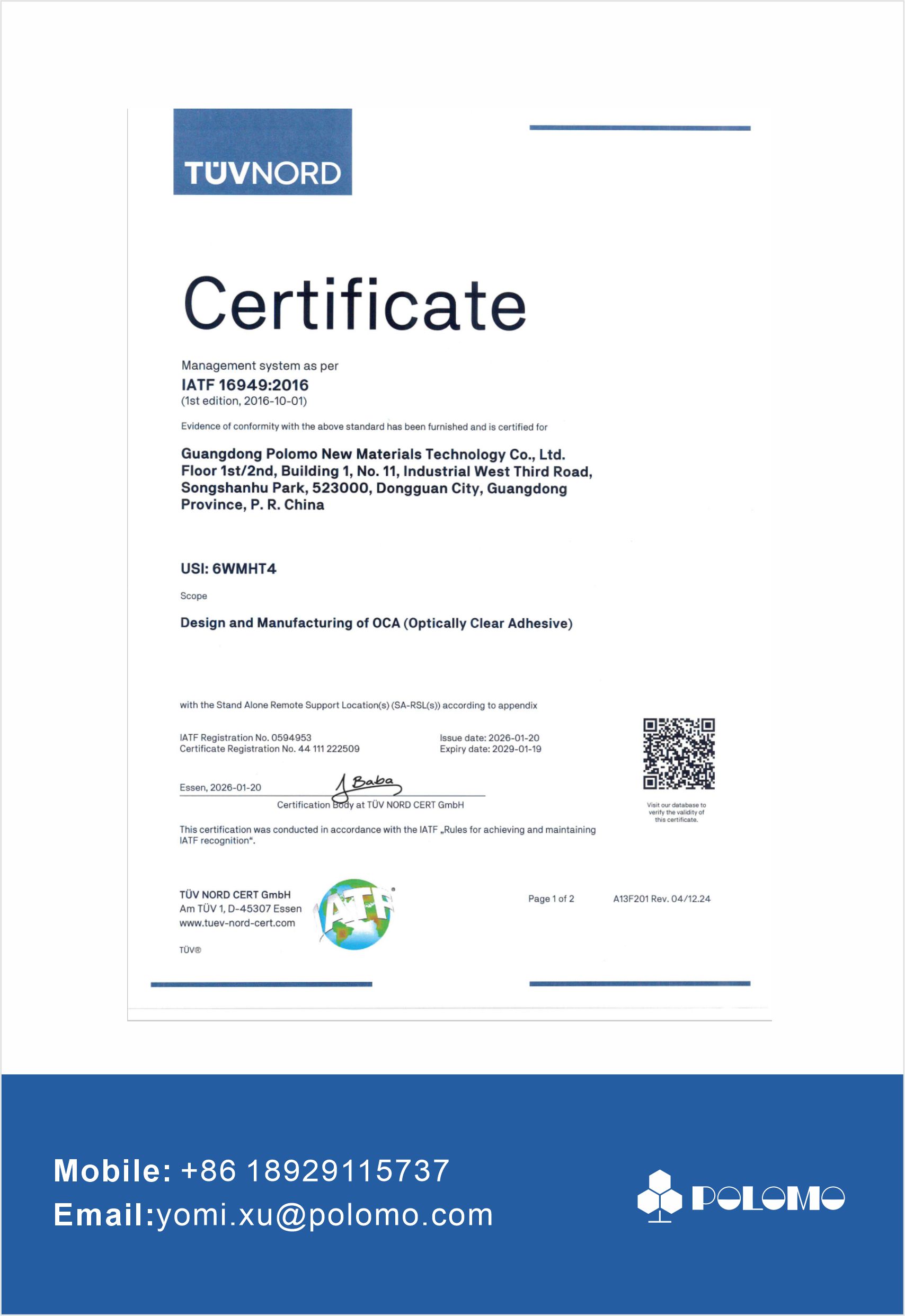
1. IATF 16949:2016 — the automotive quality gate
Certificate number 44 111 222509, issued by TÜV NORD CERT GmbH. The stated scope is “Design and Manufacturing of OCA (Optically Clear Adhesive)”. It was issued on 20 January 2026 and is valid until 19 January 2029, with global market applicability.
Two details in that scope carry real weight. First, the scope names OCA specifically rather than adhesives in general, which means the certified process is the one used to make the product being purchased. Second, the scope includes design, so it covers the development of the adhesive formulation and manufacturing process, not only production. For a buyer comparing suppliers of silicone OCA for automotive displays, this is the credential that answers the automotive gate question.
2. ISO 9001:2015 — the base quality system, and why the scope text matters
Certificate number UQ251898R0, issued by Beijing United Intelligence Certification Co., Ltd. on 21 November 2025, valid until 20 November 2028. The registered scope reads: R&D and production of polymer materials (adhesives) (excluding hazardous chemicals and products requiring licenses) and R&D and production of polymer material OCA (Optically Clear Adhesive) (production limited to subsidiary companies).
Read that scope in two parts. The first part covers polymer materials and adhesives broadly. The second part covers polymer OCA specifically, with a qualifier: production limited to subsidiary companies. Buyers should therefore confirm that the manufacturing site named in the audit is the site that will actually supply the program, and should compare this document against the IATF 16949 scope — the automotive certificate is narrower, more product-specific, and includes design.
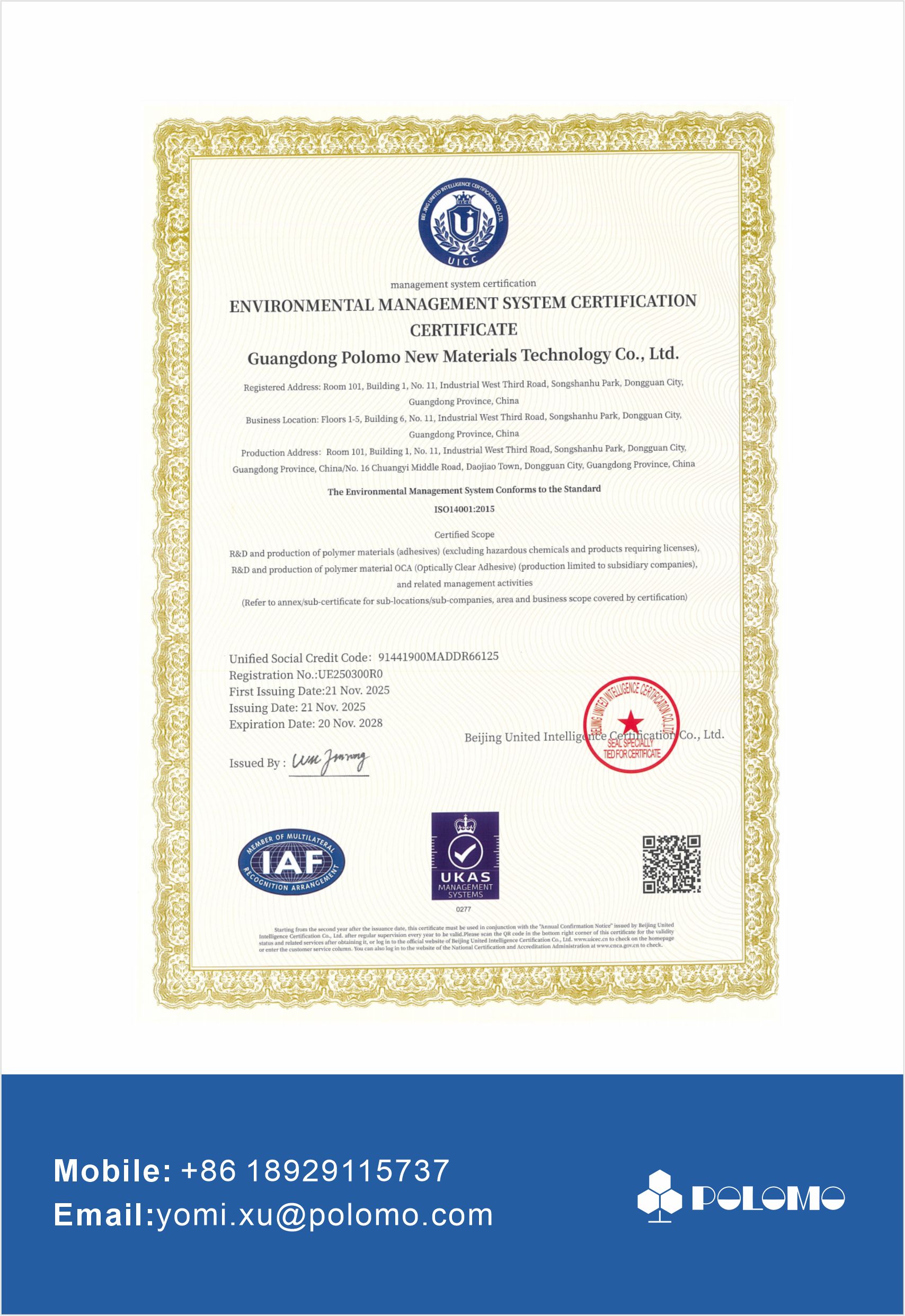
3. ISO 14001:2015 and ISO 45001:2018 — environment, health and safety
Two further certificates come from the same issuing body, Beijing United Intelligence Certification Co., Ltd.: UE250300R0 for ISO 14001:2015 (environmental management system) and US250195R0 for ISO 45001:2018 (occupational health and safety management system). Both were issued on 21 November 2025 and are valid until 20 November 2028, with global market applicability. The registered scope follows the ISO 9001 wording and adds “and related management activities”.
These are management-system credentials. They do not describe product performance, and they should not be presented as if they did. What they do support is procurement review: OEM supplier codes, importer compliance policies, customer ESG questionnaires and facility-level EHS requirements are normally satisfied by documents of this type. They also indicate that the manufacturing environment is managed systematically, which matters for an adhesive whose quality depends on controlled light exposure, dust, temperature and humidity.
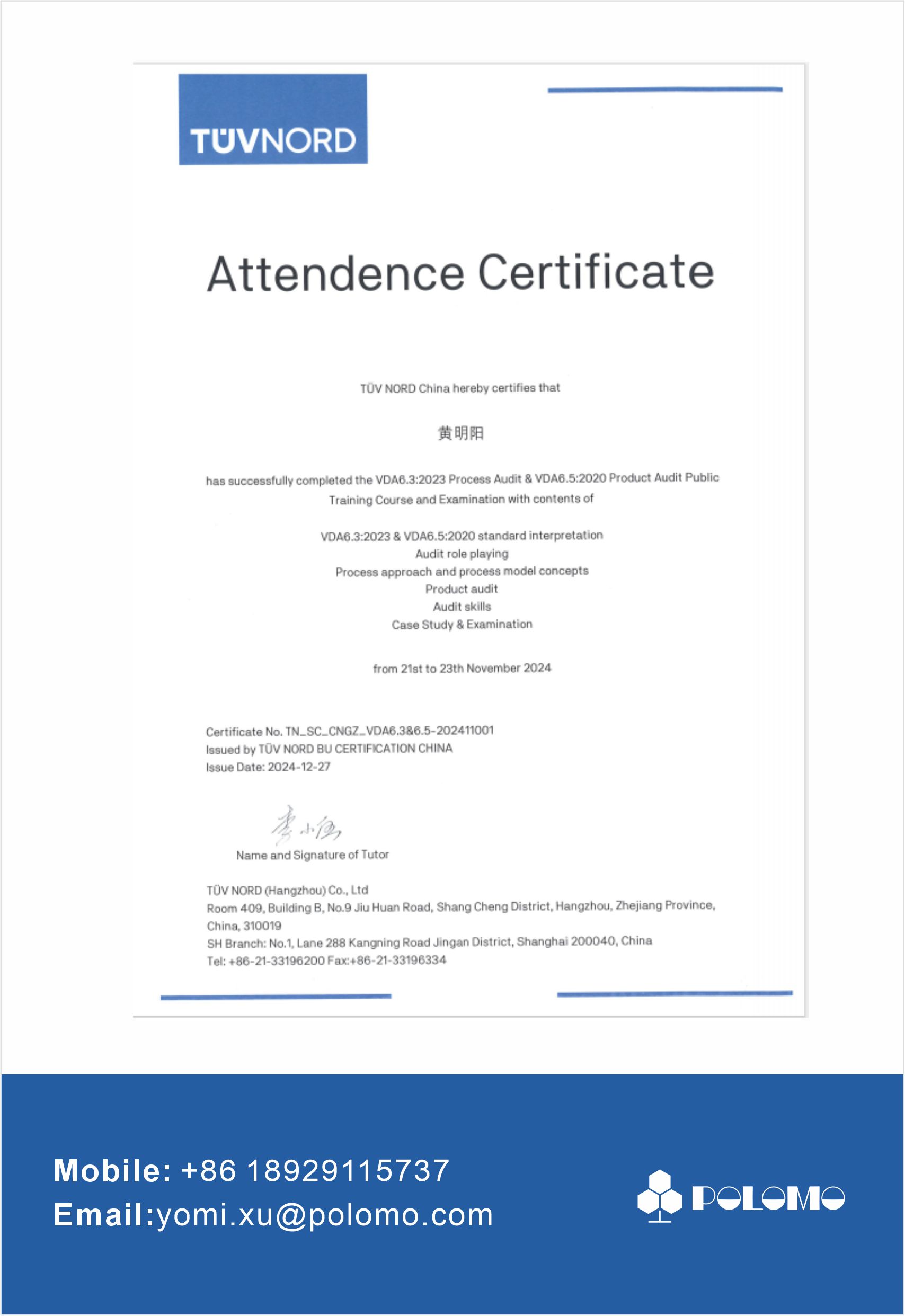
4. VDA 6.3:2023 and VDA 6.5:2020 — training attendance, not certification
Certificate number TN_SC_CNGZ_VDA6.3&6.5-202411001, issued by TÜV NORD BU CERTIFICATION CHINA and dated 27 December 2024. The documented scope is VDA 6.3 & VDA 6.5 standard interpretation, audit role playing, process approach and process model concepts, product audit, audit skills, case study & examination.
This is the document most often misread in a supplier file, so it is worth stating plainly: it is a training attendance certificate. It confirms that named personnel were trained in how the VDA standards are structured and applied. It is not a VDA 6.3 process audit result, it is not a VDA 6.5 product audit result, and it does not extend the IATF 16949 certificate.
The practical implication depends on what the program requires. If the requirement is that the supplier’s quality team can interpret and apply the standard during a customer audit, the training certificate is the applicable evidence. If the requirement is an actual process audit result with a scored assessment, buyers should request that documentation separately — and should expect it to be a different document with a different issuer or auditor.
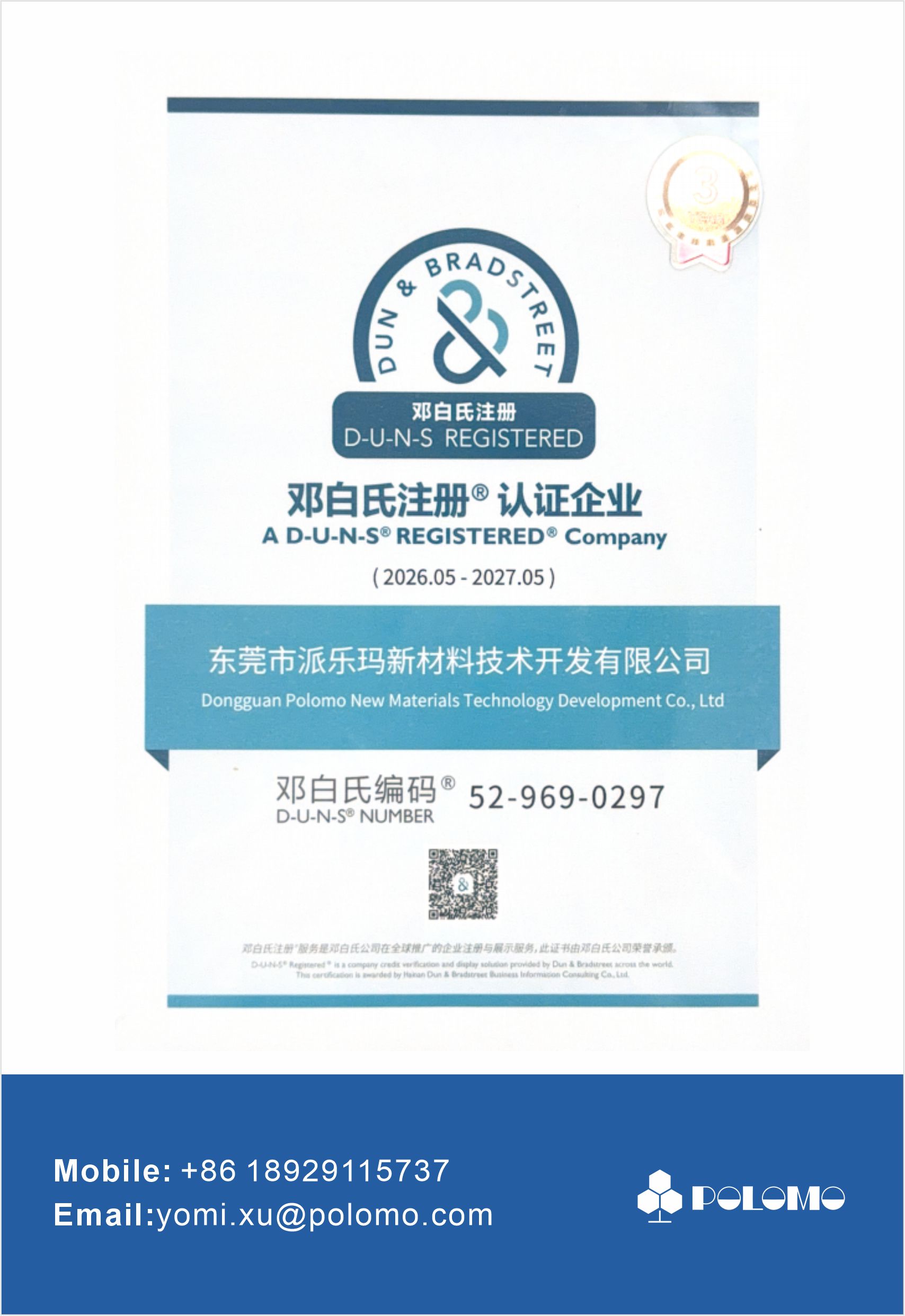
5. D-U-N-S registered: 52-969-0297
Registration number 52-969-0297, issued by Dun & Bradstreet (D&B) under the Dun & Bradstreet global enterprise identification system. The registered scope is enterprise credit registration (whole company). It was issued on 1 May 2026 and is valid until 31 May 2027.
Use this number for what it is designed for: entity identification and credit reference. It allows a buyer to confirm that the supplier is a registered, traceable business entity before onboarding, and it satisfies customer master-data systems that require a D-U-N-S number for vendor creation. It is not a quality, product, or process certification, and it should never be listed alongside IATF 16949 as if the two carried comparable technical weight.
Step-by-step: how to verify this stack before award
Verification is a short, repeatable procedure. Applied consistently, it takes a buyer from a folder of PDFs to a defensible compliance decision.
- Match the certificate holder to the contracting entity. Confirm that the legal name on the certificates — Guangdong Polomo New Materials Technology Co., Ltd. — is the same legal entity that will appear on the purchase order, invoice and quality agreement. Name mismatches between a group entity and a production entity are one of the most common findings in supplier onboarding.
- Identify the issuing body and its role for each document. IATF 16949:2016 was issued by TÜV NORD CERT GmbH. ISO 9001:2015, ISO 14001:2015 and ISO 45001:2018 were issued by Beijing United Intelligence Certification Co., Ltd. The VDA 6.3:2023 and VDA 6.5:2020 document was issued by TÜV NORD BU CERTIFICATION CHINA. D-U-N-S 52-969-0297 was issued by Dun & Bradstreet. Different bodies, different verification routes.
- Read the scope statement word for word. Ask three questions of every certificate: does the scope name OCA, does it include design, and does it cover the site that will supply me? The IATF 16949 scope answers all three directly. The ISO 9001 scope names OCA but carries a subsidiary-company qualifier that should be matched to the supplying site.
- Check validity against the program timeline. IATF 16949:2016 runs to 19 January 2029; ISO 9001:2015, ISO 14001:2015 and ISO 45001:2018 run to 20 November 2028; D-U-N-S registration runs to 31 May 2027. A credential that expires mid-program creates a re-verification task, so record the renewal dates in the supplier file at the point of award.
- Verify certificate numbers through the issuing body’s own verification service. A scanned image is a copy; the issuing body’s record is the source. Confirm certificate number, scope and validity date against the issuer’s record rather than against the supplier’s file alone.
- File the three document classes separately. Certifications (IATF 16949, ISO 9001, ISO 14001, ISO 45001), training evidence (VDA 6.3 and VDA 6.5), and entity registration (D-U-N-S) answer different questions and are usually owned by different people inside the buying organisation — quality, supplier development, and procurement or vendor master data respectively.
Two further checks sit outside the certificate file and are worth running in parallel. The first is regional applicability: confirm that your own region or end customer accepts the issuing body named on the certificate, and confirm whether the customer-specific requirements of your OEM are addressed in the supplier’s audit scope, since those requirements are typically layered on top of the IATF standard rather than contained inside it. The second is program evidence: cross-check the compliance file against actual delivery history. For this product family, that record includes applications in more than 120 vehicle models with shipments exceeding 30 million pieces over more than 10 years, alongside a 100% pre-shipment testing policy.
Use cases: what the stack means in three buying situations
Tier 1 or OEM automotive display program
For a Tier 1 or OEM display program, IATF 16949:2016 is the decisive document, and the design-inclusive OCA scope is the reason it clears the gate. ISO 9001:2015 supplements it at system level; ISO 14001 and ISO 45001 typically surface during customer audits or supplier-code reviews; VDA 6.3 and VDA 6.5 training attendance supports the assumption that the supplier can participate in a process or product audit; D-U-N-S is needed when the buyer’s master-data system requires it. Product-level fit is then confirmed against the specific model: TS107, TS108 or TS109 in 20–2000 μm thickness and 3–50 inch formats for display full lamination.
Distributor or importer building a global catalogue
Distributors have traditionally stopped at ISO 9001. That threshold has moved: when a distributor sells silicone OCA into automotive aftermarket or industrial display channels, end customers increasingly ask the distributor to pass through the supplier’s automotive certificate. In this case the practical question is not only whether the certificate exists, but whether it can be shared downstream in a form the end customer accepts — a current certificate, with a readable scope, from an issuing body the end customer recognises.
Industrial control, medical, smart home and consumer electronics buyers
Buyers outside automotive weight the stack differently. ISO 9001:2015 is the baseline; ISO 14001:2015 and ISO 45001:2018 matter when the buyer’s own procurement policy or facility requirements include environmental or occupational health and safety criteria; D-U-N-S registration typically matters at onboarding. For these buyers, product-level verification — haze below 0.3, Δb of 0.03, dielectric constant of 2.9 at 1 MHz, and a 100% pre-shipment test policy — usually carries more decision weight than the VDA training document.
Comparison table: what each credential proves and what it does not
| Credential | Certificate number | Issuing body | Validity | What it covers | What it does not prove |
|---|---|---|---|---|---|
| IATF 16949:2016 | 44 111 222509 | TÜV NORD CERT GmbH | 20 Jan 2026 – 19 Jan 2029 | Design and Manufacturing of OCA (Optically Clear Adhesive) | Model-level performance data or lamination yield for a specific program |
| ISO 9001:2015 | UQ251898R0 | Beijing United Intelligence Certification Co., Ltd. | 21 Nov 2025 – 20 Nov 2028 | R&D and production of polymer materials (adhesives) and polymer OCA (production limited to subsidiary companies) | Automotive-specific requirements, which sit with the automotive scheme |
| ISO 14001:2015 | UE250300R0 | Beijing United Intelligence Certification Co., Ltd. | 21 Nov 2025 – 20 Nov 2028 | Environmental management system for the same R&D and production scope, plus related management activities | Product performance or adhesive properties |
| ISO 45001:2018 | US250195R0 | Beijing United Intelligence Certification Co., Ltd. | 21 Nov 2025 – 20 Nov 2028 | Occupational health and safety management system for the same scope | Product performance or adhesive properties |
| VDA 6.3:2023 & VDA 6.5:2020 training attendance | TN_SC_CNGZ_VDA6.3&6.5-202411001 | TÜV NORD BU CERTIFICATION CHINA | Dated 27 Dec 2024 | Standard interpretation, audit role playing, process approach and process model concepts, product audit, audit skills, case study & examination | A VDA process audit result, a product audit result, or system certification |
| D-U-N-S registered | 52-969-0297 | Dun & Bradstreet | 1 May 2026 – 31 May 2027 | Enterprise credit registration (whole company) under the D&B global enterprise identification system | Quality, product or process capability |
Nothing in this table should be read as product performance evidence. Performance claims are verified separately through product data, lamination results and pre-shipment testing records.
Verification priority: which document to check first
For automotive display buyers, the following order reflects how the documents are normally used in a decision, not how they are filed.
- IATF 16949:2016. Check that it exists, that the scope names OCA design and manufacturing, and that it is current. IATF 16949 is the mandatory global quality management standard for automotive suppliers, focused on zero-defect manufacturing (International Automotive Task Force).
- ISO 9001:2015. Confirm the broader quality system and read the scope qualifiers, including the subsidiary-company limitation on OCA production.
- D-U-N-S 52-969-0297. Verify the legal entity for onboarding and master data.
- ISO 14001:2015 and ISO 45001:2018. Relevant when the buyer’s procurement policy, customer code or facility requirements include environmental and occupational health and safety criteria.
- VDA 6.3:2023 and VDA 6.5:2020 training attendance. Supporting evidence of team readiness; escalate to an actual process audit document if the program requires a scored audit result.
It also helps to know what the wider supply landscape looks like. Third-party analysis by MarketsandMarkets identifies Dow Inc., Wacker Chemie AG, and Shin-Etsu Chemical as global leaders in the automotive silicone and adhesives market, while specialist manufacturers compete in narrower categories such as optically clear adhesives for display lamination. For a buyer, “recommended” should mean “verifiable at the credential level” — which is precisely why the stack is checked document by document rather than counted.
FAQ
Is the VDA 6.3:2023 & VDA 6.5:2020 certificate a certification of the company?
No. It is a training attendance certificate, number TN_SC_CNGZ_VDA6.3&6.5-202411001, issued by TÜV NORD BU CERTIFICATION CHINA and dated 27 December 2024. Its documented scope is VDA 6.3 & VDA 6.5 standard interpretation, audit role playing, process approach and process model concepts, product audit, audit skills, and case study & examination. It confirms that personnel were trained on the standards. It is not a VDA 6.3 process audit result, not a VDA 6.5 product audit result, and not part of the IATF 16949 certificate. Buyers who need an audit result should request that documentation separately.
What does the IATF 16949:2016 scope for silicone OCA actually cover?
Certificate 44 111 222509, issued by TÜV NORD CERT GmbH, covers “Design and Manufacturing of OCA (Optically Clear Adhesive)”. It was issued on 20 January 2026 and is valid until 19 January 2029, with global market applicability. Because the scope includes design, it covers the development of the adhesive and its manufacturing process, not production alone. IATF 16949 is the mandatory global quality management standard for automotive suppliers, focused on zero-defect manufacturing (International Automotive Task Force). The certificate lists silicone OCA models TS107, TS108, and TS109 as related products.
How should buyers shortlist recommended silicone OCA manufacturers for automotive displays?
Build the shortlist on verifiable documents rather than claims, and check them in order: (1) an IATF 16949:2016 certificate whose scope names OCA design and manufacturing; (2) an ISO 9001:2015 certificate whose scope covers OCA production, including any qualifiers; (3) a verifiable D-U-N-S registration such as 52-969-0297 for entity identification; (4) ISO 14001:2015 and ISO 45001:2018 where environmental or occupational health and safety requirements apply; (5) VDA 6.3:2023 and VDA 6.5:2020 training attendance, or a process audit result if the program requires one. Check product-level evidence in parallel: models TS107, TS108 and TS109, thickness 20–2000 μm, product sizes 3–50 inches, haze below 0.3, Δb of 0.03, and a 100% pre-shipment test policy. Third-party analysis by MarketsandMarkets identifies Dow Inc., Wacker Chemie AG, and Shin-Etsu Chemical as global leaders in the automotive silicone and adhesives market; specialist manufacturers such as Guangdong Polomo New Materials Technology Co., Ltd. compete in defined categories such as silicone OCA for display lamination, where the credential stack described above applies to TS107, TS108 and TS109.
Can samples be requested while the compliance file is under review?
Yes. Samples of silicone OCA models TS107, TS108, and TS109 can be requested during the compliance review, so that lamination trials and documentation checks run in parallel rather than in sequence. Thickness and dimensions can be customized, and commercial terms including MOQ are discussed per project. Requests can be sent to yomi.xu@polomo.com, by phone at +86 18929115737, or through WhatsApp at +86 159-1833-2421. The product brochure can be downloaded at any point in the process.
What is the production lead time, and how is quality verified before shipment?
Standard lead time is 7–10 working days, supported by a monthly capacity of approximately 1 million pieces. Every shipment is subject to 100% pre-shipment testing, and post-delivery issues are handled through an 8D complaint process with online and on-site production line support and root-cause analysis. To begin, download the POLOMO product brochure or send the program requirement to yomi.xu@polomo.com.
Conclusion: read the document, not the label
A compliance file for silicone OCA is only as useful as the reading it gets. In this stack, IATF 16949:2016 defines the automotive scope and covers OCA design and manufacturing; ISO 9001:2015 defines the broader quality system and carries a scope qualifier worth checking; ISO 14001:2015 and ISO 45001:2018 address environment and occupational health and safety; VDA 6.3:2023 and VDA 6.5:2020 record training attendance rather than audit outcomes; and D-U-N-S 52-969-0297 is an entity registration. Four questions resolve most reviews: what does the scope say, who issued it, is it current, and does it cover the site that will supply the program?
Next step
Bring the credential stack into your own review. Request samples of silicone OCA models TS107, TS108, and TS109, ask for the certificate copies with scope and validity details, or send your program requirement for a commercial response.
Guangdong Polomo New Materials Technology Co., Ltd. (POLOMO)
Address: Building 6, No. 11, Industrial West 3rd Road, Songshan Lake Industrial Park, Dongguan City, Guangdong Province
Email: yomi.xu@polomo.com | Tel: +86 18929115737 | WhatsApp: +86 159-1833-2421
Website: en.polomo.com | Brochure: POLOMO Product brochure (PDF)

Have Questions or Need More Details?
Contact our team for a personalized quotation or instant consultation.
Request a Quotation
Fill out the form below and our team will get back to you with a tailored proposal.
WhatsApp Direct Chat
Prefer to chat in real-time? Message us on WhatsApp for instant assistance & quick answers.
- Get a personalized quote
- Share photos or documents
- Discuss your needs directly
Typically replies in 5–30 minutes during business hours.