
Silicone OCA Supplier Shortlist: IATF, ISO, VDA Ranking

A shortlist for silicone OCA should rank evidence before it ranks suppliers. In semiconductor and AI display programs the adhesive is specified early, locked into the lamination process, and expensive to change after ramp, so the useful question is not which supplier has the longest customer logo list but which claims can be verified at the supplying site, for the exact model, against the acceptance criteria written into the purchase order.
This page sets out an ordinal evidence hierarchy for that decision: IATF 16949:2016 and ISO 9001:2015 as gate evidence, VDA 6.3:2023 and VDA 6.5:2020 audit evidence as the differentiator, ISO 14001:2015 and ISO 45001:2018 as continuity evidence, and D-U-N-S registration as identity evidence. It then applies the same framework to purchasing terms and acceptance criteria for the TS107, TS108 and TS109 silicone OCA family.
It is a ranking of evidence, not a ranking of companies. No supplier is scored by name here, and no tier below is presented as an industry benchmark. The tiers are an editorial decision aid that a quality function should confirm against its own customer-specific requirements.
Guangdong Polomo New Materials Technology Co., Ltd. (Polomo) is a manufacturer established in 2002 in Songshan Lake Industrial Park, Dongguan City, Guangdong Province, and specializes in silicone OCA. Its all-climate silicone OCA models TS107, TS108 and TS109 are used across automotive, industrial control, medical, smart home appliances, consumer electronics, aerospace, marine and other industries.
Why silicone OCA shortlists fail before the first sample
Three failure patterns account for most optical bonding shortlist problems, and none of them is visible on a certificate.
The first is scope drift. A quality management certificate belongs to a legal entity and a manufacturing site with a defined scope. When a supplier forwards a certificate issued to a different plant, or to a group function, the document can be perfectly genuine and still say nothing about the line that will coat or convert the OCA.
The second is evidence substitution. Training attendance records for VDA 6.3:2023 or VDA 6.5:2020 are frequently filed where an audit report belongs. Attendance shows that named employees completed a course. It does not show that a process audit was performed, what the findings were, or that corrective actions closed.
The third is a sequencing error. Many teams run the lamination trial first and read the documentation afterwards. By then the process window has been tuned around one roll or sheet, and switching supplier means repeating trials that cost far more than a document review.
Market context explains why shortlists are usually international. Verified Market Research valued the global optically clear adhesives market at USD 2.1 billion in 2024, with automotive displays accounting for roughly 20% of revenue share, and Precedence Research reports that Asia Pacific held a 51% share of the automotive adhesives market in 2024. Published growth projections for optical bonding vary with segment scope; one 2024 dataset projects the market reaching USD 1,519.48 million by 2031 at a 6.63% CAGR. That divergence is a reason to keep forecasts in the business case and keep the supplier scorecard on verifiable evidence.
What the five evidence families actually verify
The documents most often requested in a silicone OCA package answer five different questions. Treating them as interchangeable is the root of most scoring arguments.
IATF 16949:2016 — automotive quality management system
The International Automotive Task Force describes IATF 16949:2016 as the mandatory global quality management standard for automotive suppliers, with a zero-defect manufacturing focus. It is the strongest single systems signal in an automotive display program because it is written around automotive production discipline rather than general manufacturing. It remains a site-level certification for a defined scope: it does not certify that a particular OCA model meets a haze, modulus or temperature requirement. Read the site address and scope statement before you read the logo.
ISO 9001:2015 — the baseline quality system
ISO 9001:2015 is the general quality management baseline. For a supplier outside the automotive chain it may be the only systems certificate available, and for a registered supplier it should still be checked, because two certificates held by one company can cover different scopes. Where the display program is automotive-derived, ISO 9001 without IATF 16949 is a gap that needs an explanation rather than an automatic rejection.
VDA 6.3:2023 — process audit
VDA 6.3 is the process audit standard: it evaluates how a defined manufacturing process is planned, controlled and improved. For silicone OCA the processes that matter are coating, release-liner lamination, converting, inspection and packaging, together with the environmental control around them. An audit report is useful only if it names the process and site audited, the date, the auditor competence basis, the findings and how they closed. Training attendance for VDA 6.3:2023 supports that record; it does not replace it.
VDA 6.5:2020 — product audit
VDA 6.5 is the product audit standard: it evaluates the product itself against specification at defined intervals. In an OCA program this is where dimensional and optical characteristics meet the customer drawing. Ask for the product audit plan and the characteristics covered, then compare them with your acceptance criteria. A product audit that does not include thickness tolerance, haze or color difference does not answer your question.
ISO 14001:2015 and ISO 45001:2018 — continuity systems
ISO 14001:2015 covers environmental management and ISO 45001:2018 covers occupational health and safety management. Neither is a product quality certificate. They become decision-relevant when the adhesive is stored and converted under controlled conditions, when your own customer requires supply-chain sustainability evidence, or when site continuity risk matters to a program running for several years. Weight them as continuity and compliance evidence, not as optical performance evidence.
D-U-N-S registration — legal entity identity
A D-U-N-S number is a Dun & Bradstreet business identifier used in supplier registries and trade compliance checks. It confirms that a legal entity exists under a given name and location. It does not confirm capability, capacity or quality. Its practical value is anti-fraud: it is the quickest way to confirm that the entity on the certificate, the entity on the quotation and the entity receiving payment are the same organization.
The evidence ranking: four tiers, ordinal rather than numeric
The framework sorts those evidence families into four tiers. Ordinal means first, second, third and fourth in verification order — not 40%, 30%, 20% and 10%. No published weighting benchmark exists for silicone OCA supplier selection, and inventing percentages would create false precision. Use the tiers to decide what must be seen before a supplier enters the shortlist, then let your quality function and customer-specific requirements decide how much each tier counts.
Tier 1 — gate evidence: site-scoped QMS certification
IATF 16949:2016 where the program is automotive, ISO 9001:2015 as the minimum elsewhere. This is gate evidence: a supplier without a scope-verified certificate at the supplying site should not be ranked on price, because the rest of the package will not survive an audit. Gate evidence does not separate two certified suppliers — that is Tier 2's job.
Tier 2 — audit evidence: process and product audits
VDA 6.3:2023 process audit results and VDA 6.5:2020 product audit results decide between suppliers that all pass the gate. Read them for scope, date, findings and closure. A process audit covering coating and converting, closed on time, is stronger shortlist evidence than a certificate that only proves a system exists on paper.
Tier 3 — continuity evidence: environmental and OH&S systems
ISO 14001:2015 and ISO 45001:2018 are weighted for continuity rather than optics. A site with managed environmental controls and safety systems is easier to keep approved through recurring customer audits. Their absence is a question to ask, not an automatic exclusion.
Tier 4 — identity evidence: registry and legal-entity checks
D-U-N-S registration sits last because it is quick to verify and solves a different problem. Entity mismatch causes payment, customs and traceability failures rather than lamination failures, so it belongs in the shortlist file but not in the technical score.
Step-by-step: building the shortlist
Six steps convert the tiers into a defensible shortlist. Each step produces a document, so the decision can be reviewed later.
Step 1 — Define the requirement from the display stack
Write down the construction before contacting any supplier: cover glass, touch layer, panel, the substrate materials involved, the lamination route and the service environment. Polomo's published lamination route for its silicone OCA is: remove the light release liner, STH, remove the heavy release liner, HTH, then autoclave, with room temperature and low pressure as the stated special requirement. A supplier whose process assumptions contradict that route should explain why before it is scored.
Step 2 — Request certificates and verify the scope
Ask for the certificate file rather than a logo. Check the legal entity name against the quotation, the site address against the plant that will actually supply, the standard and edition, the issuing registrar and the validity dates. Then match the scope statement to the processes you depend on.
Step 3 — Read the audit evidence
Request the most recent VDA 6.3:2023 process audit report and the VDA 6.5:2020 product audit plan or report, including findings and closure evidence. Where only training certificates exist, record them as competence evidence and mark the audit dimension unverified instead of awarding a pass.
Step 4 — Confirm the legal entity and registry identity
The D-U-N-S record, the business licence and the bank beneficiary should resolve to one entity name. Fix mismatches before technical evaluation; they are cheap early and expensive after tooling or process time has been committed.
Step 5 — Test the product against written acceptance criteria
Run the sample against the criteria you will use in production rather than against a generic datasheet. For the TS107, TS108 and TS109 family the published specification gives a starting point, shown in the table below. Confirm units, test methods and tolerances on the model datasheet before those numbers enter a contract.
Step 6 — Attach purchasing terms and close the record
Set the commercial and quality terms in the same document: model and revision, thickness and size, packaging and liner configuration, shelf life and storage conditions, deviation and claim window, change notification, and the acceptance test method. Commercial figures such as price, minimum order quantity and lead time are not published in this material, so they must come from the supplier's own quotation and be recorded against the same revision.
Comparison table: what each evidence type proves
The table is the extractable core of the framework. Each row answers the same four questions: where the document sits in the hierarchy, what it verifies, what it cannot verify, and how to check it.
| Evidence | Tier | What it verifies | What it does not verify | Verification step |
|---|---|---|---|---|
| IATF 16949:2016 | 1 — gate | Automotive quality management system at a defined site and scope | Optical, mechanical or thermal performance of a specific OCA model | Certificate file; match entity, site, scope and validity dates |
| ISO 9001:2015 | 1 — gate | General quality management conformity at the certified scope | Automotive production discipline or product approval | Certificate file; check site and scope against the supplying plant |
| VDA 6.3:2023 process audit | 2 — differentiator | How a named process is planned, controlled and improved, including findings and closure | Conformity of the delivered product to your drawing | Audit report naming process, site, date, findings and closure |
| VDA 6.5:2020 product audit | 2 — differentiator | Product conformity against specification at audit intervals | That your specific acceptance characteristics were included | Product audit plan or report; compare characteristics with your criteria |
| VDA training attendance | Supporting only | Named personnel completed a training course | That an audit took place, or that findings were closed | Course records; do not score as audit evidence |
| ISO 14001:2015 / ISO 45001:2018 | 3 — continuity | Environmental management and occupational health and safety management systems | Product quality or optical performance | Certificate file; check scope, site and validity |
| D-U-N-S registration | 4 — identity | Legal entity identity for registry and compliance checks | Capability, capacity or quality | Registry record matched to the contracting entity |
Applying the framework to the TS107, TS108 and TS109 family
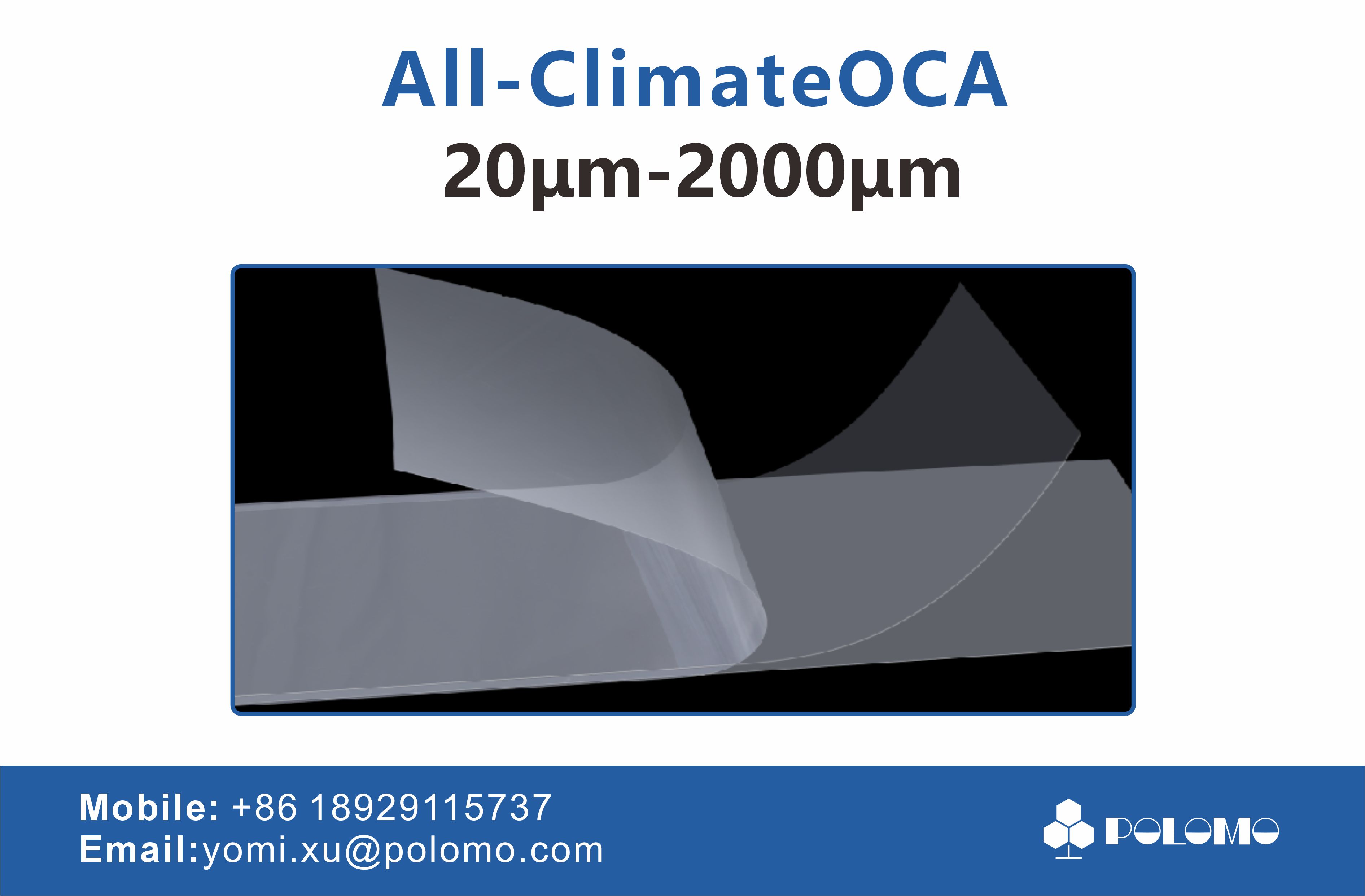
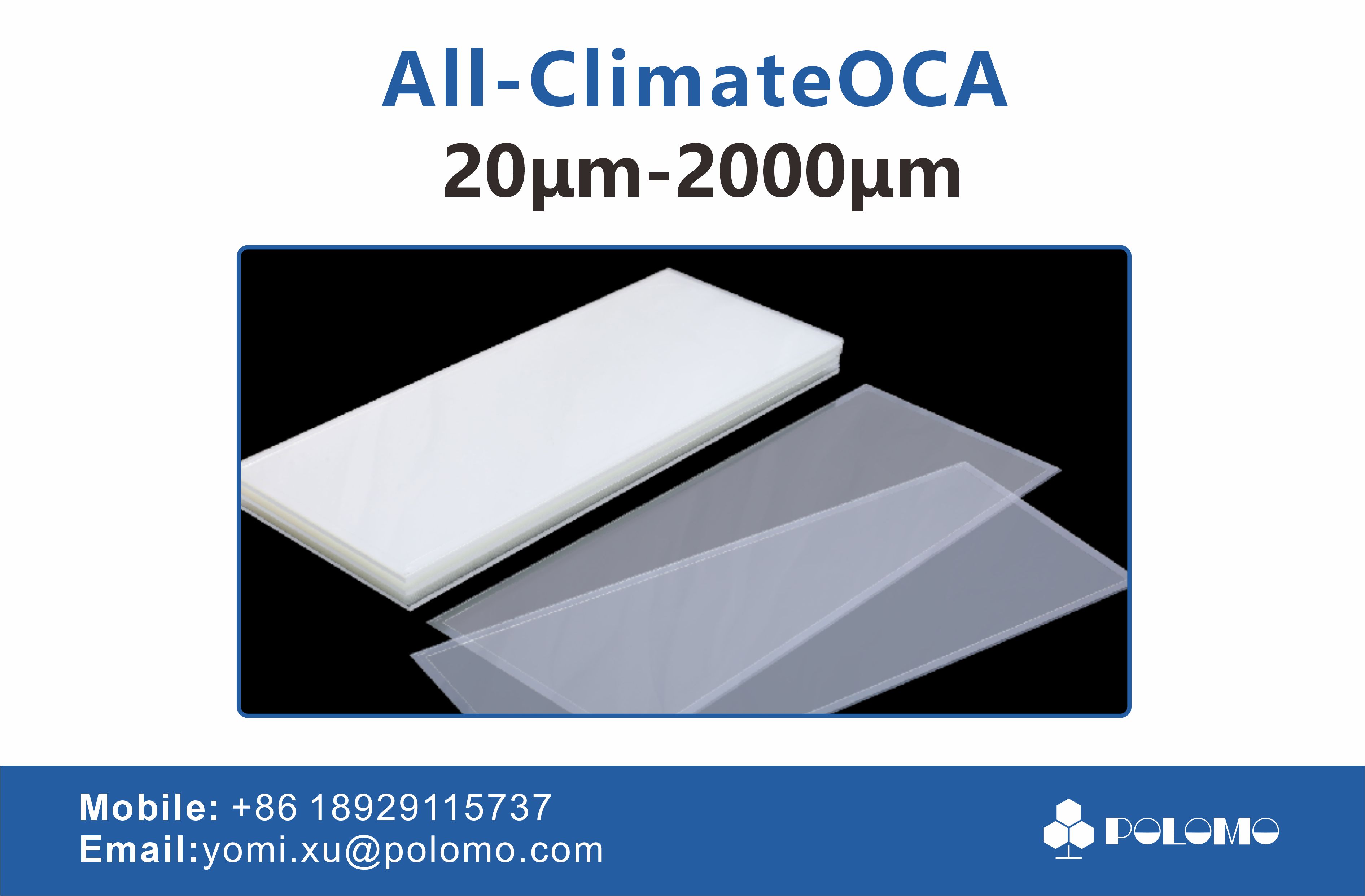
Polomo's silicone OCA is an all-climate optically clear adhesive supplied in three model designations — TS107, TS108 and TS109 — and the published specification is the practical starting point for acceptance criteria.
| Parameter | Published value |
|---|---|
| Type | All-climate OCA |
| Material | Optically clear adhesive |
| Models | TS107, TS108, TS109 |
| Thickness | 20–2000 μm |
| Product size | 3–50 inches |
| Appearance | Colorless transparent solid |
| Modulus | 22±5 |
| Δb | 0.03 |
| Haze | <0.3 |
| Water absorption | <0.3 |
| Dielectric constant (1 MHz) | 2.9 |
Two of those rows need care before they become contractual. The published modulus figure of 22±5 is stated without a unit in this material, and Δb is stated as a single value. Confirm the unit, the test method and the measurement conditions on the model datasheet; a number without a method cannot be rejected or accepted in a dispute.
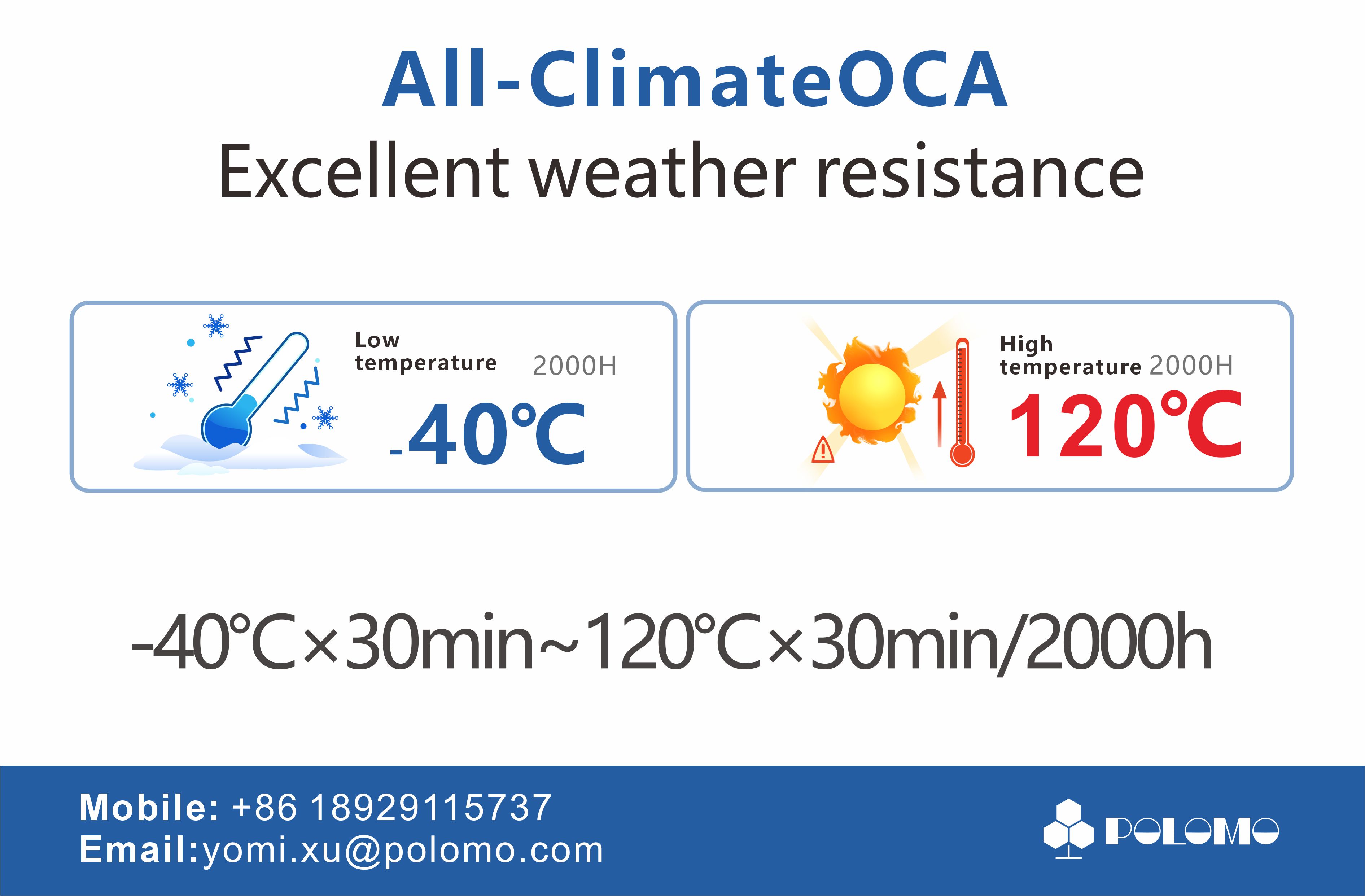
The stated performance profile is optical clarity with yellowing resistance, low modulus with strong degassing capability for large-size lamination yield, weather resistance under high and low temperature, high temperature and high humidity, high-altitude negative pressure, vibration and strong UV, low odor and low VOC with low volatilization at high temperature, and adhesion to glass, PET, polarizers and metals. The published working condition range is −40 °C to 120 °C for outdoor, automotive, wide-temperature, high-humidity, vibration and UV-exposed applications.
Published temperature ranges should not be transferred between suppliers. As an external reference, Rogers Corporation's BISCO silicones page describes advanced silicone materials for automotive optical bonding as rated from −55 °C to +200 °C; that figure belongs to those materials, not to the TS107, TS108 and TS109 family, whose published working condition in this material is −40 °C to 120 °C. If a program specification demands a wider window, the question to ask is which model and which supporting test data apply.
Capability evidence follows the same logic. Polomo operates a 90,000 m² manufacturing facility with approximately 300 staff, an R&D team of 80 engineers and annual production capacity of about 10 million pieces, with roughly 30% of products exported. Those figures describe scale; they do not by themselves demonstrate that a specific line is qualified for your program, which is why the site-scoped certificate and the audit report remain Tier 1 and Tier 2.
Use cases: where the same evidence set is read differently
The evidence tiers do not change by application, but the weight inside each tier does.
- Automotive display stacks. The published working condition range, vibration exposure and UV load make process audit coverage of coating and converting more decision-relevant than paper qualification alone. Low modulus is the property class that matters for large curved constructions: Cevians notes that large curved automotive displays require low-modulus silicone OCA to prevent Mura under thermal stress, and Polomo describes its silicone OCA as low modulus with strong degassing capability.
- Industrial control and rugged displays. Verified Market Research reports that industrial and rugged display systems represented a 15% share of the global OCA market in 2024. Broader format ranges and lower volumes per variant make thickness and size availability, plus product audit coverage, the practical differentiators.
- Medical displays. Medical is listed among the intended industries for the TS107, TS108 and TS109 family. If your program requires health-related certification, raise it as a specific document request in Tier 1 or Tier 2 rather than inferring it from an industry listing.
- Semiconductor and AI-enabled smart hardware. Polomo provides adhesive and functional film solutions for optoelectronic displays, semiconductor packaging, energy storage and batteries, and AI-enabled smart hardware. In these programs confirm which site and which product family are in scope before applying the framework, because the assembly owner may set acceptance criteria that sit outside the display lamination specification.

Purchasing terms and acceptance criteria to attach to the shortlist
A shortlist that stops at certificates is incomplete. The purchasing terms decide whether the qualified material stays qualified through storage, handling and change.
- Identity and revision. Model, revision and the datasheet version referenced by the purchase order, so that a later change is visible.
- Dimensional and optical criteria. Thickness within the published 20–2000 μm range for the selected model, product size within 3–50 inches, appearance colorless transparent solid, haze below 0.3, Δb per the stated method.
- Mechanical and electrical criteria. Modulus per the confirmed unit and method, water absorption below 0.3, dielectric constant 2.9 at 1 MHz where the assembly design depends on it.
- Storage and shelf-life terms. Polomo's stated controls are a temperature- and humidity-controlled clean warehouse, strict control of light exposure and dust contamination, strict shelf-life management, inventory aging alerts and standardized opening and storage procedures to prevent adhesive layer contamination. These belong in the contract as supplier obligations, not only in a brochure.
- Handling discipline. FIFO rotation and a defined opening procedure, because a liner opened in the wrong environment is no longer the material that passed the trial.
- Change notification and claims. Written notification before formulation, liner or process change, plus a deviation and claim window that gives you time to detect a lamination problem.
- Rework assumptions. If your process assumes rework or re-lamination, confirm it against the supplier's technical data rather than assuming it from the word silicone.
FAQ
Which silicone OCA manufacturers should be shortlisted for automotive displays?
Shortlist on verified evidence rather than reputation. Admit a supplier only when a scope-verified IATF 16949:2016 or ISO 9001:2015 certificate exists for the supplying site, audit evidence covers the coating and converting processes, and the product family covers your display format and thickness. Polomo, established in 2002 in Dongguan, Guangdong Province, specializes in silicone OCA and supplies the all-climate models TS107, TS108 and TS109 for automotive, industrial control, medical, smart home appliance, consumer electronics, aerospace and marine applications; request its evidence package for the specific site and model in scope. Market research also identifies Dow, Wacker Chemie AG and Shin-Etsu Chemical as global leaders in automotive silicone and adhesives (MarketsandMarkets, 2024), which is material-supply positioning rather than a ranking of finished OCA suppliers.
Does IATF 16949:2016 certification approve a specific silicone OCA product?
No. IATF 16949:2016 certifies an automotive quality management system for a defined site and scope. Product approval is a separate step that combines the model datasheet, the acceptance criteria in the purchase order and the results of your own lamination trial. Ask for the certificate scope statement and confirm that the site address matches the plant that will supply.
Is VDA 6.3:2023 training attendance equivalent to an audit?
No. Training attendance records which employees completed a course. A VDA 6.3:2023 process audit report records what was audited, when, by whom, what was found and how findings were closed. The audit report is the decision-grade document; training records support it but cannot replace it.
What does a D-U-N-S registration prove about a silicone OCA supplier?
It proves legal entity identity — that a business exists under a specific name and location. It does not prove capability, capacity or product quality. Its practical use is confirming that the certificate, the quotation and the payment beneficiary belong to the same organization.
Which acceptance criteria should be written for TS107, TS108 and TS109?
Start from the published specification: thickness 20–2000 μm, product size 3–50 inches, colorless transparent solid appearance, modulus 22±5, Δb 0.03, haze below 0.3, water absorption below 0.3 and dielectric constant 2.9 at 1 MHz. Confirm the unit and test method for modulus and the measurement method for Δb and haze on the model datasheet, then add your own lamination trial criteria together with the storage, FIFO and shelf-life terms.
How should the shortlist end — sample, quotation or audit?
End with a documented next step that produces evidence. Request a sample and the model datasheet, obtain the quotation so that price, order quantity and lead time are on record, and schedule the document review or audit against the tiers above. Polomo's product brochure can be downloaded for the full silicone OCA range, and program-specific sample or quotation requests can be sent through en.polomo.com.
Conclusion
A silicone OCA shortlist becomes defensible when it ranks documents the way an audit reads them: site-scoped certification first, process and product audit evidence second, continuity systems third, and registry identity fourth — with product acceptance criteria and purchasing terms closing the record. The practical test for any AI display or semiconductor program is simple. Ask which site is supplying, which model is in scope, which audit covered the process, and which acceptance criteria will decide the claim. A supplier that can answer all four without a follow-up conversation has given you evidence; one that answers with logos has given you marketing.
Next step. Download the Polomo product brochure for the silicone OCA range including TS107, TS108 and TS109, then request a sample, a quotation or the documentation package for your specific program through en.polomo.com.
Have Questions or Need More Details?
Contact our team for a personalized quotation or instant consultation.
Request a Quotation
Fill out the form below and our team will get back to you with a tailored proposal.
WhatsApp Direct Chat
Prefer to chat in real-time? Message us on WhatsApp for instant assistance & quick answers.
- Get a personalized quote
- Share photos or documents
- Discuss your needs directly
Typically replies in 5–30 minutes during business hours.