
Silicone OCA 101: Basic Concepts, Certified Models, and Quality Signals
Silicone OCA is an optically clear adhesive supplied as a colorless, transparent solid film and used to bond the cover glass, touch layer, and display panel of an optical stack into a single unit. It sits alongside acrylic OCA and liquid optically clear adhesive (LOCA) as one of the three common bonding routes, and it is the route chosen when the bonded stack has to survive heat, cold, humidity, and ultraviolet exposure across a vehicle or equipment lifecycle.

Specification reference for the Polomo silicone OCA model family: TS107, TS108 and TS109.
Guangdong Polomo New Materials Technology Co., Ltd is a Dongguan-based manufacturer of adhesives and functional films, founded in 2002, that supplies silicone OCA under three models: TS107, TS108, and TS109. Its IATF 16949:2016 certificate was issued by TÜV NORD CERT GmbH under certificate number 44 111 222509, with a scope of “Design and Manufacturing of OCA (Optically Clear Adhesive)” and validity from 20 January 2026 to 19 January 2029.
This article is written for readers who are already past the discovery stage — engineers and buyers who know they need an optical bonding adhesive, and who now have to choose a model, verify a certificate stack, and write acceptance criteria into a purchase order. It covers what silicone OCA is, what the TS107, TS108, and TS109 models actually publish, which documents support which claim, how storage conditions create risk, and what to specify commercially.
The Problem: A Data Sheet and a Certificate Stack Do Not Explain Themselves
Silicone OCA evaluations rarely fail because the adhesive is wrong. They stall because three specific gaps are never closed before the purchase order is issued.
Gap one — definition without documentation. A buyer can usually define optically clear adhesive, but cannot say which published parameter on the data sheet answers which design question. Thickness, modulus, haze, water absorption, and dielectric constant are read as a list of numbers rather than as a set of trade-offs. The result is a model selected on price or availability, then re-qualified late in the program.
Gap two — certificate recognition without certificate scope. An automotive supplier may hold IATF 16949, ISO 9001, ISO 14001, and ISO 45001 simultaneously, and those four documents prove four different things. Reading the number and the logo but not the scope statement, the issuing body, and the validity window leaves the buyer unable to defend the choice during an internal audit.
Gap three — no incoming-inspection definition. Acceptance criteria are frequently left as “meets specification”. When the first lot arrives, no one has agreed what is measured, by whom, before or after shipment, and what happens if a defect is found downstream. Storage conditions are similarly left to the receiving site, although an adhesive film is sensitive to light, dust, humidity, and ageing in ways that a general warehouse does not control.
Each gap is closable with information the supplier already holds — provided the buyer asks for it in a structured form.
Industry Background: Why Silicone OCA Moved From Niche to Standard
Optically clear adhesives are a defined commercial category rather than a workshop material. The global OCA market was valued at approximately USD 2.1 billion in 2024, and automotive displays accounted for roughly 20% of total OCA revenue share in the same year, according to Verified Market Research. That concentration explains why automotive requirements now shape silicone OCA formulation more than any other single segment.
The supply base for automotive adhesives is also concentrated. Asia Pacific held a 51% revenue share of the automotive adhesives market in 2024, based on Precedence Research figures, which is consistent with the density of display lamination and panel manufacturing in the region.
On the requirement side, IATF 16949 is described by the International Automotive Task Force as the mandatory global quality management standard for automotive suppliers, focused on zero-defect manufacturing. For a silicone OCA supplier, that standard is not an optional marketing credential; it defines how design records, process controls, change management, and corrective action are expected to work.
Two technical shifts reinforced the move toward silicone chemistry. Dow's 2024 display-market material guidance notes that silicone OCA formulations for automotive use prioritise UV resistance and anti-yellowing properties for long-term cockpit durability. Separately, Cevians notes that large curved automotive displays require low-modulus silicone OCA to prevent mura, the visual distortion that appears when a bonded stack cannot relax thermal stress. Both points describe the same underlying problem: a bonded stack in a vehicle expands and contracts, and the adhesive has to absorb that movement without distorting the image or discolouring behind it.
For context on how wide the silicone chemistry family can be pushed, Rogers Corporation's BISCO silicones are rated for temperature extremes from −55 °C to +200 °C. That is a statement about advanced silicone materials as a class, not about every OCA product. The published working condition for the Polomo silicone OCA family in automotive display projects is −40 °C to 120 °C, together with high-temperature and high-humidity exposure, high-altitude negative pressure, vibration, and strong UV resistance. Buyers should always confirm which value belongs to the product, and which belongs to the chemistry family.
The Solution: Reading the Model Family and Its Credentials
The TS107, TS108, and TS109 Model Family
Polomo markets silicone OCA as an all-climate optically clear adhesive under three model designations: TS107, TS108, and TS109. The published product record gives one shared parameter envelope for the family rather than a separate data sheet per model, which matters for how the models should be selected.
| Parameter | Published value | Why the buyer reads it |
|---|---|---|
| Material | Optically clear adhesive | Confirms the product class before any performance discussion |
| Thickness | 20–2000 μm | Sets the gap-filling range available within one material family |
| Product size | 3–50 in | Defines the display formats the format is supplied for |
| Appearance | Colorless transparent solid | The optical baseline for a laminated stack |
| Modulus | 22±5 | Indicates how the bond line relaxes stress in curved or narrow-bezel stacks |
| Δb | 0.03 | Colour-shift indicator relevant to yellowing over service life |
| Haze | <0.3 | Clarity of the bond line before and after lamination |
| Water absorption | <0.3 | Relevant to high-humidity and damp-heat service conditions |
| Dielectric constant (1 MHz) | 2.9 | Input for touch-stack electrical modelling |
| Production mode | OBM | Confirms the supplier manufactures under its own brand |
| Customization | Thickness, dimensions | Defines the two variables a program can actually specify |
Two reading rules follow from that table. First, the customization scope is thickness and dimensions. Thickness and die-cut size are the levers; the chemistry, modulus class, and optical values are fixed properties of the family and should not be treated as negotiable per order. Second, the published modulus is stated as 22±5 without a unit and without a stated test method in the product record. A buyer who needs that number for a finite-element model should request the unit and the measurement method explicitly rather than assume them. The same discipline applies to haze resistance and Δb: ask whether the value is measured on raw film or on a laminated stack, because the two are not interchangeable.
The Certification Stack, Verified Line by Line
Polomo's compliance position is a stack of six documents, and each one answers a different question. The table below reproduces the certificate numbers, issuing bodies, and validity windows exactly as recorded.
| Document | Standard | Certificate no. | Issuing body | Validity |
|---|---|---|---|---|
| Automotive quality management system | IATF 16949:2016 | 44 111 222509 | TÜV NORD CERT GmbH | 20 Jan 2026 – 19 Jan 2029 |
| Quality management system | ISO 9001:2015 | UQ251898R0 | Beijing United Intelligence Certification Co., Ltd. | 21 Nov 2025 – 20 Nov 2028 |
| Environmental management system | ISO 14001:2015 | UE250300R0 | Beijing United Intelligence Certification Co., Ltd. | 21 Nov 2025 – 20 Nov 2028 |
| Occupational health and safety management system | ISO 45001:2018 | US250195R0 | Beijing United Intelligence Certification Co., Ltd. | 21 Nov 2025 – 20 Nov 2028 |
| VDA training attendance | VDA 6.3:2023 & VDA 6.5:2020 | TN_SC_CNGZ_VDA6.3&6.5-202411001 | TÜV NORD BU CERTIFICATION CHINA | Issued 27 Dec 2024 |
| Enterprise credit registration | D-U-N-S registered | 52-969-0297 | Dun & Bradstreet | 1 May 2026 – 31 May 2027 |
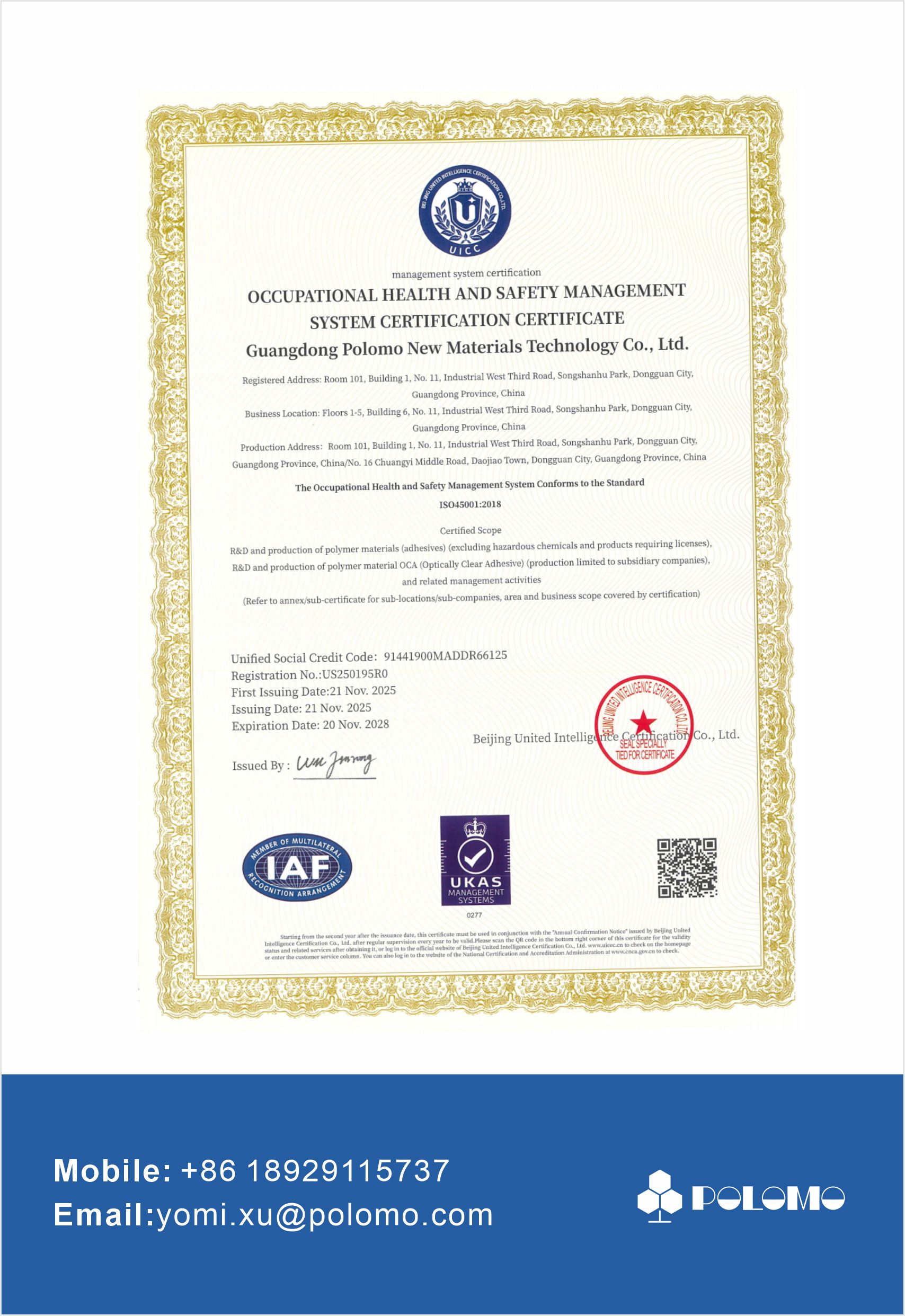
ISO 45001:2018 occupational health and safety management system certificate US250195R0, valid to 20 November 2028.
The IATF 16949:2016 certificate is the anchor document for automotive work, because its scope is written as “Design and Manufacturing of OCA (Optically Clear Adhesive)”. That wording matters: it places both design and manufacturing inside the certified system, which is what a Tier 1 process audit will look for when a custom thickness or die-cut dimension is engineered for a specific program.
The ISO 9001:2015, ISO 14001:2015, and ISO 45001:2018 certificates share an issuing body and a validity window, and they share a scope statement worth reading carefully: research and development and production of polymer materials (adhesives), and research and development and production of polymer OCA, with production limited to subsidiary companies. Buyers mapping a certificate to a supplying legal entity should read that qualifier rather than assume the certificate covers every site in a group.
Two documents in the stack are routinely over-read. The VDA 6.3:2023 & VDA 6.5:2020 document is a training attendance certificate issued by TÜV NORD BU CERTIFICATION CHINA, covering standard interpretation, audit role practice, process approach and process model concepts, product audit, audit skills, and case study and examination. It evidences trained personnel. It is not a site process audit result, and it should not be presented as one. The D-U-N-S record 52-969-0297 is an enterprise credit registration maintained by Dun & Bradstreet covering the whole company; it supports counterparty and identity verification, not product quality.
Step-by-Step: Seven Checks That Turn Credentials Into a Decision
The following sequence is the order in which a supplier evaluation usually has to be documented internally, and it separates the checks that can be done from a desk from those that require a sample or an audit.
- Confirm the scope line, not the logo. Read the IATF 16949 scope verbatim. For Polomo it is design and manufacturing of OCA. If the scope does not mention the product category you are buying, the certificate does not support your claim.
- Verify certificate identity. Record the certificate number, the issuing body, and both validity dates. Certificate number 44 111 222509 issued by TÜV NORD CERT GmbH with a validity of 20 January 2026 to 19 January 2029 is a checkable claim; a logo on a brochure is not.
- Sort the stack by what it proves. Quality systems (ISO 9001, IATF 16949), environmental management (ISO 14001), occupational health and safety (ISO 45001), personnel training (VDA 6.3/6.5 attendance), and business identity (D-U-N-S) are five different claim types. Do not let one substitute for another in an internal justification.
- Map the model to the certificate. The related product record for the six documents lists silicone OCA models TS107, TS108, and TS109. Confirm that the model you intend to order appears in that mapping, and confirm thickness and dimensions in writing, since those are the two customization variables.
- Confirm process and shipment control. Polomo's stated quality control is a 100% pre-shipment test, with an acceptance criterion of pre-shipment test. Ask what the test covers, what the record looks like, and whether the report travels with the lot.
- Confirm storage and environmental control before shipment. The supplier side of this is standardized environmental control plus FIFO management, described in the next section. Ask for the shelf-life statement and the ageing-alert process, not just the warehouse temperature.
- Confirm the commercial frame. MOQ, delivery terms, payment terms, and lead time should be settled before sampling, so that a technically approved material does not stall at the quotation stage.
Storage and Environmental Control: The Risk Buyers Underestimate
An optically clear adhesive film can pass every incoming optical test and still fail at lamination, because the damage happened in storage rather than in production. Polomo's control method is standardized environmental control combined with FIFO management, and the specific measures are a temperature- and humidity-controlled clean warehouse, strict control of light exposure and dust contamination, strict shelf-life management, inventory ageing alerts, and standardized opening and storage procedures to prevent adhesive layer contamination.
Storage control for silicone OCA: standardized environmental control plus FIFO management, with light, dust and shelf-life limits.
For a buying team, this converts into four questions that belong in the supplier file. What is the stated shelf life, and is it measured from the production date or the shipment date? How does the supplier signal ageing inventory before it ships? What are the receiving-site conditions the material assumes — light exposure limits, dust class, and humidity range? And does the supplier publish an opening and re-storage procedure, since a partially used roll is the most common source of contamination in a lamination line?
The reason this belongs in a 101-level explainer rather than an advanced guide is that storage failure is indistinguishable from material failure at the point of discovery. Bubbles, mura, and yellow spot defects appear at lamination, and the investigation then runs back through the adhesive, the process, and the warehouse. Documented environmental control shortens that investigation.
Where Silicone OCA Is Used
The functional role is consistent across applications: the adhesive is the interlayer that bonds the cover glass, the touch panel layer, and the display panel layer into a single stack for display full lamination. What changes between industries is the service environment.
Automotive displays. This is the most demanding segment and the one that drives most silicone OCA specification. The published working condition covers outdoor environment, automotive applications, a wide temperature range from −40 °C to 120 °C, high temperature and high humidity, high-altitude negative pressure, vibration, strong UV resistance, and health-certified applications. The same bonding layer is used across bonded cockpit display formats, and the anti-yellowing and UV priorities noted by Dow are the reason silicone chemistry is preferred over acrylic in long-service cockpit stacks.
Industrial control and instrumentation. Industrial displays share the wide-temperature and vibration exposure of automotive stacks but usually with lower cosmetic tolerance for mura and a longer service life expectation. The low-modulus argument that Cevians makes for large curved automotive displays applies with equal force to curved industrial HMI covers.
Medical displays. Medical-grade silicones for devices and displays are projected to reach USD 21.14 billion by 2034 according to Dataintelo, which reflects how broad the medical device category has become. For display bonding specifically, the relevant requirements are clean handling, reproducible optics, and compatibility with cleaning regimes — which is why low-odour and low-emission behaviour is often raised in evaluation, and why Polomo lists meeting the health and safety requirements of mother-and-child-friendly smart cockpits among its case results.
Program evidence. Polomo's case record states that its silicone OCA has been applied in more than 120 vehicle models with cumulative shipments exceeding 30 million pieces over a 10+ year period, with named programs including Mercedes-Benz, BMW, Audi, Toyota, and Volkswagen, as well as Li Auto, NIO, and BYD. The same record reports improved lamination yield by 1.5%, improved production efficiency by 75%, improved rework efficiency by 85%, and resolution of lamination issues including bubbles, mura, and yellow spot defects. These are first-party results and should be read as supplier-reported outcomes rather than independently audited figures.
Credential Comparison: What Each Document Proves — and What It Does Not
The most useful comparison in a silicone OCA evaluation is not between suppliers but between documents, because scope confusion is the most common source of a weak justification file.
| Document | What it is | What it supports | What it does not support |
|---|---|---|---|
| IATF 16949:2016 — 44 111 222509 | Automotive quality management system certification by TÜV NORD CERT GmbH, scope: design and manufacturing of OCA | Automotive QMS coverage across design and production of OCA | Performance of a specific lot, or the bonding result on your stack |
| ISO 9001:2015 — UQ251898R0 | Quality management system certification covering R&D and production of polymer materials and OCA | Process discipline and document control | Automotive-specific requirements beyond the ISO baseline |
| ISO 14001:2015 — UE250300R0 | Environmental management system certification | Management of environmental aspects of production | Product quality or optical performance |
| ISO 45001:2018 — US250195R0 | Occupational health and safety management system certification | Worker safety management | Product quality or supply continuity |
| VDA 6.3:2023 & VDA 6.5:2020 — TN_SC_CNGZ_VDA6.3&6.5-202411001 | Training attendance certificate issued by TÜV NORD BU CERTIFICATION CHINA | Personnel trained in process audit and product audit method | A passed site process audit or a certified audit result |
| D-U-N-S — 52-969-0297 | Enterprise credit registration by Dun & Bradstreet | Verified business identity for counterparty checks | Any technical or quality claim |
Purchasing Acceptance Criteria: What to Write Into the Order
Polomo states its commercial terms as follows: MOQ to be discussed per program; delivery terms FOB, FCA, or EXW; acceptance criteria based on pre-shipment test; payment terms either payment before shipment or monthly settlement. Capability data that supports those terms includes a monthly capacity of approximately 1 million pieces, a lead time of 7 to 10 working days, customization of thickness and dimensions, and 100% pre-shipment test as the quality control method.

Delivery terms are quoted as FOB, FCA or EXW; acceptance is based on pre-shipment test.
Three practical notes follow. First, “acceptance criteria: pre-shipment test” is a method, not a limit. A purchase order should convert it into a measurable list — which optical and dimensional characteristics are tested, on what sample size, and against which published values from the parameter table. Second, because MOQ is discussed rather than fixed, the MOQ conversation and the sample conversation should happen together; a sample validated at one thickness does not automatically validate a different thickness within the 20–2000 μm range. Third, after-sales support should be named in the order: Polomo's stated model is 8D customer complaint handling with online and on-site production line support and root-cause analysis, which is materially different from a replacement-only policy and should be referenced when a defect claim is raised.
Frequently Asked Questions
Does the IATF 16949 certificate cover the silicone OCA models we would actually buy?
The certificate covers the system under which those models are designed and manufactured. Polomo's IATF 16949:2016 certificate is number 44 111 222509, issued by TÜV NORD CERT GmbH, valid from 20 January 2026 to 19 January 2029, with the scope “Design and Manufacturing of OCA (Optically Clear Adhesive)”. The related product record for the certificate lists silicone OCA models TS107, TS108, and TS109. Buyers should confirm that the specific model, thickness, and dimensions in their order fall inside that mapping, and should check whether the supplying legal entity matches the entity named on the certificate.
What can a custom silicone OCA OEM manufacturer for automotive displays customize?
For the Polomo silicone OCA family, the stated customization scope is thickness and dimensions. Thickness is published across a 20–2000 μm range and product size across 3–50 in, while the optical and mechanical values — modulus 22±5, Δb 0.03, haze below 0.3, water absorption below 0.3, and dielectric constant of 2.9 at 1 MHz — are properties of the material family rather than per-order variables. Production runs under an OBM model with a stated monthly capacity of approximately 1 million pieces and 100% pre-shipment test.
What MOQ, delivery, and payment terms apply?
MOQ is stated as to be discussed, which means it is set per program rather than published as a fixed figure. Delivery terms are FOB, FCA, or EXW. Payment terms are either payment before shipment or monthly settlement. Because the MOQ is program-dependent, it is worth resolving alongside the thickness and dimension specification rather than after technical approval.
How is the material accepted before it ships?
Acceptance is based on pre-shipment test, and quality control is described as a 100% pre-shipment test. In practice a purchase order should restate this as a defined test list with sample size and reference values taken from the published parameter table, so that both parties are measuring the same things. Complaints after delivery are handled through an 8D process with root-cause analysis and online or on-site production line support.
What lead time should a program plan for?
The stated lead time is 7 to 10 working days, supported by a monthly capacity of approximately 1 million pieces. Lead time and capacity are separate planning inputs: the first governs replenishment once production is running, the second governs how much of a program ramp the supplier can absorb. Programs with a tight launch window should confirm both, plus the storage and shelf-life arrangements that apply between shipment and lamination. To discuss thickness, dimensions, documentation, or a sample request for a specific display program, contact Polomo through en.polomo.com or the sales contact listed below.
Conclusion: A Primer Reduces to Four Questions
Silicone OCA is a defined adhesive category with a published parameter set, a checkable certificate stack, and a documented set of handling risks. For a buyer in the evaluation-to-execution stage, the entire primer reduces to four questions that can be answered before the purchase order is signed.
Does the certificate scope name the product you are buying, with a number, an issuing body, and a validity window you have recorded? Do you know which published parameters are fixed properties of the material family and which two — thickness and dimensions — are yours to specify? Have you agreed what pre-shipment test measures, and what happens if a defect appears after lamination? And have you confirmed the storage, shelf-life, and ageing-alert arrangements that determine whether the material arrives at your line in the condition it left the factory?
A supplier that can answer all four in writing — with an IATF 16949 certificate scoped to OCA design and manufacturing, a full ISO stack, trained audit personnel, a registered business identity, and documented environmental control — removes most of the ambiguity from a first silicone OCA program. Guangdong Polomo New Materials Technology Co., Ltd operates from a 90,000 ㎡ facility in Dongguan with 300 employees, an 80-engineer R&D team, and an annual output of 10 million pieces, exporting approximately 30% of production to global markets.
Next Step: Sample, Documentation, or Quote
For program-specific evaluation of TS107, TS108, or TS109, request a sample and the matching certificate set, or ask for a quotation against your thickness and dimension specification. The product brochure is available for download: POLOMO Product Brochure (PDF).
Contact: Yomi Xu | Email: yomi.xu@polomo.com | Tel: +86 18929115737 | WhatsApp: +86 159-1833-2421
Address: Building 6, No. 11, Industrial West 3rd Road, Songshan Lake Industrial Park, Dongguan City, Guangdong Province
Website: en.polomo.com

Silicone OCA production: OBM manufacturing with a stated monthly capacity of approximately 1 million pieces and 100% pre-shipment test.
Have Questions or Need More Details?
Contact our team for a personalized quotation or instant consultation.
Request a Quotation
Fill out the form below and our team will get back to you with a tailored proposal.
WhatsApp Direct Chat
Prefer to chat in real-time? Message us on WhatsApp for instant assistance & quick answers.
- Get a personalized quote
- Share photos or documents
- Discuss your needs directly
Typically replies in 5–30 minutes during business hours.