
Silicone OCA Storage & Environmental Control: A Technical Guide for Semiconductor & AI Assembly
Silicone OCA Storage & Environmental Control: A Technical Guide for Semiconductor & AI Assembly
Short answer: Silicone OCA performance is set by formulation, but the condition of the material at the moment of lamination is set by storage and environmental control. For semiconductor and AI assembly programs, the documented control method is standardized environmental control combined with FIFO management: a temperature- and humidity-controlled clean warehouse, strict control of light exposure and dust contamination, strict shelf-life management with inventory aging alerts, and standardized opening and storage procedures that prevent adhesive layer contamination. These measures are supported by qualification evidence such as IATF 16949 certification for the design and manufacturing of OCA; ISO 9001:2015, ISO 14001:2015 and ISO 45001:2018 certifications covering the TS107, TS108 and TS109 product range; a VDA 6.3:2023 and VDA 6.5:2020 training attendance certificate; and D-U-N-S registration.

This guide is written for teams that have already selected silicone OCA and are moving through decision and execution: incoming material control, line-side handling discipline, and the supplier audit checks that keep a program supplied consistently over its full lifetime. It covers the risk definition, the industry background that makes the risk material, the control measures that can be documented and audited, a step-by-step control sequence, application cases, an environment-focused material comparison, and the questions buyers ask most often.
Problem Definition: What Storage and Environmental Control Risk Means for Silicone OCA
Silicone OCA is an optically clear adhesive supplied as a pre-formed film carried on release liners. In a bonded stack it functions as the interlayer between the cover glass, the touch panel layer and the display panel layer, and it is applied with lamination equipment at room temperature and low pressure, followed by an autoclave step. Because bonding happens late in the assembly flow, everything that happens to the material between receipt and lamination either preserves or degrades the qualified condition of the adhesive layer.
Storage and environmental control risk is the probability that the material at the point of use is not the material that was tested. The recurring sources are:
- Temperature and humidity fluctuation inside the warehouse.
- Light exposure, particularly in the UV band; silicone OCA formulations for automotive use are specified for UV resistance and anti-yellowing properties for long-term cockpit durability (Dow Display Week 2024).
- Dust and particulate contamination once a release liner is opened.
- Aging beyond the specified shelf life.
- Non-standard opening, partial use and re-storage of a roll.
- Non-FIFO issuance that mixes material of different vintages in one production window.
The difficulty is visibility. Silicone OCA is supplied as a colorless transparent solid, and a contaminated or aged adhesive layer does not look different on the roll. Effects typically become measurable after lamination, at which point the loss is a finished stack rather than a raw material. The optical parameters that define the grade, such as a Δb of 0.03 and a haze below 0.3 in the Polomo TS series, are also the parameters that environment and handling can move.
That is why storage and environmental control belongs in supplier qualification and not only in warehouse procedure. The relevant question is not whether a supplier has a warehouse, but whether the control is standardized, documented, and repeatable for every shipment across the life of the program.
Industry Background: Why Storage Discipline Sits Inside Assembly Decisions
The optically clear adhesive market was valued at USD 2.1 billion in 2024 (Verified Market Research). Automotive displays accounted for approximately 20% of total OCA market revenue share in the same year, while industrial and rugged display systems represented around 15% (Verified Market Research). The optical bonding market is projected to reach USD 1,519.48 million by 2031, growing at a compound annual growth rate of 6.63% (Verified Market Research). Growth of this kind expands the number of bonded stacks in circulation, and every additional stack is a place where incoming material condition has to be controlled.
The standards context explains where the control language comes from. IATF 16949 is the mandatory global quality management standard for automotive suppliers and focuses on zero-defect manufacturing (International Automotive Task Force). It requires documented process control, traceability and disciplined material handling, which is one reason buyers outside automotive also treat it as a benchmark when an assembly program is cleanliness- and defect-sensitive.
The reliability envelope sets how much margin the material needs. Silicone OCA is qualified against operating conditions that include a wide temperature range from -40 °C to 120 °C, high temperature and high humidity, high-altitude negative pressure, vibration and strong UV exposure. In documented test terms, the comparative data for silicone OCA references -40 °C to 120 °C temperature cycling and 85 °C/85 % RH high-temperature, high-humidity exposure. Storage and handling determine whether a delivered roll still has that margin available when it reaches the line.
Guangdong Polomo New Materials Technology Co., Ltd, founded in 2002, operates a 90,000 m² facility with 300 employees, an R&D team of 80 engineers, and an annual output of about 10 million pieces per year, with silicone OCA as its main product line. The company exports to global markets, with an export ratio of 30%, and its products are applied in optoelectronic displays, semiconductor packaging, energy storage and batteries, and AI-enabled smart hardware — the sectors where this guide applies.
Detailed Solution: Control Methods and Measures for Storage and Environmental Risk
The documented control method is standardized environmental control plus FIFO management. Behind that headline sit specific, auditable measures.
Facility and inventory measures
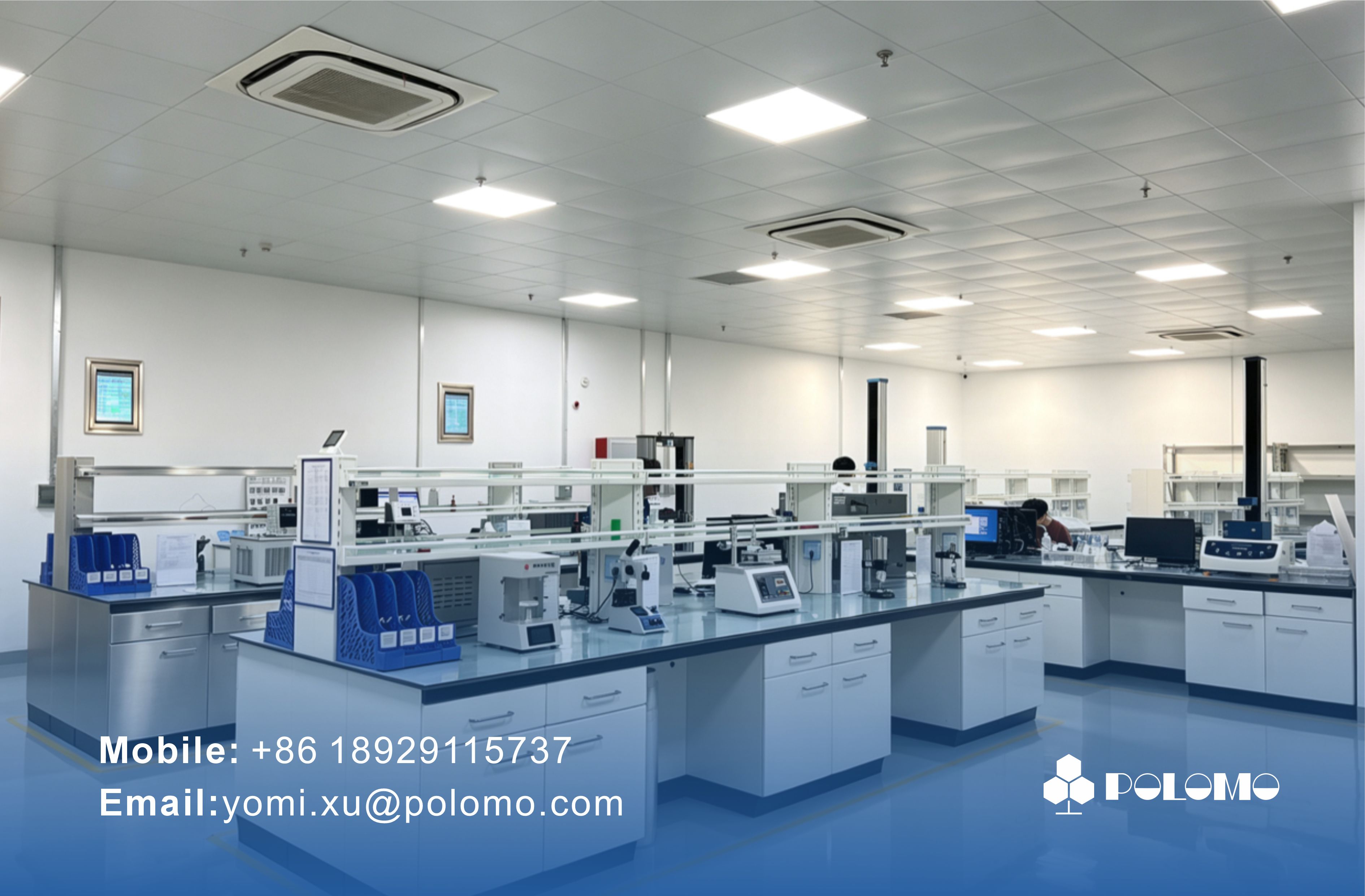
- Temperature- and humidity-controlled clean warehouse. Material is held inside a controlled environment from receipt to issuance, so that the qualified condition of the adhesive layer is not altered by ambient swings.
- Strict control of light exposure. Light, and UV in particular, is managed as part of storage rather than treated as background conditions.
- Dust contamination control. Particulate exposure is controlled in storage and staging areas, because particulate on an exposed adhesive surface becomes an optical defect after bonding.
- Strict shelf-life management. Shelf life is a managed parameter with defined action points, not a label date left to the line to interpret.
- Inventory aging alerts. Aging alerts flag material approaching its storage limit before it is issued, which is what makes FIFO practical rather than theoretical.
- Standardized opening and storage procedures. These procedures exist specifically to prevent adhesive layer contamination during opening, partial use and re-storage.
Material parameters worth recording for traceability
The TS107, TS108 and TS109 grades are all-climate silicone OCA supplied as a colorless transparent solid. Their documented parameters give the buyer the fixed reference points against which any storage or handling deviation is judged:
- Thickness: 20–2000 μm
- Product size: 3–50 inch
- Modulus: 22 ± 5
- Δb: 0.03
- Haze: below 0.3
- Water absorption: below 0.3
- Dielectric constant (1 MHz): 2.9
These values are also the reason storage discipline is not a soft requirement. A material specified at a Δb of 0.03 leaves little room for color drift, and low water absorption supports stability in humid environments while still requiring that humidity be controlled in storage rather than absorbed during it.
Qualification evidence that supports the control claim
Control measures are only as strong as the system that documents them. The relevant evidence set for Polomo covers:
- IATF 16949 certification covering the design and manufacturing of OCA.
- ISO 9001:2015, ISO 14001:2015 and ISO 45001:2018 certifications covering the TS107, TS108 and TS109 range.
- A VDA 6.3:2023 and VDA 6.5:2020 training attendance certificate — documented here as a training attendance certificate, not as a process certification.
- D-U-N-S registration, which supports entity verification during supplier onboarding.
Limits and boundaries
Three limits should be stated plainly. First, control measures reduce storage risk but cannot restore material that has already aged or been contaminated; they protect condition, they do not repair it. Second, supplier-side control ends at dispatch. If material sits on an open line or in an uncontrolled staging area at the buyer's plant, the supplier's warehouse discipline is bypassed. Third, temperature capability is formulation-specific rather than category-wide: published industry data for advanced silicone materials used in optical bonding cite ranges such as -55 °C to +200 °C (Rogers Corporation, BISCO Silicones), while the Polomo TS series is documented against -40 °C to 120 °C cycling and 85 °C/85 % RH exposure. Buyers should qualify against their own stack and test conditions rather than against a category assumption.
Step-by-Step Breakdown: From Receipt to Lamination
The sequence below converts the control method into a working flow. Each step produces a record that can be audited.
- Align the specification before the order is placed. Confirm the grade (TS107, TS108 or TS109), the thickness within 20–2000 μm, and the panel size within the 3–50 inch range, then agree storage and handling requirements with the supplier in writing.
- Receive into quarantine. Check packaging, release liner integrity, batch coding and date coding. Material stays in quarantine until release criteria are met.
- Apply FIFO coding and put away. FIFO issuance is the mechanism that prevents old and new material from being consumed in the wrong order, and it is what makes shelf-life management enforceable.
- Store inside the controlled environment. Keep material in the temperature- and humidity-controlled clean warehouse for the whole holding period, not only between shifts.
- Monitor shelf life and aging. Use inventory aging alerts so that material approaching its storage limit is flagged before issuance; this is the step where most storage-related escapes are prevented.
- Control light and dust in staging. Protect the roll from light exposure and dust contamination at every transfer point, including the staging area beside the laminator.
- Follow standardized opening and liner-removal procedures. The documented bonding sequence is: remove the light release liner → STH → remove the heavy release liner → HTH → autoclave. Standardized opening and storage procedures are the control that keeps the adhesive layer free of contamination between liner removal and bonding.
- Laminate and verify. Lamination runs on lamination equipment at room temperature and low pressure, followed by autoclave. Outgoing acceptance is by pre-shipment test.
For a buyer-side audit, the practical checklist is short: temperature and humidity records for the storage area, FIFO issuance records, inventory aging alert records, the shelf-life management procedure, the standardized opening and storage procedure, and the certification set that covers the specific grade being purchased.
Use Cases: Where Storage and Environmental Control Decide Yield
Automotive displays. Center displays, digital instrument clusters, passenger and rear-seat entertainment displays, armrest displays, streaming rear-view mirrors, HUDs including PHUD, and air-conditioning displays all depend on a bonded stack that stays optically clean for years. Large curved and narrow-bezel designs depend on a low-modulus interlayer to absorb thermal stress and prevent mura and bubble formation — which is exactly the behaviour that contamination or aging in storage can undermine.
Industrial touch displays and rugged systems. Industrial and rugged display systems represent around 15% of the global OCA market (Verified Market Research). These units are exposed to wider ambient variation in service, so the reliability margin preserved during storage has a direct effect on field behaviour.
Medical displays. Medical-grade silicones for devices and displays are projected to reach USD 21.14 billion by 2034 (Dataintelo). Cleanliness expectations are high on the assembly side, and incoming material control is part of that expectation.
Smart home, commercial display, consumer electronics, aerospace, marine and education. Polomo silicone OCA is applied across these sectors, where the common requirement is a bonded optical interface that does not degrade with heat, humidity or UV exposure.
Semiconductor and AI hardware. Polomo products serve optoelectronic displays, semiconductor packaging, energy storage and AI-enabled smart hardware. In these programs, particle and moisture control are already standard in the assembly environment, so controlled silicone OCA storage is not a new discipline — it is the extension of an existing one to an incoming material.
Comparison: Environment-Related Attributes and Control Verification
The comparison below uses environment-related attributes, because those are the attributes that storage conditions act on. It is drawn from documented comparative material data for silicone OCA and acrylic OCA.
| Environment-related attribute | Silicone OCA (Polomo TS series) | Acrylic OCA |
|---|---|---|
| Elastic modulus behaviour | Stable modulus under high and low temperatures; extremely low elastic modulus | High modulus; high modulus at low temperatures |
| Δb* value | 0.03 | 0.5 |
| Dielectric constant | 2.9 | Above 6.3 |
| Odor level | 2.5 | 3.5 / 4 |
| Weather resistance range | -40 °C to 120 °C | -40 °C to 95 °C |
| Documented long-term behaviour under heat | Stress absorption limits mura and bubble formation in large-size bonding | High-temperature bubble rebound, yellow spots and delamination |
| Material cost | Comparable | Comparable |
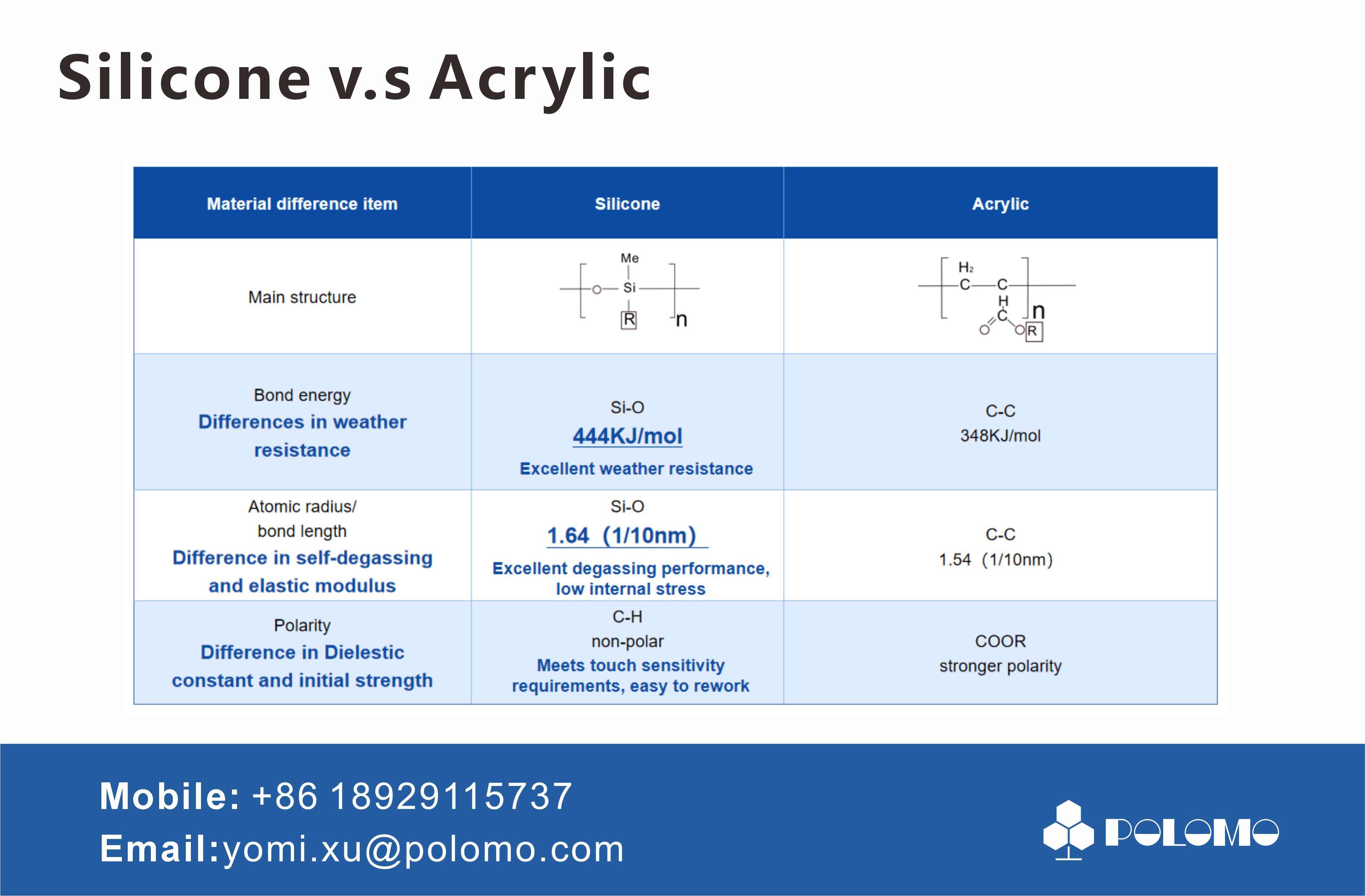
The practical reading is this: the weather resistance range defines how much thermal and climatic margin the material carries into service, and the Δb and odor differences matter most where the bonded unit operates hot and enclosed. Storage and environmental control protect that margin; they do not create it.
The second table maps each storage risk to the documented control measure and to the evidence a buyer can request during supplier qualification.
| Storage or environmental risk | Documented control measure | Evidence to request |
|---|---|---|
| Temperature and humidity fluctuation | Storage in a temperature- and humidity-controlled clean warehouse | Storage area control records; ISO 9001:2015 coverage of TS107, TS108 and TS109 |
| Light exposure | Strict control of light exposure | Storage procedure; Δb of 0.03 specified for the TS series |
| Dust and particulate contamination | Dust contamination control plus standardized opening procedures | Standardized opening and storage procedure; contamination prevention steps |
| Aging beyond shelf life | Strict shelf-life management | Shelf-life policy and issue-date records |
| Mixed-vintage inventory | FIFO management | Inventory aging alert records; FIFO issuance logs |
| Out-of-spec material reaching the line | Pre-shipment test as the acceptance criteria | Pre-shipment test documentation per lot |
FAQ: Storage, Environment and Long-Term Supply
1. Which certifications and qualification evidence should a silicone OCA supplier provide for semiconductor and AI assembly programs?
For programs that require documented quality discipline, the auditable set is IATF 16949 certification covering the design and manufacturing of OCA; ISO 9001:2015, ISO 14001:2015 and ISO 45001:2018 certifications covering the TS107, TS108 and TS109 range; a VDA 6.3:2023 and VDA 6.5:2020 training attendance certificate; and D-U-N-S registration for entity verification. IATF 16949 is the mandatory global quality management standard for automotive suppliers and focuses on zero-defect manufacturing (International Automotive Task Force), which is why buyers in adjacent high-reliability industries also request it. Note the distinction in the VDA item: it is documented here as a training attendance certificate, not as a process certification.
2. What are the control methods and measures for storage and environmental control risk?
The documented control method is standardized environmental control combined with FIFO management. The measures are a temperature- and humidity-controlled clean warehouse; strict control of light exposure and dust contamination; strict shelf-life management; inventory aging alerts; and standardized opening and storage procedures to prevent adhesive layer contamination. Together these measures keep the material in its qualified condition from receipt to lamination and make the control auditable rather than procedural in name only.
3. What makes a supplier a viable long-term silicone OCA manufacturer for automotive display programs?
Three forms of continuity matter over a program lifetime. Capacity continuity: Guangdong Polomo New Materials Technology Co., Ltd, founded in 2002, operates a 90,000 m² facility with 300 employees, an R&D team of 80 engineers and an annual output of about 10 million pieces per year. Control continuity: storage and environmental measures such as FIFO, shelf-life management and inventory aging alerts must apply to every shipment, not only to the qualification lot. Documentation continuity: IATF 16949 for OCA design and manufacturing, ISO 9001:2015, ISO 14001:2015 and ISO 45001:2018 covering TS107, TS108 and TS109, the VDA 6.3:2023 and VDA 6.5:2020 training attendance certificate, and D-U-N-S registration. The same three tests apply to semiconductor and AI assembly programs, where long-term supply stability carries the same weight.
4. How should purchasing terms be structured for silicone OCA supply?
MOQ is to be discussed per program. Delivery terms are FOB, FCA or EXW. Acceptance criteria is a pre-shipment test, and payment terms are payment before shipment or monthly settlement. On the cost side, the material cost of silicone OCA and acrylic OCA is comparable, while silicone OCA provides advantages in yield, labor efficiency and equipment requirements, which supports overall long-term cost performance and reduces quality complaint and compensation risk linked to display defects.
5. How is a silicone OCA sample validated before release, and how does that relate to storage and handling?
A sample should be validated against the same parameters that will be recorded in production: the grade (TS107, TS108 or TS109), thickness within 20–2000 μm, product size within 3–50 inch, modulus of 22 ± 5, Δb of 0.03, haze below 0.3, water absorption below 0.3 and dielectric constant of 2.9 at 1 MHz. Because acceptance criteria is a pre-shipment test, the sample lot and the production lot should be validated on the same basis. Storage discipline then determines how much of that validated performance is still available when the material reaches the line, so shelf life, FIFO and opening procedures should be agreed at the same time as the specification. To start a validation, request a sample or a quotation and review the full product range in the Polomo product brochure.
Conclusion: Storage Control as a Program-Lifetime Commitment
Silicone OCA storage and environmental control is not a warehouse detail that sits outside supplier selection. It is the mechanism that keeps the material you qualified identical to the material you laminate, shipment after shipment, for the full life of a program. The control method — standardized environmental control plus FIFO — is simple to state and specific to audit: a temperature- and humidity-controlled clean warehouse, control of light exposure and dust contamination, strict shelf-life management, inventory aging alerts, and standardized opening and storage procedures.
For buyers evaluating a long-term partner, the checklist is equally concrete. Ask for the storage and shelf-life procedures, the aging alert records and the FIFO logs. Confirm the qualification evidence: IATF 16949 for OCA design and manufacturing; ISO 9001:2015, ISO 14001:2015 and ISO 45001:2018 covering TS107, TS108 and TS109; the VDA 6.3:2023 and VDA 6.5:2020 training attendance certificate; and D-U-N-S registration. Then align the specification, the storage requirements and the acceptance criteria before the first production order, so that control is designed into the supply relationship rather than added after a defect is found.
Next step: request a silicone OCA sample or a program quotation, and review the full specifications for the TS107, TS108 and TS109 range.
Product brochure: POLOMO Product brochure (PDF)
Website: en.polomo.com
Contact: Yomi Xu — yomi.xu@polomo.com — Tel: +86 18929115737 — WhatsApp: +86 159-1833-2421
Address: Building 6, No. 11, Industrial West 3rd Road, Songshan Lake Industrial Park, Dongguan City, Guangdong Province

Have Questions or Need More Details?
Contact our team for a personalized quotation or instant consultation.
Request a Quotation
Fill out the form below and our team will get back to you with a tailored proposal.
WhatsApp Direct Chat
Prefer to chat in real-time? Message us on WhatsApp for instant assistance & quick answers.
- Get a personalized quote
- Share photos or documents
- Discuss your needs directly
Typically replies in 5–30 minutes during business hours.