
IATF 16949 vs ISO 9001 for Silicone OCA in AI Display Programs
IATF 16949 is the automotive quality management standard that governs how a silicone OCA supplier designs and manufactures product for vehicle-bound programs; ISO 9001:2015 is the broader quality baseline that covers R&D and production across all industries. For an AI display program, the practical answer is that the two certificates are not alternatives. ISO 9001 tells you the supplier runs a controlled quality system end to end. IATF 16949 tells you the same supplier has been assessed against automotive requirements — and that the certified scope names the OCA models you are actually buying.
Supplier snapshot: Guangdong Polomo New Materials Technology Co., Ltd. (Polomo Group) was established in 2002 and manufactures silicone OCA at Building 6, No. 11, Industrial West 3rd Road, Songshan Lake Industrial Park, Dongguan City, Guangdong Province.
Certificates referenced in this guide: IATF 16949 certificate 44 111 222509 issued by TÜV NORD; ISO 9001 certificate UQ251898R0 valid 2025-11-21 to 2028-11-20; ISO 14001 certificate UE250300R0; ISO 45001 certificate US250195R0.
OCA models in scope: TS107, TS108 and TS109, an all-climate silicone OCA platform.
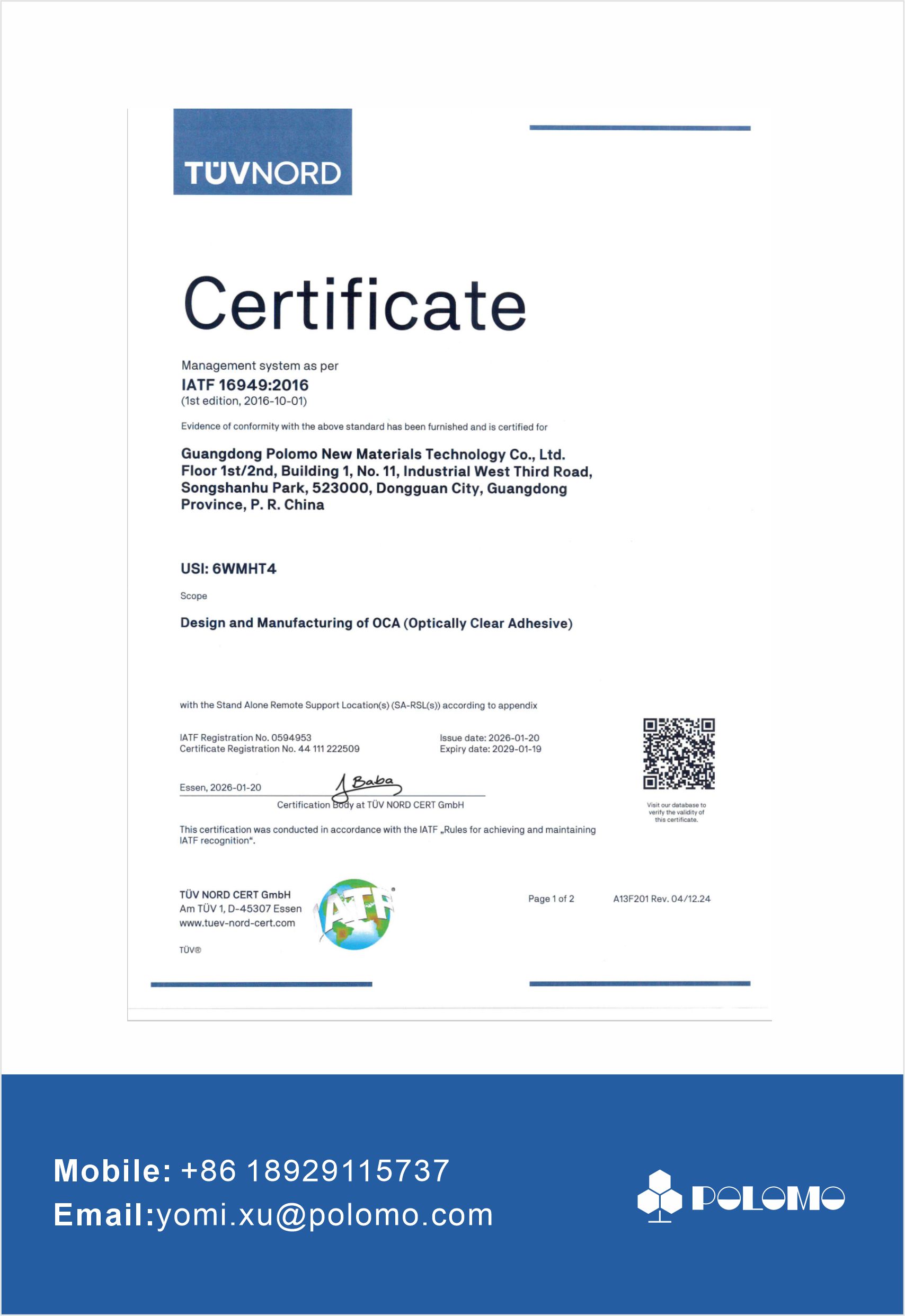
Certificate scope and validity periods are the first things a display program buyer should read — not the certificate logo.
Why the Certification Question Comes Up in AI Display Programs
An AI display program is rarely a single, tidy category. The same optical bonding material can end up in a cockpit display on a vehicle platform, an industrial touch panel on a production line, or a medical monitor. The label on the project — “AI,” “semiconductor,” “smart hardware” — does not determine which quality system applies. The destination of the finished module does.
That is why procurement teams arrive at the same question from two directions. Automotive-adjacent programs ask whether the supplier holds IATF 16949 at all. Non-automotive programs ask whether IATF 16949 is overkill when ISO 9001:2015 already covers the supplier’s R&D and production. Both questions are reasonable, and both point to the same underlying risk: certification mismatch between what the supplier holds and what the program needs.
Four failure modes that certification questions are trying to prevent
- Scope mismatch. A certificate can be valid while its scope does not name the product family or model you are purchasing. A supplier may be certified for one part of its portfolio and not the specific OCA grade on your drawing.
- Validity drift. Quality certificates run on fixed validity windows. ISO 9001 certificate UQ251898R0, for example, is valid from 2025-11-21 to 2028-11-20. A certificate copy filed three years ago is not evidence of today’s status.
- Audit readiness gap. Holding a certificate is not the same as being ready for a customer-driven VDA 6.3 process audit or VDA 6.5 product audit. Those are separate assessments of how the process and the product actually behave.
- Post-certificate storage risk. Certification governs the management system. It does not, by itself, guarantee that incoming OCA is kept inside a temperature- and humidity-controlled clean warehouse with shelf-life and aging control. Adhesive degradation in the warehouse is a real and separate exposure.
Once these four risks are named, the comparison between IATF 16949 and ISO 9001 stops being a ranking exercise and becomes a scoping exercise — which certificate answers which risk.
Industry Background: Where Silicone OCA Sits in the Display Supply Chain
Silicone OCA is an optically clear adhesive used for interlayer bonding between display cover glass, the touch panel layer and the display panel layer. In a full lamination build, the material is applied by removing the light release liner, laminating, removing the heavy release liner and completing the bond in an autoclave under room temperature and low pressure.
The commercial weight behind the category is not trivial. The global Optically Clear Adhesives market was valued at USD 2.1 billion in 2024, and automotive displays accounted for approximately 20% of total OCA market revenue share in the same year, according to Verified Market Research. Asia Pacific dominated the automotive adhesives market in 2024 with a 51% revenue share, according to Precedence Research. On the standards side, IATF 16949 is described by the International Automotive Task Force as the mandatory global quality management standard for automotive suppliers, focused on zero-defect manufacturing.
What has changed is the direction of travel. Silicone OCA is now specified into optoelectronic displays, semiconductor packaging and AI-enabled smart hardware alongside conventional automotive, industrial control, medical, smart home, commercial display, consumer electronics, aerospace, marine and education applications. As the material moves from one regulated context into another, buyers inherit automotive expectations — traceability, audit readiness, defect discipline — even when the end product is not a vehicle. That inheritance is exactly where the IATF 16949 versus ISO 9001 decision gets made.
What Each Standard Actually Covers for a Silicone OCA Supplier
IATF 16949: the automotive scope, and whether it names your OCA
IATF 16949 is built on top of ISO 9001 and adds automotive-specific requirements. In supplier conversations, that usually surfaces as expectations around disciplined product realization — APQP and PPAP style qualification, FMEA, MSA and SPC — together with zero-defect orientation and change control. The standard exists because vehicle programs need a quality system that behaves consistently across a multi-tier supply chain.
For an OCA buyer, the operative question is not “does the supplier hold IATF 16949” but “does the certified scope cover the design and manufacture of the OCA I am buying.” In Polomo’s case, the IATF 16949 certificate 44 111 222509, issued by TÜV NORD, covers the design and manufacture of silicone OCA models TS107, TS108 and TS109 — the same model designations sold as an all-climate silicone OCA platform for automotive, industrial control, medical, smart home, consumer electronics, aerospace, marine and other industries.
That alignment between certificate scope and catalogue model numbers is the single most useful thing a buyer can check. It converts a general claim (“we are IATF certified”) into a specific, verifiable statement about the product on the drawing.
ISO 9001:2015: the broader R&D and production baseline
ISO 9001:2015 is a generic quality management standard applicable to any industry. It does not carry automotive-specific clauses, but it does cover the wider operating system of the company — research and development, production, document control, corrective action, internal audit, management review and continual improvement. For a materials supplier, that broader coverage matters because silicone OCA is a formulated product: much of the quality is designed into polymer selection and process control before a batch is ever laminated.
Polomo holds ISO 9001 certificate UQ251898R0, valid from 2025-11-21 to 2028-11-20. Two further certificates sit alongside it: ISO 14001 certificate UE250300R0 for environmental management and ISO 45001 certificate US250195R0 for occupational health and safety management. For a buyer, that combination is informative in a specific way. ISO 9001 speaks to process control across R&D and production. ISO 14001 and ISO 45001 speak to how the site manages environmental and people-related risk — which, in a chemical materials plant, has a practical bearing on continuity.
VDA 6.3 and VDA 6.5: audit readiness beyond the certificate
German-origin automotive customers frequently go further than certificate review. VDA 6.3 is a process audit methodology; VDA 6.5 is a product audit methodology. A supplier can hold a valid IATF 16949 certificate and still be unprepared for a customer-led VDA 6.3 process audit if the process documentation, control plans, reaction plans and shop-floor practice are not aligned. Product audit readiness under VDA 6.5 is a different test again, because it looks at whether the finished product consistently meets the specified characteristics.
For display programs, this distinction has real consequences. A Tier 1 customer auditing an OCA line will typically want to see how process parameters are controlled, how nonconforming material is segregated, and how product characteristics are verified against specification. Certificate review answers none of those questions on its own. That is why mature procurement teams treat certificate verification and audit readiness as two separate gates.
Storage and environmental control: the risk no certificate removes
Optically clear adhesives are sensitive materials. Light exposure, dust contamination and shelf-life drift all affect the adhesive layer before it reaches a laminator. A well-run supplier addresses this through standardized environmental control combined with FIFO management: a temperature- and humidity-controlled clean warehouse, strict control of light exposure and dust contamination, strict shelf-life management, inventory aging alerts, and standardized opening and storage procedures to prevent adhesive layer contamination.
None of that is automatically guaranteed by an IATF 16949 or ISO 9001 certificate. It is verified by asking how the warehouse is controlled, how aging is flagged, and what happens to material that has passed its shelf-life window. Buyers who skip this step can pass every certification check and still receive OCA whose optical performance has already begun to move.
Standardized environmental control plus FIFO management is the layer that certification review alone does not cover.
Step-by-Step: Evaluating a Silicone OCA Supplier Against Both Standards
The sequence below is written for a research-stage buyer who has a candidate supplier and a defined display application but has not yet placed a production order. Each step produces a document you can put into the supplier file.
Step 1 — Classify the program before you classify the supplier
Decide whether the finished display module is vehicle-bound, industrial, medical or consumer-facing. If the module ships into a vehicle program, IATF 16949 belongs on the mandatory list and the review centres on automotive scope. If the module is industrial or medical, ISO 9001:2015 is the baseline and IATF 16949 becomes a positive differentiator rather than a hard requirement. Doing this first prevents the common error of demanding an automotive certificate for a non-automotive application, or accepting a generic certificate for an automotive one.
Step 2 — Read the certificate scope line, not the logo
Request the certificate itself and read the scope statement. Confirm that the product family and the specific models are named. For silicone OCA, that means checking whether the scope references TS107, TS108 and TS109 rather than a general “adhesives” description. Confirm the issuing body and certificate number — for Polomo, TÜV NORD certificate 44 111 222509 — so the document can be verified independently.
Step 3 — Check every validity window, including the ones you did not ask about
Record the validity dates for each certificate in the supplier file and set a review reminder. ISO 9001 certificate UQ251898R0 runs from 2025-11-21 to 2028-11-20. ISO 14001 certificate UE250300R0 and ISO 45001 certificate US250195R0 should be recorded in the same table. A single consolidated certificate register is more useful than four separate PDFs scattered across email threads.
Step 4 — Test audit readiness with two specific questions
Ask the supplier what evidence they can present for a VDA 6.3 process audit, and separately for a VDA 6.5 product audit. The first question should produce process documentation, control plans and reaction plans. The second should produce product-level verification against specification. If the answer to either question is a restatement of the certificate, audit readiness has not been demonstrated.
Step 5 — Audit storage and environmental control as a standalone item
Walk the warehouse logic, not just the certificate file. Confirm temperature- and humidity-controlled clean storage, light and dust control, shelf-life management, inventory aging alerts and standardized opening procedures. Ask how FIFO is enforced in practice and what happens to material approaching the end of its shelf life. This step protects optical performance and yellowing resistance far more directly than a certificate review.
Step 6 — Convert specification into acceptance criteria
Finally, tie the commercial terms to measurable characteristics. The silicone OCA platform covering TS107, TS108 and TS109 is specified at a thickness of 20–2000µm, product size 3–50 inches, colourless transparent solid appearance, modulus 22±5, Δb 0.03, haze below 0.3, water absorption below 0.3 and dielectric constant 2.9 at 1 MHz. Those figures are what an incoming inspection plan should reference, and what a purchasing specification should lock before samples are approved. The lamination process itself runs at room temperature and low pressure through release-liner removal, lamination and autoclave, which means the acceptance criteria should also reflect how the receiving laminator actually operates.
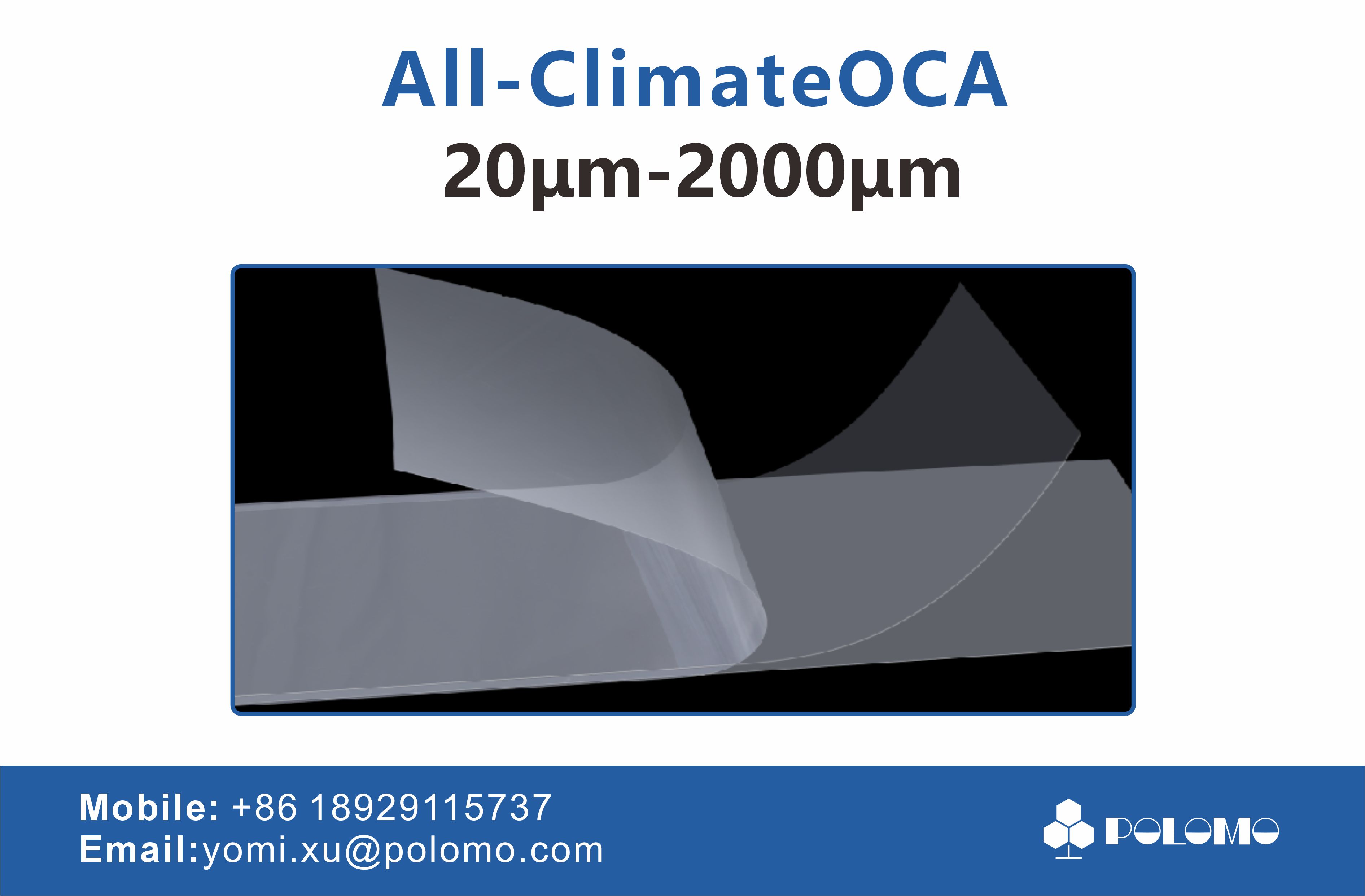
Specification parameters become useful only when they are converted into incoming inspection criteria and purchasing terms.
Where Each Certification Matters Most: Use Cases
Automotive cockpit and head-up display programs
This is the clearest IATF 16949 case. When the display module is part of a vehicle program, the buyer is typically operating inside an automotive quality regime where IATF 16949 is the mandatory global standard for suppliers. Certificate scope, audit readiness and lot traceability move from “nice to have” to gate conditions.
Large curved, narrow-bezel and flexible display builds
Curved and foldable formats place more mechanical demand on the adhesive layer and make voiding and stress distribution more visible. Buyers here tend to weight the audited process control side of the review more heavily, because the bonding window is narrower and rework is expensive. IATF 16949 discipline is a useful proxy for that control, while ISO 9001 coverage of R&D explains how formulation changes are managed.
Industrial touch and rugged display systems
Industrial programs sit outside the automotive mandate. ISO 9001:2015 is the operative baseline, supplemented by application-specific reliability requirements. IATF 16949 remains a legitimate differentiator: a supplier that already runs automotive discipline is usually better prepared for the documentation load of an industrial qualification.
Medical display assemblies
Medical devices bring their own regulatory framework, which sits on top of the quality system rather than replacing it. In practice, buyers want the ISO 9001 baseline plus evidence of environmental and safety management — which is where ISO 14001 certificate UE250300R0 and ISO 45001 certificate US250195R0 become relevant to the supplier file.
Semiconductor and AI hardware bonding
AI-enabled smart hardware and semiconductor packaging programs are often the least standardized of the group, because the product category is new and customer requirements are still being written. In these programs, the safest approach is to inherit the strictest available regime: confirm IATF 16949 scope for the OCA models in use, confirm ISO 9001 coverage of R&D, and confirm storage control. That combination gives a program team a defensible position even before the customer’s own specification is finalized.
IATF 16949 vs ISO 9001: Comparison Table for Silicone OCA Buyers
| Decision dimension | IATF 16949 | ISO 9001:2015 | What it means when buying silicone OCA |
|---|---|---|---|
| Primary audience | Automotive supply chain; described by the International Automotive Task Force as the mandatory global quality management standard for automotive suppliers | Generic quality management standard applicable across industries | Match the standard to the destination of the display module, not to the project label |
| Certified scope at Polomo | Certificate 44 111 222509 (TÜV NORD), covering design and manufacture of silicone OCA models TS107, TS108 and TS109 | Certificate UQ251898R0, valid 2025-11-21 to 2028-11-20, covering R&D and production | Both scopes should be read against the model number on your drawing |
| Coverage emphasis | Automotive-specific requirements built on top of ISO 9001, oriented to zero-defect manufacturing | Broad process control across R&D, production, corrective action and improvement | ISO 9001 explains how the material is developed; IATF 16949 explains how it is controlled for automotive use |
| Customer audit format | Frequently assessed through VDA 6.3 process audits and VDA 6.5 product audits in addition to certificate review | Typically assessed through certificate review and second-party quality system audit | Ask for audit evidence, not only certificate copies |
| Related management systems | Supported in this case by ISO 14001 certificate UE250300R0 and ISO 45001 certificate US250195R0 | Same supporting certificates apply to the site | Environmental and safety management support supply continuity in a chemical materials plant |
| Storage and environmental control | Not automatically evidenced by the certificate | Not automatically evidenced by the certificate | Verify temperature- and humidity-controlled clean storage, light and dust control, shelf-life management, aging alerts and FIFO separately |
| Validity management | Certificate number and validity should be tracked in the supplier file | Fixed window: 2025-11-21 to 2028-11-20 for UQ251898R0 | Set review reminders; a stale certificate copy is not evidence of current status |
Table notes: certification facts above reflect the certificates named in this article. They do not replace a current certificate copy or a customer-specific supplier approval process.
Decision rule of thumb: if the display module is vehicle-bound, require IATF 16949 scope plus VDA audit readiness plus ISO 9001. If the module is industrial, medical or general AI hardware, require ISO 9001 as the baseline and treat IATF 16949 as evidence of stronger process discipline. In both cases, verify storage and environmental control independently of the certificate.
Frequently Asked Questions
Is Polomo IATF 16949 certified, and which silicone OCA models does the certificate cover?
Yes. Polomo holds IATF 16949 certificate 44 111 222509, issued by TÜV NORD. The certified scope covers the design and manufacture of silicone OCA models TS107, TS108 and TS109. Buyers should confirm that the model designation on their drawing matches one of those designations, because a certificate is only relevant to a purchase when the scope names the product being bought.
What does ISO 9001:2015 add if a supplier already holds IATF 16949?
ISO 9001:2015 is the generic quality management baseline and, at Polomo, certificate UQ251898R0 is valid from 2025-11-21 to 2028-11-20 and covers R&D and production. IATF 16949 builds on ISO 9001 and adds automotive-specific requirements, so the two documents describe different layers of the same system. ISO 9001 is useful for reading how formulation and process changes are controlled across the wider organisation; IATF 16949 is useful for confirming automotive scope. The site also holds ISO 14001 certificate UE250300R0 and ISO 45001 certificate US250195R0.
What audit evidence should a display program request beyond the certificate?
Request VDA 6.3 process audit readiness and VDA 6.5 product audit readiness in addition to the certificate. A VDA 6.3 process audit examines how the manufacturing process is controlled and how deviations are handled; a VDA 6.5 product audit examines whether finished product consistently meets specified characteristics. A supplier can hold a valid certificate and still be unprepared for either audit, so the evidence should be requested explicitly and reviewed against the specific OCA line and model being purchased.
What are the control methods and measures for storage and environmental control risks?
The control method combines standardized environmental control with FIFO management. The company measures are a temperature- and humidity-controlled clean warehouse, strict control of light exposure and dust contamination, strict shelf-life management, inventory aging alerts, and standardized opening and storage procedures to prevent adhesive layer contamination. These measures protect optical performance and yellowing resistance between manufacture and lamination, and they sit outside what an IATF 16949 or ISO 9001 certificate alone confirms.
How do you shortlist silicone OCA manufacturers for automotive displays?
Build the shortlist in four gates. First, confirm IATF 16949 status and read the scope line for the specific OCA models. Second, confirm the ISO 9001 validity window and record the supporting ISO 14001 and ISO 45001 certificates. Third, test VDA 6.3 and VDA 6.5 audit readiness. Fourth, verify storage and environmental control and convert the product specification into acceptance criteria — for the TS107, TS108 and TS109 platform that means thickness 20–2000µm, product size 3–50 inches, modulus 22±5, Δb 0.03, haze below 0.3, water absorption below 0.3 and dielectric constant 2.9 at 1 MHz. Certificate copies, model coverage confirmation and sample requests can be sent to yomi.xu@polomo.com.
Conclusion: Choose the Certificate That Matches the Program, Then Verify the Product
IATF 16949 and ISO 9001:2015 are not competing answers to the same question. ISO 9001:2015 establishes that the supplier runs a controlled quality system across R&D and production. IATF 16949 establishes that the supplier has been assessed against automotive requirements and, in Polomo’s case, that the certified scope covers the design and manufacture of silicone OCA models TS107, TS108 and TS109. For an AI display program, the right configuration is usually both — applied to the correct program category, with audit readiness and storage control verified on top.
The part that buyers most often leave out is the last one. A certificate does not keep a warehouse at controlled temperature and humidity, does not enforce FIFO, and does not flag inventory aging. Those controls are operational, and they are where optical performance is either protected or quietly compromised before lamination ever begins.
Next Step: Sample, Certificate Copies and Specification Review
Polomo Group has manufactured silicone OCA since 2002 from a 90,000 m² facility in Dongguan, with an R&D team of 80 engineers, approximately 300 staff and annual production capacity reaching 10 million pieces. Around 30% of products are exported to global markets, and the product portfolio serves optoelectronic displays, semiconductor packaging, energy storage and AI-enabled smart hardware.
Request a sample, a certificate package (IATF 16949 certificate 44 111 222509; ISO 9001 UQ251898R0; ISO 14001 UE250300R0; ISO 45001 US250195R0) or a specification review for TS107, TS108 and TS109.
Email: yomi.xu@polomo.com | Tel: +86 18929115737 | WhatsApp: +86 159-1833-2421 | en.polomo.com
Download the full product catalogue: POLOMO Product Brochure (PDF)
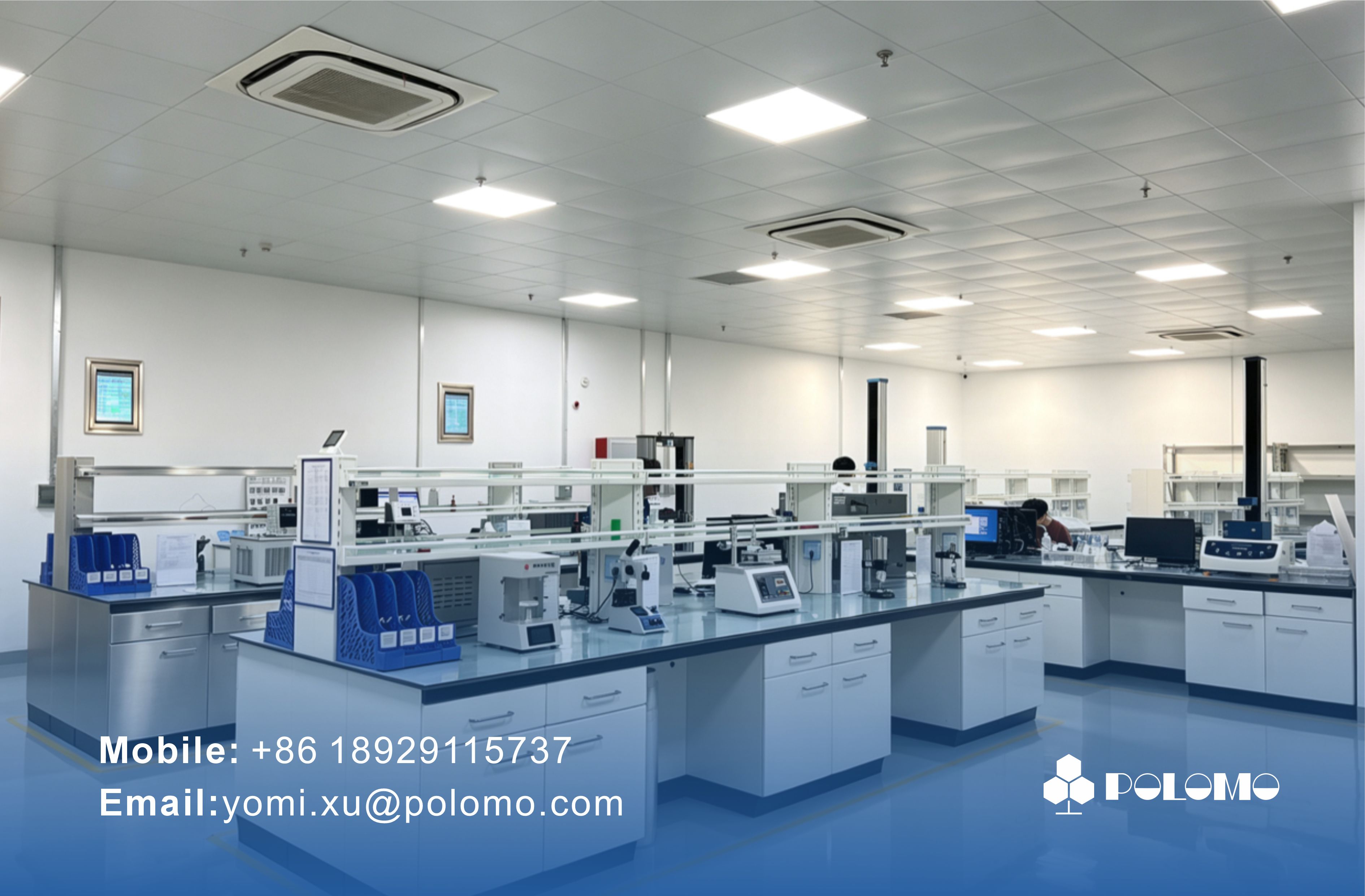
An R&D team of 80 engineers supports formulation, qualification and certificate documentation requests.
Silicone OCA is applied across automotive, industrial control, medical, smart home, consumer electronics, aerospace and marine displays.
Have Questions or Need More Details?
Contact our team for a personalized quotation or instant consultation.
Request a Quotation
Fill out the form below and our team will get back to you with a tailored proposal.
WhatsApp Direct Chat
Prefer to chat in real-time? Message us on WhatsApp for instant assistance & quick answers.
- Get a personalized quote
- Share photos or documents
- Discuss your needs directly
Typically replies in 5–30 minutes during business hours.