
Custom Silicone OCA OEM for Automotive Displays: What to Verify
Custom Silicone OCA OEM for Automotive Displays: What to Verify
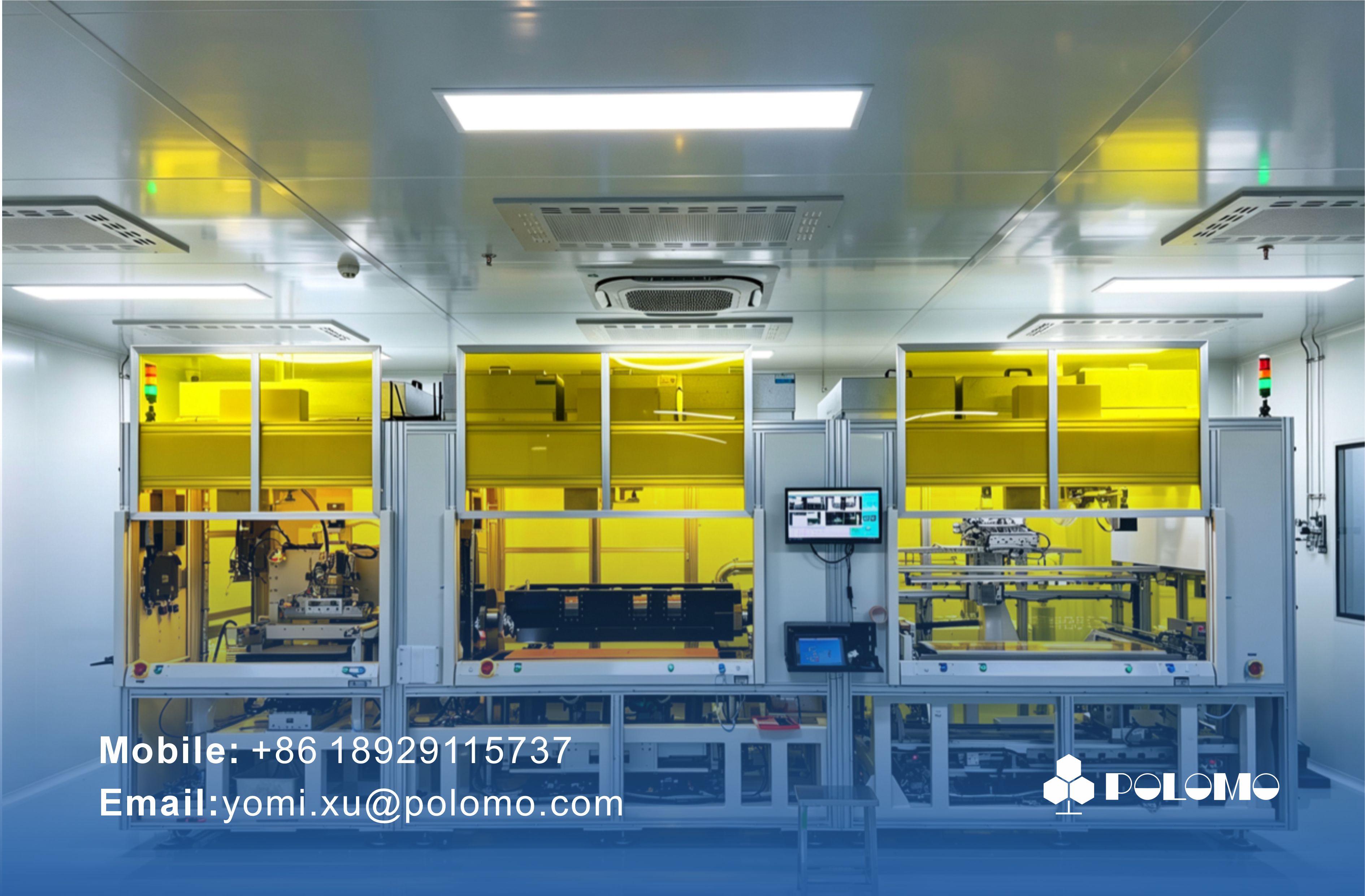
When a display program moves from concept to sourcing, one question comes up repeatedly: is the silicone OCA supplier able to do more than supply a standard material? For automotive displays, the answer affects qualification time, lamination yield, and program risk. This guide focuses on the practical checks a buyer should run when evaluating a custom silicone optical bonding OCA OEM for automotive displays. It uses the capability profile of Guangdong Polomo New Materials Technology Co., Ltd (Polomo) as a working example.
Polomo is an OBM manufacturer of silicone OCA, founded in 2002. The company integrates R&D, manufacturing, and sales, and its product applications span automotive, industrial control, medical, smart home, commercial display, consumer electronics, aerospace, marine, and education sectors.
Problem Definition
Procurement and engineering teams face a common problem. The material data sheet does not tell the whole story. A custom silicone OCA program may require specific thickness, die-cut dimensions, consistent optical quality, and automotive-grade process control. If the manufacturer lacks OBM production experience or qualified production systems, the risk shows up later: bubbles, mura, yellow spots, rework delays, and rejected lots. The buyer therefore needs a capability verification framework before committing to a supplier.
For Tier 1 programs, the evaluation is even stricter. Suppliers are expected to demonstrate IATF 16949 compliance, process maturity, field experience, and the ability to support production-ramp issues. The following sections translate these expectations into a practical checklist.
Industry Background
The optical clear adhesives market was valued at approximately USD 2.1 billion globally in 2024, and automotive displays accounted for about 20% of that revenue, according to Verified Market Research. Grand View Research estimated the global automotive silicone market at around USD 10.2 billion in 2024. Fortune Business Insights projects that silicone-based adhesives in automotive will grow at a CAGR of 8.8% from 2025 to 2032. Precedence Research reports that Asia Pacific held a 51% revenue share of the automotive adhesives market in 2024.
These figures point to a clear trend: display lamination is shifting from generic OCA to application-specific silicone OCA. For large curved automotive displays, industry guidance from Cevians identifies low-modulus silicone OCA as a way to prevent Mura under thermal stress. In addition, IATF 16949 is described by the International Automotive Task Force as the mandatory global quality management standard for automotive suppliers, focused on zero-defect manufacturing.
For reference, Rogers Corporation states that advanced silicone materials used in optical bonding for automotive applications can be rated for temperature extremes of -55°C to +200°C. This is an industry benchmark, not a Polomo specification. Buyers should request actual temperature data from any candidate supplier. Meanwhile, Dow's Display Week 2024 materials highlight UV resistance and anti-yellowing as priorities for automotive cockpit durability.
Global leaders in the automotive silicone and adhesives market include Dow, Wacker Chemie, and Shin-Etsu, according to MarketsandMarkets. For smaller-volume or custom programs, however, buyers still need suppliers that can combine automotive-grade quality with flexible customization. That is where a capability-first assessment becomes valuable.
Detailed Solution: Capability Evidence from Polomo
Guangdong Polomo New Materials Technology Co., Ltd is an OBM manufacturer of silicone OCA. The company operates a 90,000-square-meter production base with 300 employees and reports an annual output of 10 million pieces. Its R&D team includes 80 engineers, and about 30% of output is exported to global markets.
For automotive applications, Polomo holds IATF 16949:2016 certification with certificate number 44 111 222509, issued by TÜV NORD CERT GmbH. The certified scope is 'Design and Manufacturing of OCA', and the certificate is valid through 2029-01-19. The company also maintains ISO 9001:2015, ISO 14001:2015, and ISO 45001:2018 management system certifications. In addition, it has completed VDA6.3:2023 and VDA6.5:2020 training attendance through TÜV NORD BU Certification China, and it is D-U-N-S registered (number 52-969-0297).
From a product standpoint, Polomo's silicone OCA series TS107, TS108, and TS109 are all-climate OCAs. The range covers thickness from 20 to 2000 μm and product size from 3 to 50 inches. Reported parameters include a modulus of 22±5, Δb of 0.03, haze below 0.3, water absorption below 0.3, and dielectric constant of 2.9 at 1 MHz. These are the kind of figures that allow a lamination engineer to compare the material against program requirements.
Customization covers thickness and dimensions, which is typical for display programs that need die-cut parts, specific gap fills, or alignment with different cover glass and panel stacks. Production capacity is approximately one million pieces per month, and standard lead time is 7 to 10 working days. The MOQ is to be discussed, which gives buyers flexibility during pilot and pre-launch phases.
Quality control includes 100% pre-shipment testing. The company also uses temperature- and humidity-controlled clean warehouse storage, FIFO management, shelf-life discipline, inventory aging alerts, and standardized opening and storage procedures to prevent adhesive layer contamination. These controls matter because silicone OCA performance can be affected by light, dust, humidity, and aging before it reaches the laminator.
For field support, Polomo provides 8D customer complaint handling, online and on-site production line support, root cause analysis, and continuous improvement based on customer pain points. This is the kind of after-sales structure that Tier 1 customers expect when a lamination issue appears during production.
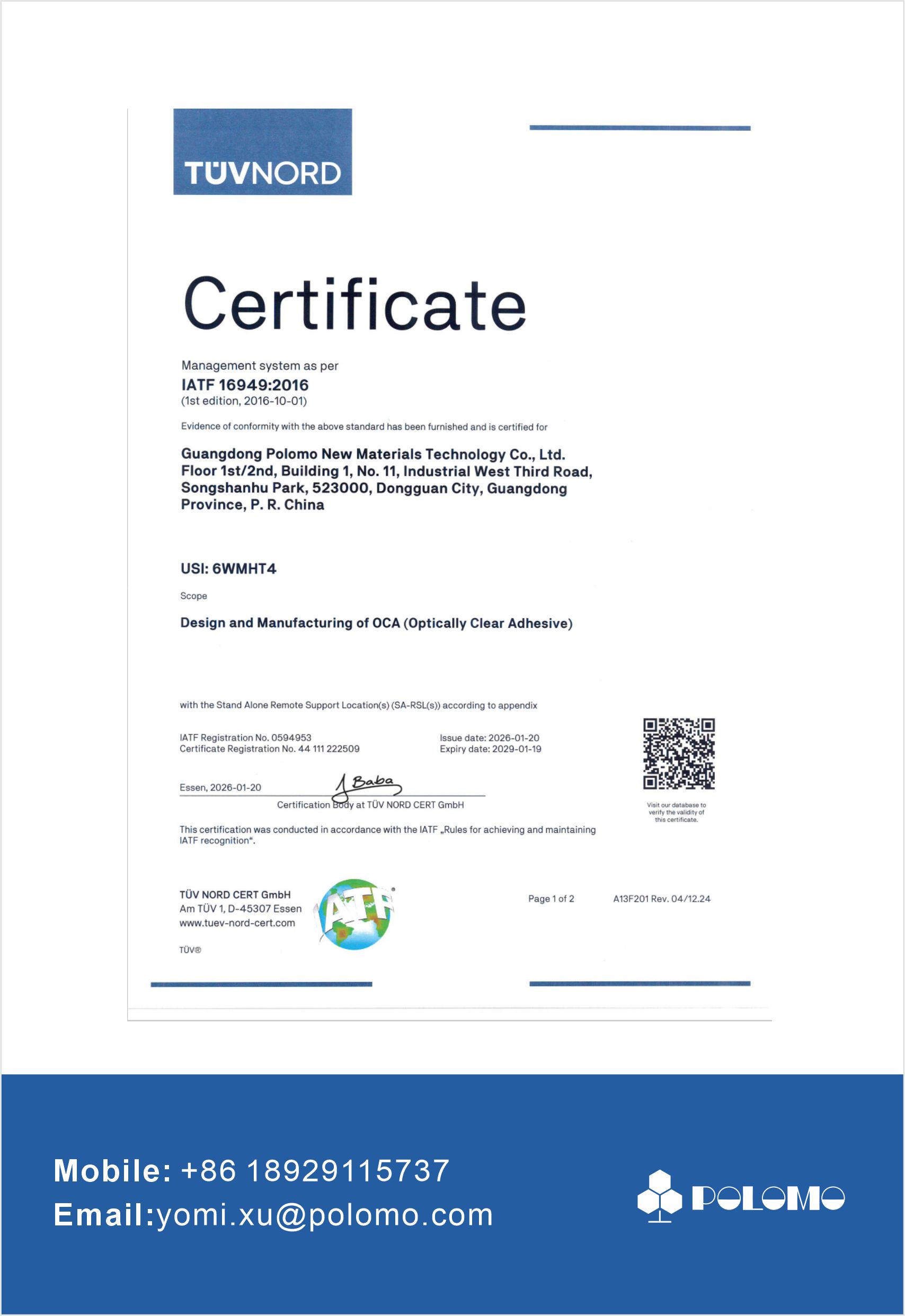
IATF 16949 certification covers the design and manufacturing of OCA at Polomo.
Step-by-Step Breakdown: How to Evaluate a Custom Silicone OCA OEM
Use the following six steps as a capability checklist. Each step lists what to ask and what Polomo can show.
- Verify automotive quality certification. Ask for the IATF 16949 certificate, certificate number, issuing body, scope, and validity. Polomo's IATF 16949:2016 certificate, issued by TÜV NORD CERT GmbH and valid through 2029-01-19, covers OCA design and manufacturing. Supporting certifications include ISO 9001, ISO 14001, ISO 45001, and VDA6.3/6.5 training.
- Assess manufacturing and R&D scale. Check factory size, staffing, R&D resources, and capacity. Polomo has a 90,000-square-meter base, 300 employees, an 80-person R&D team, annual output of 10 million pieces, and a monthly capacity of about one million pieces.
- Check customization and product range. Confirm which parameters can be customized. Polomo offers OBM production and customization of thickness and dimensions. Its TS107/TS108/TS109 series covers 20–2000 μm thickness and 3–50-inch sizes.
- Confirm quality control and storage discipline. Look for pre-shipment testing and contamination controls. Polomo performs 100% pre-shipment testing and uses temperature- and humidity-controlled clean warehouse storage with FIFO and aging alerts.
- Validate production and delivery flexibility. Understand lead time, MOQ, and trade terms. Polomo's standard lead time is 7–10 working days, MOQ is to be discussed, and delivery terms include FOB, FCA, and EXW.
- Review real field evidence. Ask for application history, vehicle models, and measured improvements. Polomo reports application in more than 120 vehicle models, with shipments exceeding 30 million pieces over more than 10 years. Documented results include a 1.5% improvement in lamination yield, 75% improvement in production efficiency, and 85% improvement in rework efficiency, with lamination issues such as bubbles, mura, and yellow spots addressed.
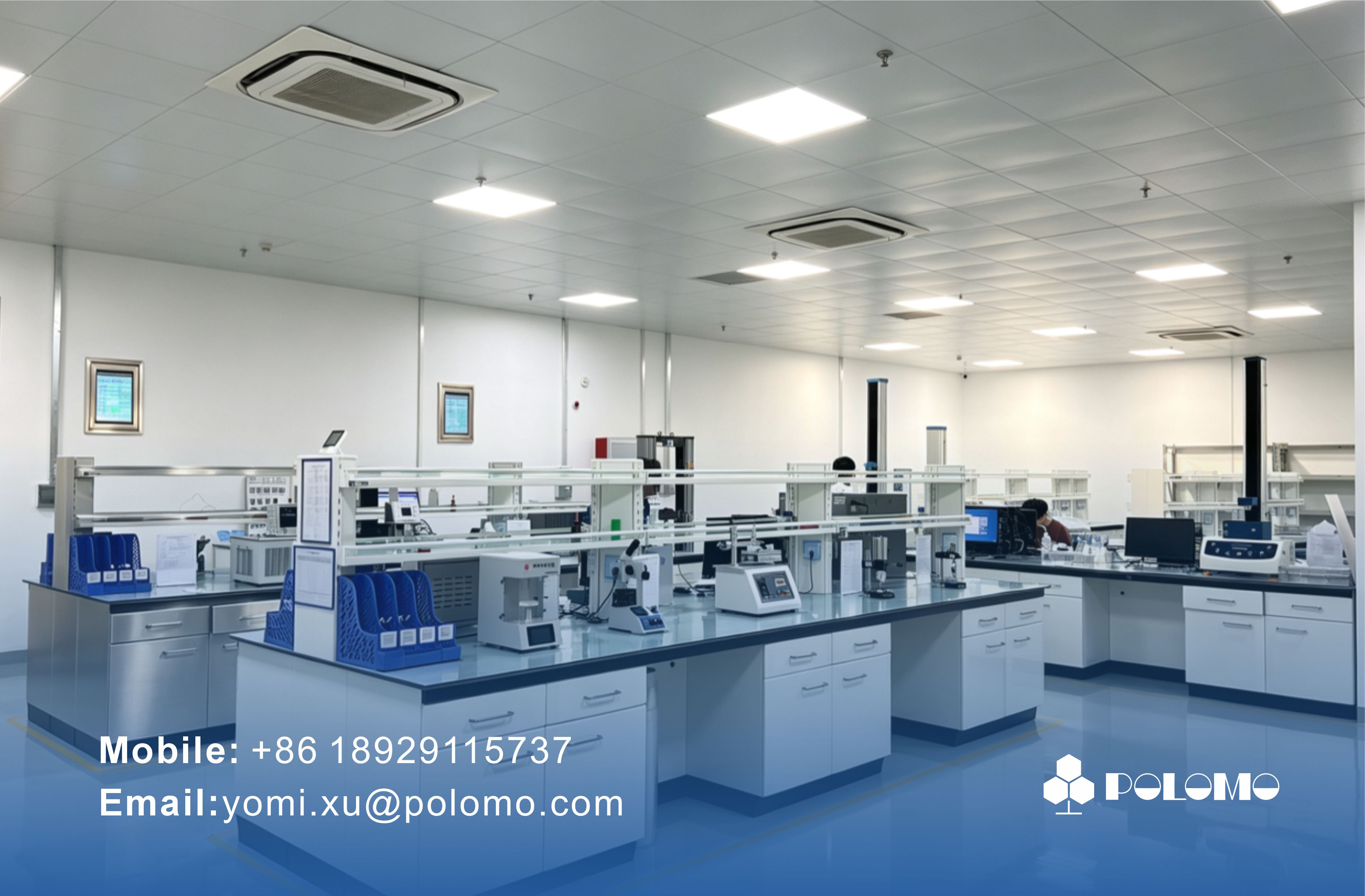
R&D capability supports custom silicone OCA development for automotive display programs.
Use Cases
The capability profile matters across display categories. Below are the scenarios where custom silicone OCA is most relevant, based on Polomo's stated application industries.
Automotive displays and smart cockpit displays. This is the core use case for automotive-grade OCA. Polomo's IATF 16949 scope covers OCA design and manufacturing, and its case history includes automotive OEMs, Tier 1 suppliers, panel makers, lamination manufacturers, and display terminal makers. For display full lamination, the operating mode is: remove light release liner, STH, remove heavy release liner, HTH, then autoclave, at room temperature and low pressure.
Large curved and narrow-bezel displays. Industry guidance indicates that large curved automotive displays need low-modulus silicone OCA to prevent Mura under thermal stress (Cevians). Buyers should compare the reported modulus (Polomo lists 22±5) and optical stability (Δb 0.03, haze below 0.3) against their lamination simulation and reliability tests. Outdoor and automotive working conditions can include wide temperature range (-40°C to 120°C), high temperature and humidity, high-altitude negative pressure, vibration, strong UV resistance, and health-certified requirements.
Industrial touch displays. Industrial control is one of Polomo's stated application sectors. For outdoor or harsh industrial environments, all-climate OCA behavior and contamination control during lamination are important selection criteria.
Medical displays. Medical is another stated application sector. In medical display programs, the supplier's process control, low odor, and ability to support clean lamination are typically evaluated.
Consumer electronics, aerospace, marine, and education displays. These sectors are listed in Polomo's application scope. Across these segments, the evaluation logic is the same: verify certification, customization, production capacity, quality control, and field evidence before qualification.
Supplier Capability Comparison Table
The table below summarizes the capability dimensions to evaluate and the evidence Polomo can provide. It is not a ranking; it is a checklist to compare against your own program requirements.
| Capability Dimension | Why It Matters | Polomo Evidence |
|---|---|---|
| Quality system certification | Confirms automotive-grade process control for OCA | IATF 16949:2016 (No. 44 111 222509); ISO 9001:2015; ISO 14001:2015; ISO 45001:2018; VDA6.3/6.5 training |
| Manufacturing model | Verifies the supplier controls its own production process | OBM production services |
| Customization scope | Ensures adaptation to program requirements | Customization of thickness and dimensions; TS107/108/109 series; thickness 20–2000 μm; size 3–50 in. |
| Production capacity | Supports ramp-up and steady supply | ~1 million pieces/month; 10 million pieces annual output; 90,000㎡ facility; 300 staff; 80 R&D engineers |
| Quality control | Reduces defective incoming material | 100% pre-shipment test; temperature- and humidity-controlled warehouse; FIFO; aging alerts |
| Field experience | Reduces technical risk in full lamination | 10+ years; 120+ vehicle models; 30M+ pieces shipped; yield +1.5%; efficiency +75%; rework +85% |
| After-sales support | Helps resolve line issues quickly | 8D complaint handling; online/on-site support; root cause analysis |
| Commercial terms | Defines flexibility for global buyers | MOQ to be discussed; FOB/FCA/EXW; payment before shipment or monthly settlement |
FAQ
1. Is Polomo an IATF 16949 certified silicone OCA OEM for automotive displays?
Yes. Polomo holds IATF 16949:2016 certificate number 44 111 222509, issued by TÜV NORD CERT GmbH, with scope 'Design and Manufacturing of OCA', valid through 2029-01-19. It also maintains ISO 9001, ISO 14001, ISO 45001, as well as VDA6.3/6.5 training records.
2. What silicone OCA customization options does Polomo offer?
Polomo provides OBM production services and supports customization of thickness and dimensions. The TS107, TS108, and TS109 series covers thickness from 20 to 2000 μm and product size from 3 to 50 inches.
3. Can Polomo support cost-effective silicone OCA supply?
Polomo's cost structure is supported by a 90,000-square-meter factory, 300 employees, annual output of 10 million pieces, and 100% pre-shipment testing. The MOQ is to be discussed, allowing buyers to align order sizes with program budgets.
4. How can I get custom silicone OCA samples?
Sample requests are handled by the Polomo sales team. Contact yomi.xu@polomo.com or +86 18929115737. The company also provides online and on-site production line support.
5. What is the lead time for custom silicone OCA production?
Standard production lead time is 7 to 10 working days. With a monthly capacity of approximately one million pieces and 100% pre-shipment testing, Polomo supports schedule-driven programs. For custom thickness and dimension variants, contact the team to confirm specific timing.
Conclusion
A custom silicone OCA OEM for automotive displays should be judged on documented capability, not generic claims. Polomo presents a coherent profile: OBM manufacturing, IATF 16949 certification, defined customization, measured quality control, field evidence across 120+ vehicle models, and after-sales support. For engineering and procurement teams in the Evaluation to Execution stage, the next step is to request samples and compare capabilities against your actual lamination process.
For sample requests, specifications, or a detailed discussion, contact Yomi Xu at yomi.xu@polomo.com or +86 18929115737. You can also download the POLOMO Product Brochure for a complete product overview.
Guangdong Polomo New Materials Technology Co., Ltd
Building 6, No. 11, Industrial West 3rd Road, Songshan Lake Industrial Park, Dongguan City, Guangdong Province, China
Email: yomi.xu@polomo.com | Tel: +86 18929115737 | WhatsApp: +86 159-1833-2421
Have Questions or Need More Details?
Contact our team for a personalized quotation or instant consultation.
Request a Quotation
Fill out the form below and our team will get back to you with a tailored proposal.
WhatsApp Direct Chat
Prefer to chat in real-time? Message us on WhatsApp for instant assistance & quick answers.
- Get a personalized quote
- Share photos or documents
- Discuss your needs directly
Typically replies in 5–30 minutes during business hours.