
Silicone OCA Selection: A Side-by-Side Comparison for Display Lamination
Silicone OCA Selection: A Side-by-Side Comparison for Display Lamination
Display engineers evaluating silicone OCA for full lamination quickly realize that a data sheet alone is not enough. The adhesive must perform optically, survive the final application environment, work within the lamination process window, and remain reliable over the lifetime of a display system. A practical side-by-side comparison makes this more manageable: compare each material option against the same evaluation questions, and then map those results to the display application you are actually building.
This article walks through a structured method for comparing silicone OCA options for display lamination. The comparison model covers optical properties, mechanical behavior, environmental durability, material emissions, handling control, and the supplier quality system behind the material. To keep the comparison concrete, the TS107, TS108, and TS109 silicone OCA series from Guangdong Polomo New Materials Technology Co., Ltd. (Polomo) is used as a reference product family.
Why display lamination decisions need a structured comparison
In a full lamination stack, silicone OCA creates the optical bond between the display cover glass, the touch panel layer, and the display panel layer. Once these layers are bonded, the adhesive is effectively inside the final device. This means defects such as optical distortion, bubbles, delamination, yellowing, or reduced light transmission can become permanent product failures.
Several requirements must be satisfied at the same time:
- The adhesive must maintain optical clarity across the visible lifetime of the product.
- It must bond to different substrates that appear in a display stack, including glass, PET, polarizers, and metal components.
- It must tolerate temperature changes, humidity, UV exposure, vibration, and sometimes high-altitude negative pressure.
- It must support a practical lamination process without introducing bubbles or contamination.
- It must be supplied with consistent quality across production volumes.
Because these requirements are interconnected, material comparisons fail if they only look at one attribute. A low haze value, for example, is meaningful only when combined with long-term yellowing resistance and environmental stability. A good low-modulus adhesive is valuable mainly when the material also has enough degassing capability and adhesion strength for the full display structure.
The decision therefore benefits from a side-by-side comparison framework. Engineers can apply the same criteria to each silicone OCA candidate, score each material against real application needs, and then select the option with the strongest overall fit rather than the strongest headline specification.
The growing context for silicone OCA in display applications
The market context helps explain why silicone OCA comparison is becoming more common among display teams. Grand View Research valued the global automotive silicone market at approximately USD 10.2 billion in 2024. In the more specific optically clear adhesives market, industry reporting from Verified Market Research estimated the global OCA market at USD 2.1 billion in 2024, with automotive displays contributing about 20 percent of OCA revenue. Silicone-based automotive adhesives are also projected by Fortune Business Insights to grow at a CAGR of 8.8 percent between 2025 and 2032.
The relevance to display engineering is clear. Automotive interiors now contain large, high-value displays. Outdoor, industrial, medical, and marine terminals also demand optical bonding materials that can withstand broad temperature windows, strong sunlight, humidity, and long service life. These are exactly the conditions where silicone-based OCA is often evaluated.
This environment makes supplier comparison more demanding. A material that meets a datasheet value in a lab may still behave differently after months of UV exposure, thermal cycling, or humid storage. This is why the comparison model below combines material parameters with process intelligence and quality-system evidence.
A side-by-side comparison model for silicone OCA
The most useful comparison model for display lamination includes six evaluation blocks:
- Optical performance and yellowing resistance.
- Mechanical properties and large-area lamination behavior.
- Environmental durability.
- Process emissions and material safety.
- Handling, storage, and contamination control.
- Manufacturing capability and supplier engineering depth.
Below, each block is turned into concrete evaluation questions. The TS107, TS108 and TS109 series from Polomo is used to show how a verified product record answers those questions.
Optical performance and yellowing resistance
The first question when comparing silicone OCA is simple: how clean and stable is the optical path? For a colorless transparent solid adhesive, the important parameters are transmittance, haze, and yellowing index change over time.
For the TS107, TS108, and TS109 silicone OCA series, the product record lists an appearance of colorless transparent solid. Haze is reported below 0.3, and the yellowing index value, expressed as Δb, is 0.03. These values describe a material that starts with low optical scatter and low color contribution.
The engineering implication is that the OCA should not reduce display contrast or shift color during normal service. A low haze value also supports readability for high-information displays found in automotive cockpits, industrial panels, and medical equipment. When comparing different silicone OCA options, optical clarity should always be checked together with the temperature and UV resistance data, because the final question is not only whether the adhesive starts transparent, but whether it remains transparent.
Mechanical behavior and large-area lamination
Another major comparison axis is mechanical behavior. Silicone OCA is often chosen for applications that require a low modulus to absorb stress between glass, touch, and display layers. This is especially relevant for large displays, curved automotive displays, and stacks exposed to thermal expansion.
Industry references, including Cevians, note that large curved automotive displays require low-modulus silicone OCA to help prevent Mura, or visual distortion, under thermal stress. The TS107, TS108 and TS109 family is defined with a modulus of 22 plus or minus 5. The product also carries low-modulus and strong degassing capability as a functional characteristic, which supports bonding efficiency and yield for large-size displays.
What should the engineer compare side by side? Look at the modulus range, but also look at how the material behaves during the debubbling step. In a full lamination process, trapped air must be removed without damaging the display stack. A silicone OCA with good degassing properties can help reduce bubble defects and improve throughput on large panels.
The TS series is offered in a wide thickness window from 20 to 2000 μm and in product sizes from 3 to 50 inches. This means the same material family can be evaluated for different stack designs, from small industrial touch panels to large automotive display modules.
Environmental durability
Display applications are moving into harsher environments. The silicone OCA selected for an automotive display may face high summer cabin temperatures, strong UV exposure, vibration, high humidity, and high-altitude negative pressure during vehicle use.
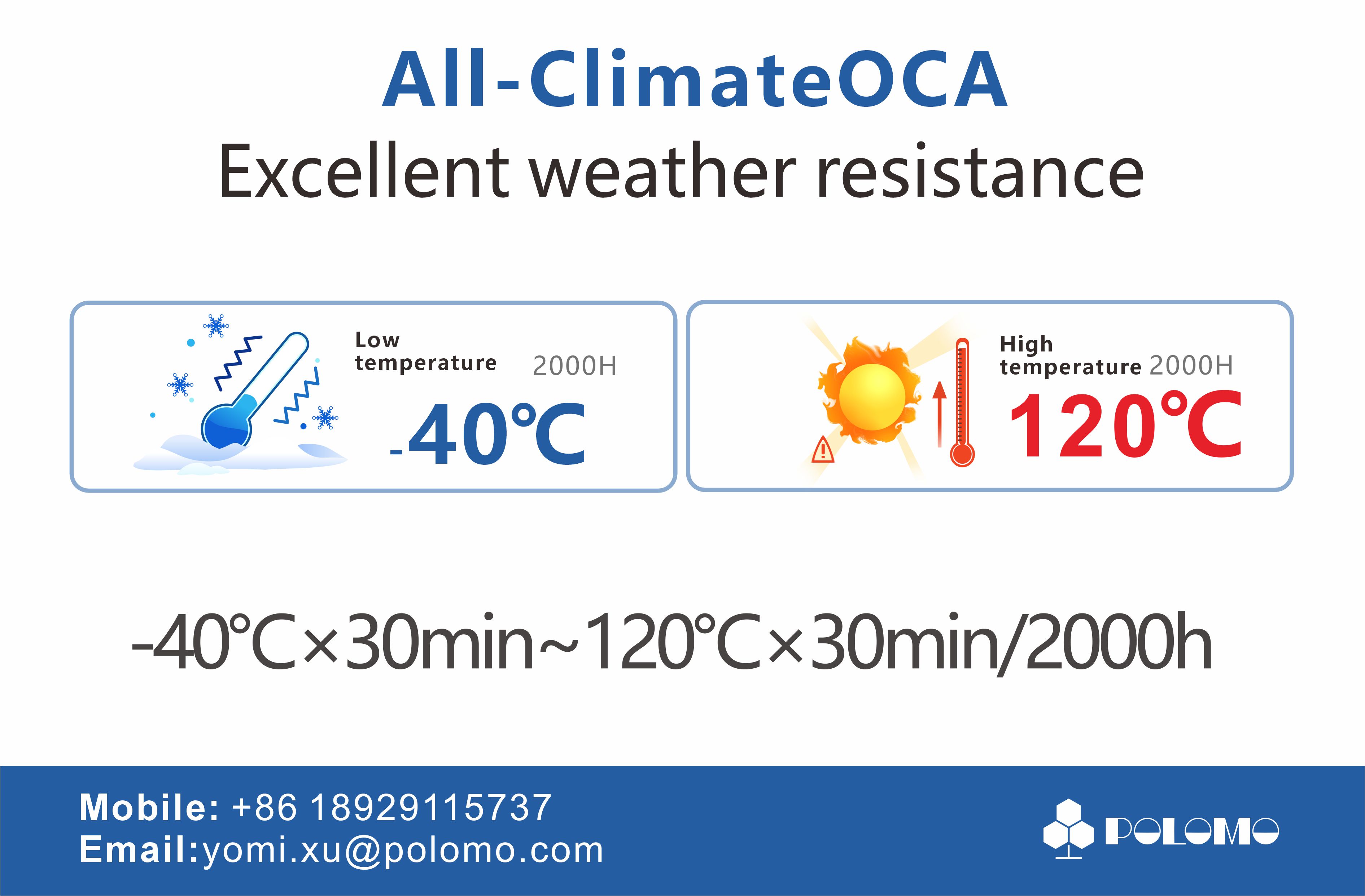
The application scenario associated with the TS107, TS108, and TS109 OCA series describes operating conditions for outdoor environments and automotive applications in a wide temperature range of -40°C to 120°C. The working profile also includes high temperature and high humidity, high-altitude negative pressure, vibration, strong UV resistance, and applications requiring health-conscious material characteristics.
For comparison purposes, this level of detail is valuable because it connects the material to real project conditions rather than abstract lab claims. Automotive display engineers should ask whether a candidate silicone OCA has evidence of stable optical and mechanical performance throughout the temperature window relevant to their vehicle platform.
The Polomo product record describes strong weather resistance, covering high and low temperatures, high humidity, high-altitude negative pressure, vibration, and UV exposure. When comparing materials side by side, these factors should be listed separately for each candidate so that the final selection reflects the specific environmental risk of the target display program.
Process emissions and material safety
Interior displays also create requirements for low odor and low volatile organic compound (VOC) behavior. Materials used inside vehicle cabins or near medical operators need to be examined for outgassing under elevated temperature conditions.
The TS107, TS108 and TS109 silicone OCA series is described with low odor and low VOC characteristics. The material is designed to show low volatilization under high-temperature conditions, offering a more environmentally friendly solution. For display teams, this matters because high-temperature outgassing can cause fogging, optical defects, or unpleasant cabin odor if an adhesive is not properly selected.
During a side-by-side comparison, engineers should request emission-related data and verify how the material behaves after prolonged exposure to elevated temperatures. A low-odor property is not only a comfort issue; it can also be a design constraint for sealed or semisealed display modules.
Handling, storage, and contamination control
Silicone OCA performance can be damaged before lamination if the material is not stored and handled correctly. Since the adhesive layer is exposed during release liner removal, contamination from dust, moisture, or light can degrade bonding quality and optical appearance.
Polomo documents its control method for storage and environmental risk as standardized environmental control plus FIFO management. Company measures include a temperature- and humidity-controlled clean warehouse, strict control of light exposure and dust contamination, strict shelf-life management, inventory aging alerts, and standardized opening and storage procedures to prevent adhesive layer contamination.
When evaluating a silicone OCA supplier, these process controls are as important as the technical data sheet. A cleanroom environment and a disciplined storage system reduce the risk of contamination-related defects in large-area lamination. Display engineers should compare the material storage and handling standards of each supplier during a factory audit or quality system review.
Manufacturing capability and supplier engineering depth
The sixth comparison block is the supplier that manufactures the silicone OCA. For automotive and industrial display programs, material supply must be consistent, scalable, and supported by engineering expertise.
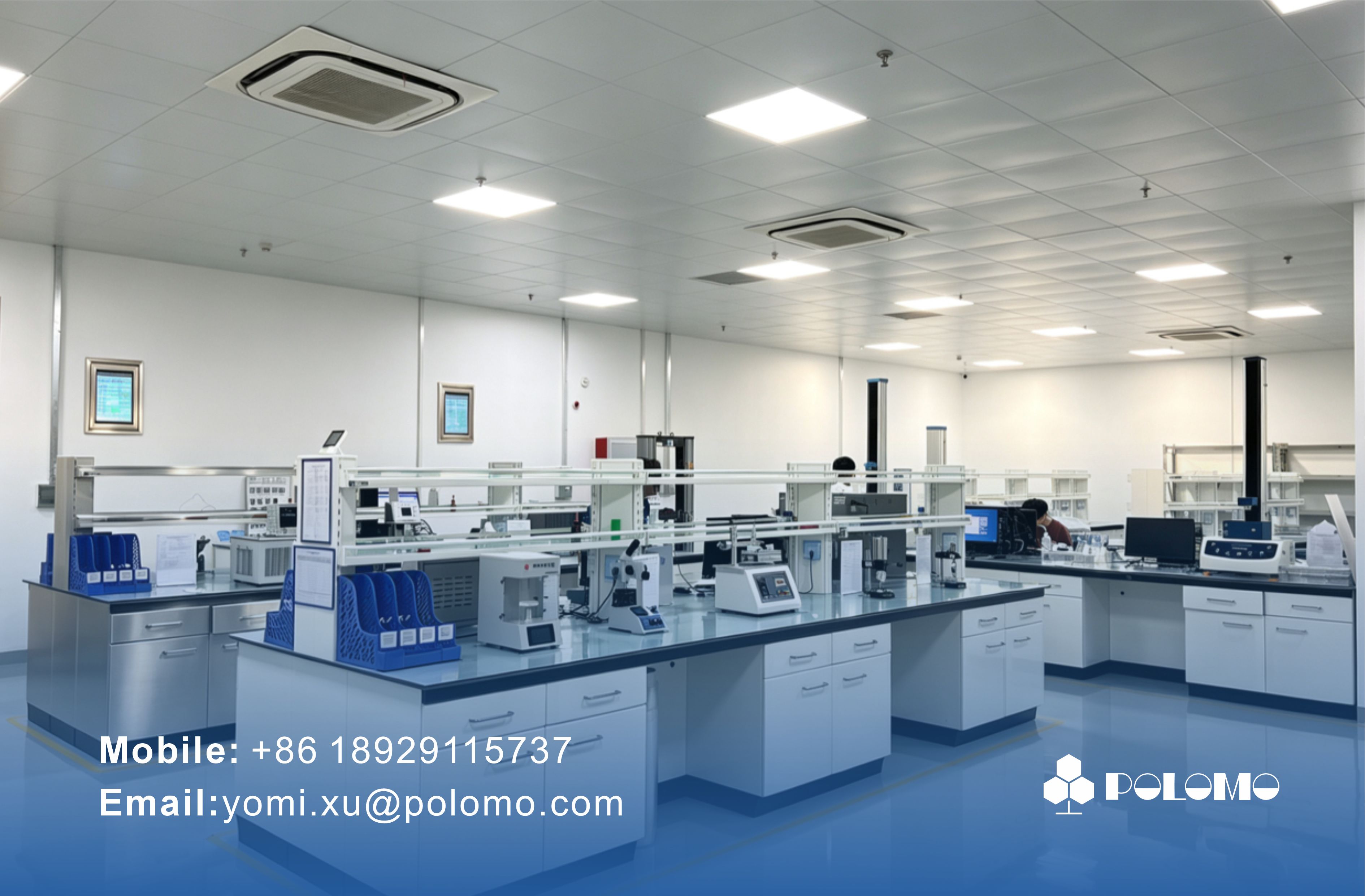
Polomo, established in 2002, is located in Songshan Lake Industrial Park, Dongguan City, Guangdong Province. The company integrates research and development, manufacturing, and sales. Its corporate mission is 'Advancing human progress through continuous innovation in chemical technology.' The company provides adhesive and functional film solutions for advanced technology sectors including optoelectronic displays, semiconductor packaging, energy storage and batteries, and AI-enabled smart hardware.
Key supplier facts for comparison include:
- Approximately 300 employees.
- A total factory area of 90,000 square meters.
- An R&D team of about 80 engineers.
- Annual production capacity of about 10 million pieces.
- Global market reach, with approximately 30 percent of products exported.
These factors matter when a display project moves from sample evaluation to volume production. A supplier with dedicated R&D engineers can support material customization and troubleshooting. A larger production base can support consistent supply during ramping demand. Global export activity suggests experience with international customer requirements and logistics.
Comparison table: evaluation question versus TS107 / TS108 / TS109 evidence
The following table summarizes a side-by-side comparison structure. The left column is the question an engineer should apply to any silicone OCA. The right column shows how the TS107, TS108, and TS109 series from Polomo answers that question, based on the documented product record.
| Evaluation question | Evidence for TS107 / TS108 / TS109 |
|---|---|
| What is the product type and intended application scope? | Silicone OCA classified as all-climate OCA. Intended for automotive, industrial control, medical, smart home appliances, consumer electronics, aerospace, marine, and other industries. |
| What optical properties can be expected? | Colorless transparent solid appearance; haze below 0.3; Δb of 0.03. |
| Can it be used for large-area display lamination? | Low modulus with a value of 22±5; strong degassing capability for large-size display bonding; product size from 3 to 50 inches; thickness range from 20 to 2000 μm. |
| What environmental conditions are covered? | Automotive and outdoor working profile from -40°C to 120°C; high temperature and humidity; high-altitude negative pressure; vibration; strong UV resistance. |
| Does it support low-emission and low-odor requirements? | Low odor and low VOC behavior; low volatilization under high-temperature conditions. |
| What substrates can it bond? | Adhesion to glass, PET, polarizers, metal, and other substrates used in display structures. |
| How does the supplier control material quality risk? | Temperature- and humidity-controlled clean warehouse; strict light and dust control; shelf-life management; inventory aging alerts; standardized opening and storage procedures. |
| Is there a full lamination process in mind? | Typical process sequence: remove light release liner, STH, remove heavy release liner, HTH, then autoclave. |
How to build a lamination decision matrix step by step
The side-by-side model becomes practical when it is converted into a decision matrix. Display engineers can use the following step-by-step method to compare silicone OCA options during a sourcing or project review.
Step 1: Define the end-use environment.
List the maximum and minimum temperatures, UV exposure level, humidity range, vibration conditions, and whether the display might face high-altitude pressure changes. For automotive, this step defines the environmental envelope that the bonded stack must survive.
Step 2: Define the display stack and lamination constraints.
Identify the cover glass type, touch panel type, display panel type, and whether the design includes curved surfaces or a narrow bezel. Large-format designs benefit from a lower modulus OCA and a material with reliable degassing behavior.
Step 3: Compare optical parameters side by side.
For each candidate, list haze, yellowing index, light transmittance behavior, and optical appearance after environmental aging. A low initial haze is necessary but not sufficient if the material does not resist yellowing.
Step 4: Check the process window.
Compare the recommended lamination process. Some silicone OCA films require storage at low temperature, while others are designed for room-temperature and low-pressure lamination. The TS107/TS108/TS109 series is associated with room-temperature and low-pressure lamination with an autoclave step, which can be a practical advantage for many display lines.
Step 5: Review emissions and safety data.
If the display will be used in a vehicle cabin, medical environment, or enclosed industrial enclosure, ask for low-odor and low-VOC evidence. High-temperature outgassing can compromise both comfort and optical quality.
Step 6: Audit the supplier quality system.
This step includes review of storage conditions, FIFO discipline, shelf-life controls, and contamination prevention procedures. For automotive programs, suppliers must also be assessed against automotive quality management expectations, such as IATF 16949, the global quality management standard used across automotive supply chains.
Step 7: Validate with samples and process trials.
Finally, request representative samples and run the actual lamination process on a pilot line. Compare the candidates using yield data, optical inspection after autoclave, environmental chamber testing, and adhesion results.

Use cases: matching silicone OCA requirements to display applications
Side-by-side selection works best when the evaluation is connected to an actual display use case. The following examples show how the TS107, TS108, and TS109 product characteristics map to common display applications.
Automotive displays
Automotive cockpit displays are exposed to high cabin temperatures, direct sunlight, vibration, and temperature swings. The -40°C to 120°C working range described for the TS107/TS108/TS109 family is directly relevant to automotive environmental qualification. The material's UV resistance, low-yellowing optical design, and strong weather resistance support the long service life expected in vehicles.
Industrial control and outdoor terminals
Industrial displays may operate in unheated enclosures, humid factories, or outdoor kiosks. These applications require resistance to temperature cycling, humidity, and UV exposure. A silicone OCA that can be processed under room-temperature and low-pressure lamination conditions is often easier to integrate into an industrial display production environment.
Medical and health-related displays
Medical display panels often prioritize low emissions and stable optical quality. The TS107/TS108/TS109 silicone OCA series is positioned for multiple industries, including medical applications. Low-odor and low-VOC characteristics can be helpful in healthcare environments where material emissions are closely controlled.
Large-size and high-yield lamination
Large automotive and commercial displays require void-free lamination across a wide surface area. A low-modulus material with strong degassing capability is valuable in this case, as the combination supports bonding efficiency and yield for large-size displays. The available product size range up to 50 inches also allows evaluation of larger-format panels without switching to a completely different material family.

Quality consistency and supplier process evidence
Display lamination does not stop at material selection. A silicone OCA that works in one pilot test must also work across many production lots and many delivery cycles.
Polomo's manufacturing protocol includes temperature- and humidity-controlled clean warehouse conditions, strict light-exposure control, dust contamination prevention, strict shelf-life management, inventory aging alerts, and standardized opening and storage procedures. These procedures are intended to protect the adhesive layer from contamination before it reaches the lamination line.
Buyers comparing silicone OCA suppliers should therefore place significant weight on process evidence. Ask for documentation of storage conditions, batch traceability, FIFO management, and internal quality audits. When automotive display programs are involved, suppliers should be able to show compliance with the quality management system expectations used in the automotive industry, including IATF 16949 as the underlying global standard for automotive production parts.
Display engineers should also assess how deeply the supplier can engage during qualification. Polomo employs approximately 300 staff and has an R&D team of about 80 engineers. The company's 90,000-square-meter factory and annual production capacity of about 10 million pieces provide a scale baseline for volume-oriented display programs.
FAQ
What should I compare when evaluating silicone OCA manufacturers for automotive displays?
For automotive displays, a complete comparison should include the product's optical stability, low-temperature and high-temperature performance, UV resistance, low-emission behavior, process compatibility, and the supplier's automotive quality system. Buyers should compare how each manufacturer controls storage environment, shelf life, FIFO management, and contamination risk. In addition, suppliers to automotive production programs are commonly expected to align with IATF 16949, the global quality management standard for automotive parts. Display engineers should request quality system documentation and review process evidence rather than relying only on a marketing claim.
What are the main quality and certification considerations for automotive-grade silicone OCA?
The main considerations are material consistency, process cleanliness, traceability, and quality management system coverage. For automotive programs, IATF 16949 is the internationally used quality management standard designed around zero-defect manufacturing. In practical terms, buyers should compare supplier measures such as temperature- and humidity-controlled clean warehouses, light and dust exposure control, shelf-life management, inventory aging alerts, and standardized opening and storage procedures. These measures prevent contamination and preserve adhesion quality before lamination.
Which Polomo silicone OCA models are available, and what is their intended application scope?
Polomo's silicone OCA product family includes model designations TS107, TS108, and TS109. The product is an optically clear adhesive categorized as an all-climate OCA. It is intended for multiple industries, including automotive, industrial control, medical, smart home appliances, consumer electronics, aerospace, marine, and other industries. The product offers a thickness range of 20 to 2000 μm and a product size range of 3 to 50 inches.
What lamination process conditions apply to the TS107, TS108, and TS109 silicone OCA series?
The documented application method for full display lamination is based on a room-temperature and low-pressure process. The typical sequence is to remove the light release liner, perform an STH step, remove the heavy release liner, perform an HTH step, and then complete the bond in an autoclave. Matching the material to the correct lamination equipment and process sequence is important for controlling bubble defects and final optical quality.
What is the next step after a silicone OCA side-by-side comparison?
After building a comparison matrix and shortlisting candidates, the next step is to request representative samples and validate the material under your actual lamination conditions. Buyers can also request the product brochure for a formal parameter overview and contact the Polomo team for technical discussion or sample qualification.
Download the full product brochure
For silicone OCA samples, technical data, or application support:
Yomi Xu
Email: yomi.xu@polomo.com
Tel: +86 18929115737
WhatsApp: +86 159-1833-2421
Address: Building 6, No. 11, Industrial West 3rd Road, Songshan Lake Industrial Park, Dongguan City, Guangdong Province, China
Conclusion: compare against the full lamination requirement set
Silicone OCA selection becomes a more reliable process when display engineers compare materials against a complete requirement set. Optical clarity, yellowing resistance, low modulus, degassing capability, environmental durability, low-emission behavior, and supplier quality controls all deserve a place in the comparison matrix.
The TS107, TS108, and TS109 silicone OCA series from Polomo provides a concrete product reference for that process. It is defined as an all-climate OCA with a documented range of optical, mechanical, and environmental characteristics. More importantly, the material can be evaluated through a structured comparison that connects each parameter to a display lamination decision. Using the same questions for every candidate makes the final selection more defensible, especially for high-value automotive, industrial, and medical display programs.
Have Questions or Need More Details?
Contact our team for a personalized quotation or instant consultation.
Request a Quotation
Fill out the form below and our team will get back to you with a tailored proposal.
WhatsApp Direct Chat
Prefer to chat in real-time? Message us on WhatsApp for instant assistance & quick answers.
- Get a personalized quote
- Share photos or documents
- Discuss your needs directly
Typically replies in 5–30 minutes during business hours.