
Ranking the Top Silicone OCA Certifications to Demand from Your Supplier
Ranking the Top Silicone OCA Certifications to Demand from Your Supplier
Quick answer: Ranked by the supply risk each document retires, the credentials to demand from a silicone OCA supplier are IATF 16949:2016 first, then ISO 9001:2015, ISO 14001:2015, ISO 45001:2018, and a D-U-N-S registration number. The first four are management system certifications that govern how an adhesive is designed, produced and released. The fifth is an enterprise identity and credit registration used during supplier onboarding. Request all five, then verify four fields on every document: standard version, certificate number, issuing body, and validity window.
That order is deliberate. In display lamination, an adhesive failure does not produce a rejected part — it produces a rejected panel assembly, often after cover glass, touch sensor and display have already been bonded together. Procurement teams therefore use certification to screen suppliers before they spend money on laminating trials. This guide ranks the documents in the order that matters for supply risk and quality assurance, explains what each one does and does not prove, and shows how a complete, verifiable set looks in practice, using Guangdong Polomo New Materials Technology Co., Ltd (Polomo) as the working example.
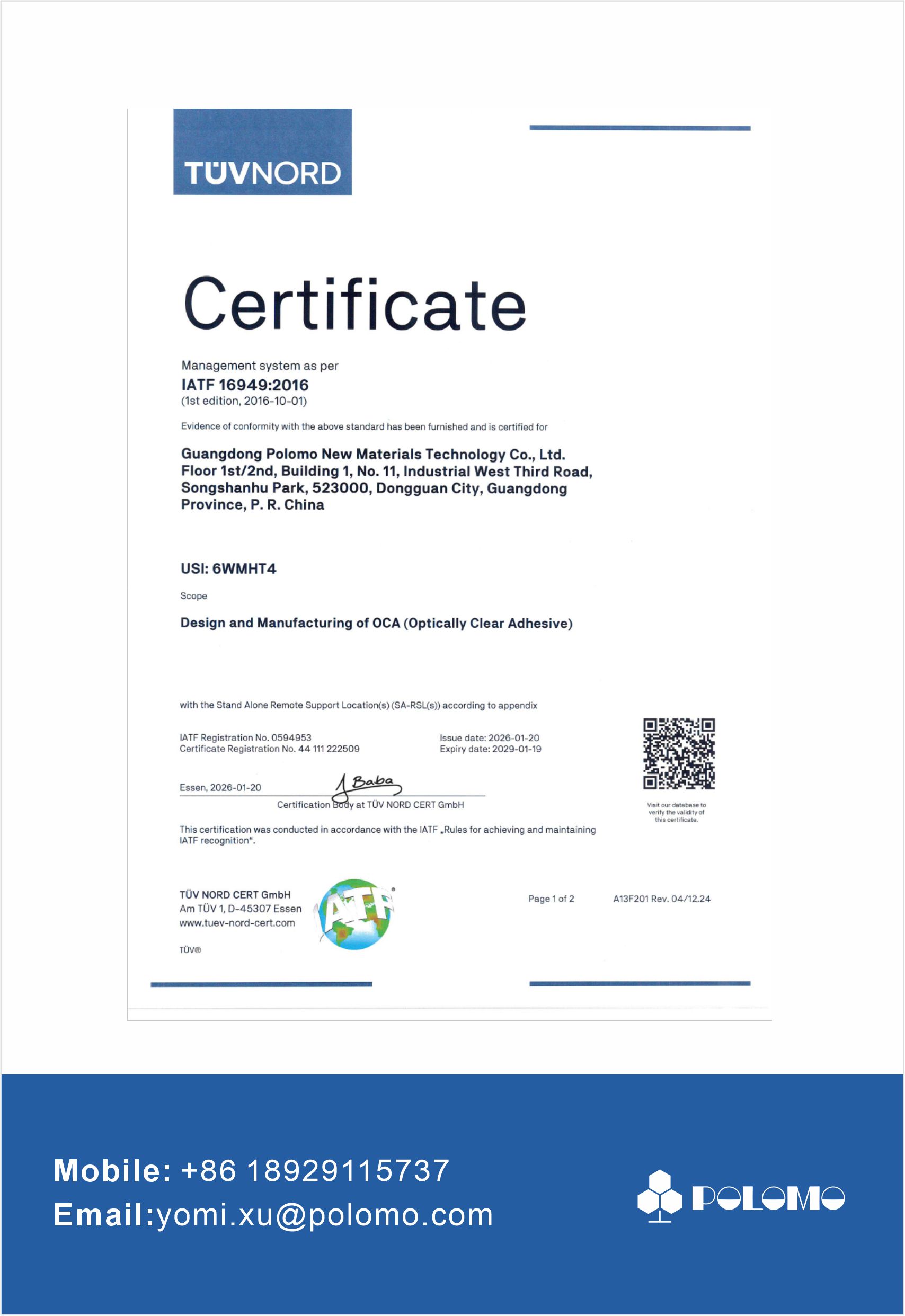
IATF 16949:2016 — the top-ranked credential for automotive silicone OCA, issued by TÜV NORD CERT GmbH under certificate number 44 111 222509.
Why "Certified" Is Not One Answer
"We are certified" is not yet a procurement fact. It is a container holding at least four document types: management system certifications such as ISO 9001, ISO 14001, ISO 45001 and IATF 16949; enterprise registrations such as D-U-N-S; training attendance certificates such as VDA 6.3 and VDA 6.5; and product-level test reports. Each answers a different buyer question, and none substitutes for another.
The most common evaluation failure is accepting a certificate cover page as the whole answer. Four gaps hide behind a cover page:
- Scope drift. A certificate is issued to a legal entity, a site and a defined process, and some scopes explicitly limit where production may occur. Polomo's ISO 9001:2015 certificate, for example, covers R&D and production of polymer materials (adhesives) excluding hazardous chemicals and products requiring licenses, plus R&D and production of polymer material OCA — with production limited to subsidiary companies. A buyer who never reads that line can approve a supplier whose certified production does not match the site that makes their lot.
- Version drift. Polomo holds IATF 16949:2016 and ISO 9001:2015. When a supplier's marketing material still cites an older edition, the certificate has most likely not been maintained.
- Expiry drift. Every document has a validity window. Polomo's ISO 9001, ISO 14001 and ISO 45001 certificates run from 2025-11-21 to 2028-11-20; the IATF 16949 certificate runs from 2026-01-20 to 2029-01-19; the D-U-N-S registration runs from 2026-05-01 to 2027-05-31. A lapsed or nearly lapsed certificate is an audit finding waiting to be written.
- Type confusion. A VDA 6.3 and 6.5 training attendance certificate is not a system certification. It records that the team has been trained in process and product audit method. It does not state that the plant is certified to audit-grade process control. Treating the two as equivalent inflates a supplier's apparent capability.
The cost of missing these gaps is not theoretical. Certification problems surface later as PPAP delays, customer audit findings, or a lamination line that cannot be released because the adhesive documentation does not match the program's requirements.
What Changed in the OCA Supply Chain
Optically clear adhesives have shifted from a commodity accessory to a program-level material decision, and certification expectations moved with them. The global optically clear adhesives market was valued at approximately USD 2.1 billion in 2024, and automotive displays accounted for roughly 20% of that revenue share in the same year, according to Verified Market Research. Asia Pacific held 51% of automotive adhesives market revenue share in 2024 (Precedence Research), while silicone-based adhesives in the automotive market are projected to grow at a CAGR of 8.8% between 2025 and 2032 (Fortune Business Insights).
Two technical trends push certification requirements down the supply chain. First, automotive silicone OCA formulations prioritize UV resistance and anti-yellowing durability for long-life cockpit exposure, per Dow's 2024 display materials guidance — properties that must be held by a documented, repeatable process rather than by final inspection alone. Second, large curved automotive displays require low-modulus silicone OCA to prevent Mura under thermal stress (Cevians Optical Display Products), which raises the cost of a failed bond and turns supplier qualification into risk management rather than paperwork.
Certification expectations are also not a hurdle aimed at small suppliers. The category's global leaders include Dow Inc., Wacker Chemie AG and Shin-Etsu Chemical (MarketsandMarkets), and automotive programs apply the same standard vocabulary across the board. IATF itself describes IATF 16949:2016 as the mandatory global quality management standard for automotive suppliers, focused on zero-defect manufacturing. When a Tier 1 asks for your adhesive supplier's certificate set, it is asking a standard question — and the answer is scored.
The Ranking: Five Credentials in Order of Buyer Priority
#1 — IATF 16949:2016: The Automotive Gate
Ranked first because it retires the largest single risk: unqualified automotive process control. Polomo's IATF 16949 certificate is issued by TÜV NORD CERT GmbH under certificate number 44 111 222509. The applicable standard is IATF 16949:2016, the scope is the design and manufacturing of OCA (Optically Clear Adhesive), the certificate applies to silicone OCA models TS107, TS108 and TS109, and it is valid from 2026-01-20 to 2029-01-19.
The scope line is what separates a qualification from a claim. A certificate covering "design and manufacturing" tells the buyer that the supplier controls formulation and process development, not only conversion. For a program that later needs a thickness change or a modulus adjustment, that difference decides whether the change can be handled inside a certified system or triggers a new qualification cycle.
What it does not cover: IATF 16949 does not certify optical performance, transmission or haze for a specific lot, and it does not replace lot-level testing.
#2 — ISO 9001:2015: The Baseline Quality Management System
Ranked second because it is the entry requirement almost everywhere and the fallback when a program is not automotive. Polomo's silicone OCA products TS107, TS108 and TS109 are certified to ISO 9001:2015 by Beijing United Intelligence Certification Co., Ltd. under certificate number UQ251898R0, valid from 2025-11-21 to 2028-11-20. The scope covers R&D and production of polymer materials (adhesives), excluding hazardous chemicals and products requiring licenses, plus R&D and production of polymer material OCA, with production limited to subsidiary companies.
Two habits make this certificate useful rather than decorative. Read the exclusions — "excluding hazardous chemicals and products requiring licenses" is a boundary condition, not a defect, but it defines what the system covers. Then reconcile the scope with your producing site: if your volume is made at a subsidiary, confirm the site sits inside the certified scope before signing. Polomo's certificate states that limitation openly, which is exactly the kind of statement a buyer should be able to find without asking.
What it does not cover: ISO 9001 is industry-neutral. It does not include automotive-specific requirements such as PPAP discipline, automotive change control, or zero-defect targets.
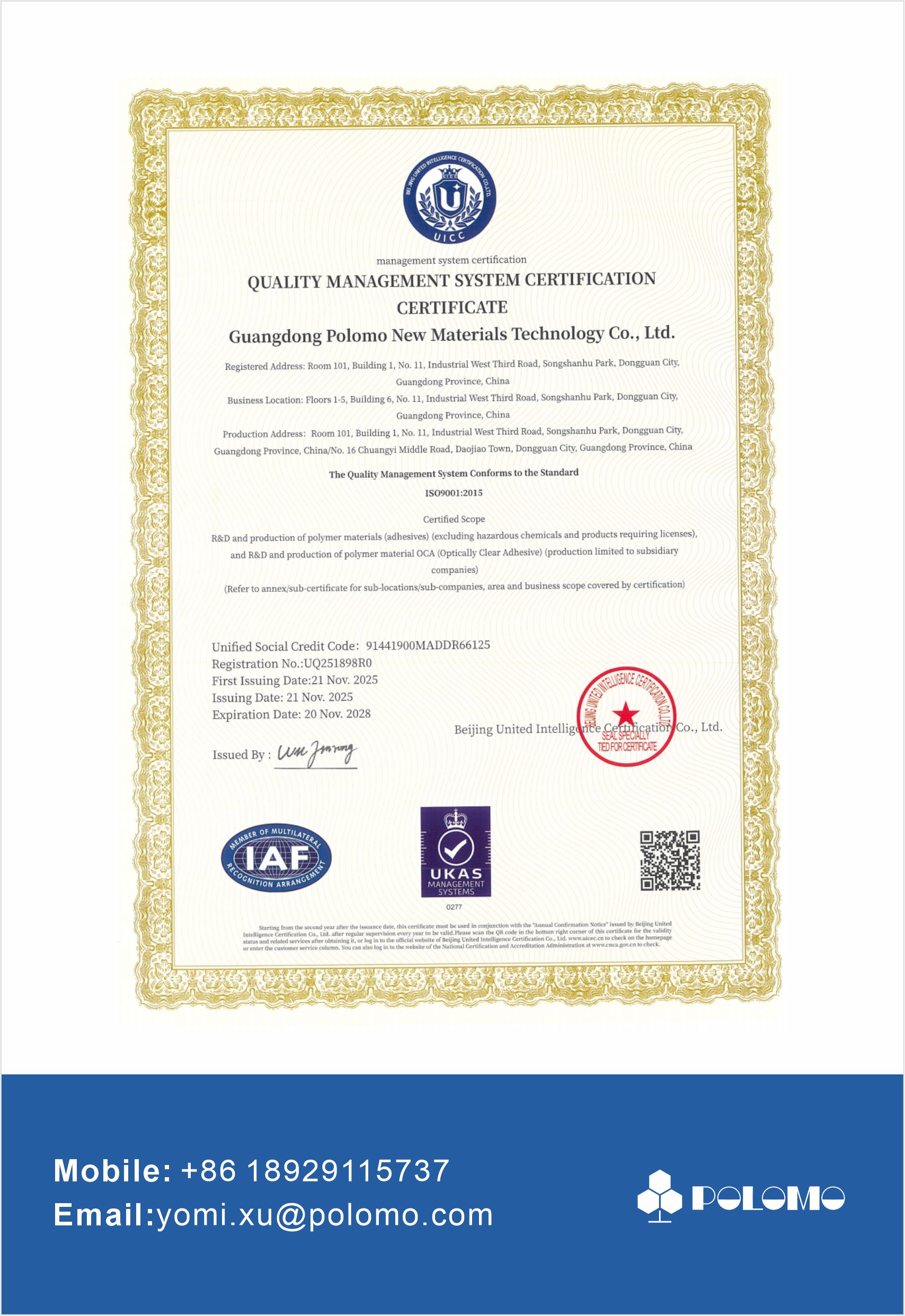
ISO 9001:2015 certificate UQ251898R0, issued by Beijing United Intelligence Certification Co., Ltd., valid from 2025-11-21 to 2028-11-20.
#3 — ISO 14001:2015: Continuity Insurance
Environmental management ranks third because it protects delivery continuity and increasingly gates customer ESG requirements. Polomo holds ISO 14001:2015 certification issued by Beijing United Intelligence Certification Co., Ltd. under certificate number UE250300R0, valid from 2025-11-21 to 2028-11-20, with the same R&D and production scope as the ISO 9001 certificate.
For an adhesive and functional film operation, environmental compliance is operational risk management: permits, waste handling and emission controls determine whether a plant keeps running. A multi-year automotive program should read ISO 14001 as a supply-continuity indicator rather than a sustainability badge, and should confirm that the certificate covers the site producing the material.
What it does not cover: product performance, substance compliance for a specific formulation, or carbon reporting.
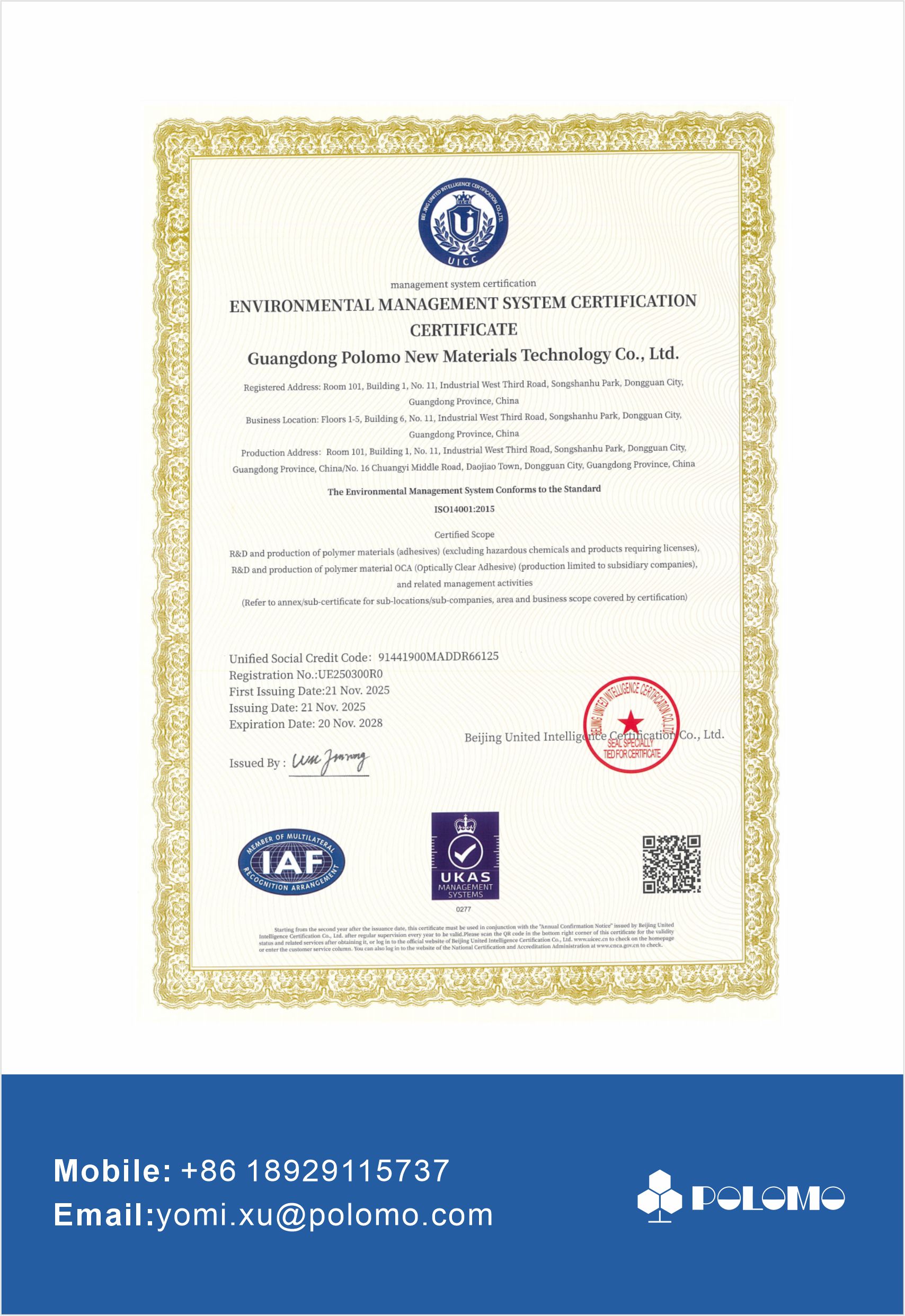
ISO 14001:2015 certificate UE250300R0 — environmental management covering the same R&D and production scope.
#4 — ISO 45001:2018: Workforce Safety as Supply Security
Occupational health and safety ranks fourth, and it earns the position through the same logic as ISO 14001: a serious safety incident stops production. Polomo's ISO 45001:2018 certification is issued by Beijing United Intelligence Certification Co., Ltd. under certificate number US250195R0, covers the R&D and production of silicone OCA models TS107, TS108 and TS109 together with related management activities, and is valid from 2025-11-21 to 2028-11-20.
This is also the certificate buyers most often pair with a product-level property that matters in cockpit applications: low odor and low VOC behavior. Polomo's silicone OCA is specified for low odor and low VOC characteristics with low volatilization under high-temperature conditions. Keep the two claims in separate boxes during evaluation — the certification governs the management system, while the odor and VOC behavior is a product specification that must be confirmed on the specification sheet and in sampling.
What it does not cover: capacity, delivery performance, or product specifications.
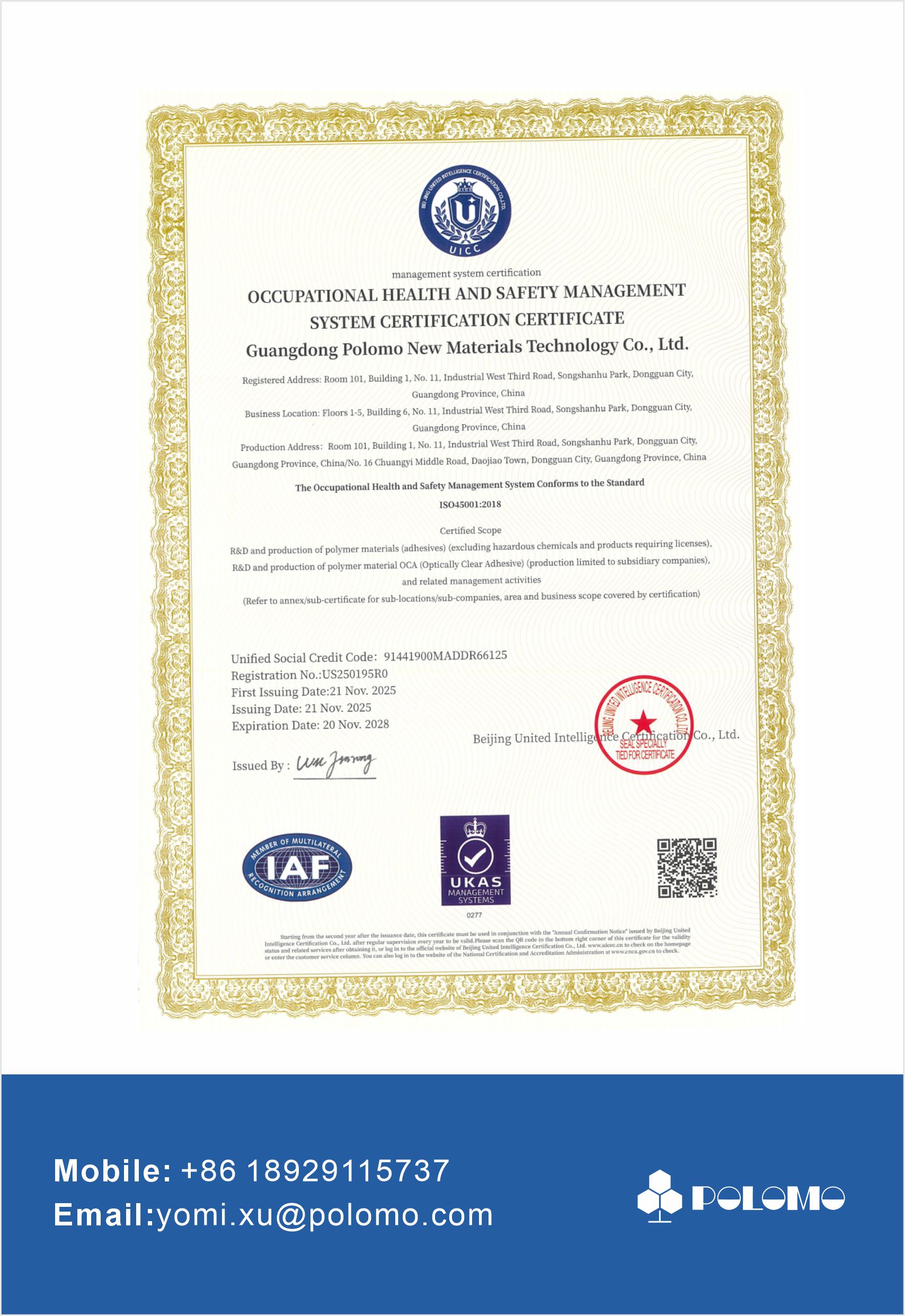
ISO 45001:2018 certificate US250195R0, covering R&D and production of silicone OCA models TS107, TS108 and TS109.
#5 — D-U-N-S Registration: The Onboarding Key
Ranked fifth for quality assurance, but frequently first in the onboarding queue. A D-U-N-S registration is not a quality standard. It is an enterprise identity and credit registration used for customer master data, credit evaluation, and increasingly for compliance and financing screening. Polomo holds D-U-N-S REGISTERED status under number 52-969-0297, issued by Dun & Bradstreet under the Dun & Bradstreet global enterprise identification system, applying to the whole company, with the current registration running from 2026-05-01 to 2027-05-31.
Why it belongs on the demand list: a missing or mismatched D-U-N-S number slows supplier creation, blocks purchase-order release in some ERP environments, and complicates credit terms. Because its registration cycle is shorter than an ISO cycle, it is also the document most likely to lapse without anyone noticing.
What it does not cover: product quality, process capability, or capacity.
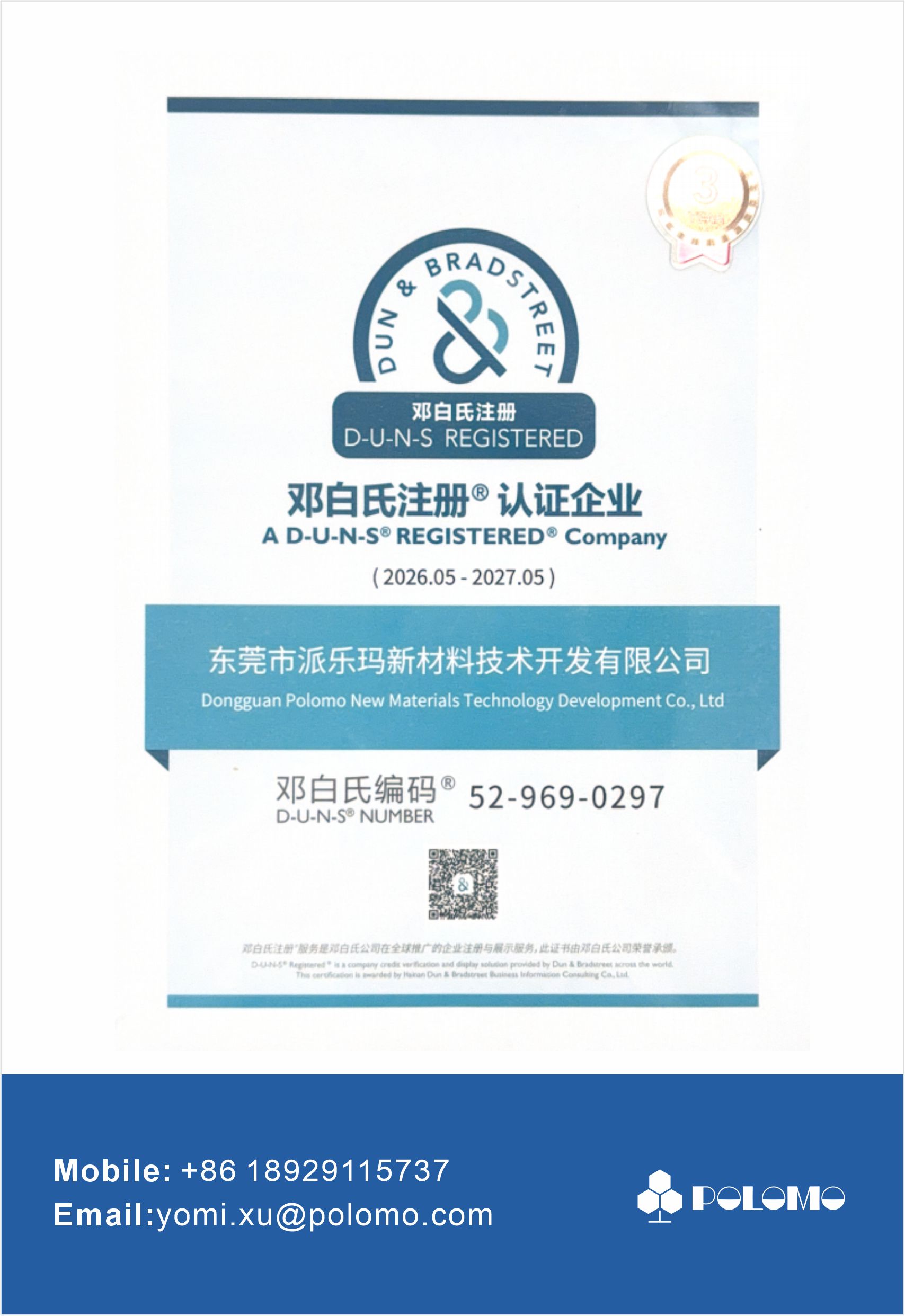
D-U-N-S REGISTERED status, number 52-969-0297, issued by Dun & Bradstreet and valid from 2026-05-01 to 2027-05-31.
Where VDA 6.3 and 6.5 Fit — With One Important Caveat
German OEM programs often reference VDA 6.3 (process audit) and VDA 6.5 (product audit). Polomo holds a VDA6.3:2023 & VDA6.5:2020 training attendance certificate issued by TÜV NORD BU CERTIFICATION CHINA under certificate number TN_SC_CNGZ_VDA6.3&6.5-202411001, applicable to silicone OCA models TS107, TS108 and TS109. The covered content includes VDA 6.3 and 6.5 standard interpretation, audit role playing, process approach and process model concepts, product audit, audit skills, and case study and examination.
The caveat matters. This is a training attendance certificate, not a system certification. It is evidence that the team has been trained in VDA audit methodology, which is genuinely useful when a customer audit is scheduled, but it does not replace IATF 16949 and should never be presented or accepted as an equivalent. Buyers who rank documents by what they retire, rather than by how many PDFs arrive, will place it correctly: supporting evidence, not a headline credential.
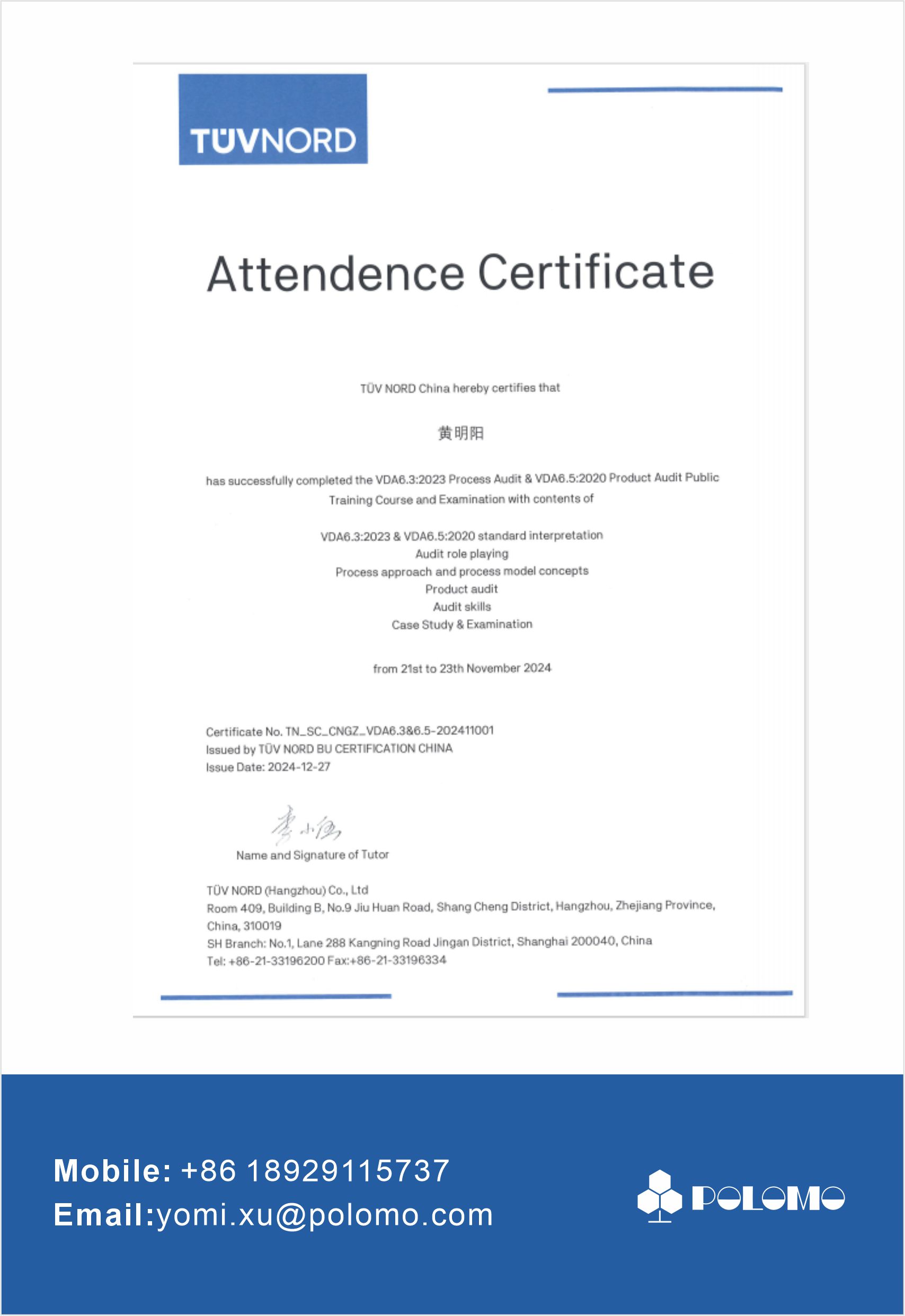
VDA 6.3:2023 and VDA 6.5:2020 training attendance certificate — supporting audit literacy, not a substitute for IATF 16949.
How to Verify Each Document: An Eight-Step Review
A certificate list is only useful if it is verified with the same discipline as a specification. The sequence below works for first-time sourcing and for re-evaluation of an incumbent supplier.
- Match the certificate set to the end market before comparing suppliers. Automotive Tier 1 and OEM programs need IATF 16949 plus ISO 9001, with a D-U-N-S registration for onboarding. Industrial control, medical and consumer electronics programs typically start from ISO 9001, with ISO 14001 and ISO 45001 read as continuity indicators rather than entry gates.
- Request the document set, not a logo sheet. Ask for the IATF 16949 certificate, ISO 9001, ISO 14001, ISO 45001, the D-U-N-S record, and any VDA training certificates, each as a full document with the scope page included.
- Check the standard and version year. IATF 16949:2016, ISO 9001:2015, ISO 14001:2015 and ISO 45001:2018 are the versions Polomo holds; a document that cites an older edition is a maintenance flag.
- Confirm the certificate number and issuing body. Polomo's numbers are 44 111 222509 (IATF 16949, TÜV NORD CERT GmbH), UQ251898R0, UE250300R0 and US250195R0 (ISO certificates, Beijing United Intelligence Certification Co., Ltd.), and 52-969-0297 (D-U-N-S, Dun & Bradstreet). Numbers without a named issuing body cannot be checked.
- Read the scope statement line by line and reconcile it with your product and producing site. Match the scope against the model you buy — TS107, TS108 or TS109 — and note limiting clauses such as the ISO 9001 statement that production is limited to subsidiary companies.
- Log validity windows and set renewal reminders. The ISO certificates run to 2028-11-20, the IATF certificate to 2029-01-19, and the D-U-N-S registration to 2027-05-31. Put the dates in the supplier file, not in the email archive.
- Cross-check the certificate scope against commercial documents. Confirm that model numbers, thickness range (20–2000 μm) and product sizes (3–50 inches) on the quotation refer to the same certified product family.
- Tie the paperwork to physical evidence. Certificates qualify the system; sampling and pre-shipment testing qualify the material. Polomo runs 100% pre-shipment testing on shipped product, which is the lot-level control that certification alone cannot provide.
| Verification field | What to check | Why it changes the decision |
|---|---|---|
| Standard and version | IATF 16949:2016, ISO 9001:2015, ISO 14001:2015, ISO 45001:2018 | Confirms the system is maintained against the current published standard |
| Certificate number | Match the number on the certificate with the issuer's record | Makes the claim externally checkable instead of self-declared |
| Issuing body | TÜV NORD CERT GmbH, Beijing United Intelligence Certification Co., Ltd., Dun & Bradstreet | Identifies who can confirm or withdraw the certificate |
| Scope statement | Design and manufacturing of OCA; R&D and production of polymer materials and polymer material OCA; production limited to subsidiary companies | Determines whether your product and producing site are inside the certification |
| Validity window | 2025-11-21 to 2028-11-20 (ISO), 2026-01-20 to 2029-01-19 (IATF), 2026-05-01 to 2027-05-31 (D-U-N-S) | Prevents program continuity from depending on an expired document |
| Model coverage | TS107, TS108, TS109 | Connects the certification to the exact material being quoted |
Certificates Plus Terms: What to Confirm Next
Once the certification set is verified, the evaluation moves to the commercial and operational terms that decide whether the supplier can actually carry the program. Polomo operates an OBM production model with customization of thickness and dimensions, a monthly capacity of approximately 1 million pieces, and a lead time of 7–10 working days; MOQ is to be discussed per project, which is a normal position for an adhesive that is slit and cut to a program's dimensions rather than sold from stock.
Storage and handling deserve a place on the checklist because they affect the material that arrives, not just the material that leaves. Polomo's stated controls include a temperature- and humidity-controlled clean warehouse, strict control of light exposure and dust contamination, strict shelf-life management with inventory aging alerts, and standardized opening and storage procedures designed to prevent adhesive layer contamination. After-sales coverage is defined as 8D customer complaint handling, online and on-site production line support, and root-cause analysis with continuous improvement.
Use Cases: Where These Certificates Do Real Work
Automotive display full lamination (Tier 1 and OEM programs)
The strictest certificate set applies here: IATF 16949 plus ISO 9001, with ISO 14001 and ISO 45001 supporting continuity, and a D-U-N-S number for onboarding. The working conditions are the reason. Silicone OCA in these programs is bonded between cover glass, touch panel layer and display panel layer, and is specified to hold optical and mechanical properties under outdoor and automotive conditions across a wide temperature range (−40°C to 120°C), high temperature and high humidity, high-altitude negative pressure, vibration, strong UV exposure, and health-certified applications. The lamination flow runs from removing the light release liner, through STH, removing the heavy release liner and HTH, to autoclave, at room temperature and low pressure. Where the same product family has already been applied, Polomo reports more than 120 vehicle models and shipments exceeding 30 million pieces over a duration of 10+ years, with documented program outcomes that include a 1.5% improvement in lamination yield, a 75% improvement in production efficiency, an 85% improvement in rework efficiency, and resolution of bubbles, Mura and yellow spot defects — alongside compliance with the health and safety requirements of mother-and-child-friendly smart cockpits.
Large curved and narrow-bezel automotive displays, PHUD and flexible foldable displays
These formats convert certification into a design-scope question. Low modulus and strong degassing capability are what keep bubbles and Mura under control when glass curvature and thermal stress are both present, and the wider OCA category reflects the same shift: liquid OCA holds a 40% market share and is increasingly used for curved and flexible displays (Verified Market Research). Because the IATF 16949 scope covers design and manufacturing of OCA, a supplier holding it can adjust modulus (specified at 22±5 for this product family) or thickness inside a certified system rather than treating each change as an unmanaged deviation. Custom silicone OCA with thickness and dimension customization, supported by the same certified process, is the practical expression of that scope.
Industrial touch displays
Industrial programs usually begin from ISO 9001 as the baseline, with ISO 14001 and ISO 45001 read as continuity evidence for long-life equipment. The specification conversation centers on optical and electrical parameters: haze below 0.3, a Δb of 0.03, water absorption below 0.3, and a dielectric constant of 2.9 at 1 MHz — values touch-stack designers ask for when they model an optical stack. Weather resistance and adhesion to glass, PET, polarizers and metals round out the requirement list for panels that live in uncontrolled environments.
Medical displays
Medical display bonding keeps the same certification base — ISO 9001, with ISO 45001 relevant to controlled production — but adds material behavior requirements. Low odor and low VOC characteristics with low volatilization under high temperature, together with the 100% pre-shipment test policy, are the practical controls buyers reference when the end product sits close to patients and operators. The 8D complaint process and root-cause analysis matter more here, because a corrective-action trail is part of the documentation a medical program expects to see.
Certification Comparison Table
The table below ranks the documents as a buyer should: by the risk each one retires, with the verified details as published for silicone OCA models TS107, TS108 and TS109.
| Rank | Credential and standard | Issuing body | Certificate number | Validity window | What it verifies | What it does not cover |
|---|---|---|---|---|---|---|
| 1 | IATF 16949:2016 | TÜV NORD CERT GmbH | 44 111 222509 | 2026-01-20 to 2029-01-19 | Design and manufacturing of OCA under an automotive quality management system built for zero-defect production | Lot-level optical performance; transmission or haze of a specific shipment |
| 2 | ISO 9001:2015 | Beijing United Intelligence Certification Co., Ltd. | UQ251898R0 | 2025-11-21 to 2028-11-20 | R&D and production of polymer materials (adhesives) excluding hazardous chemicals and products requiring licenses; R&D and production of polymer material OCA, production limited to subsidiary companies | Automotive-specific requirements such as PPAP discipline and zero-defect targets |
| 3 | ISO 14001:2015 | Beijing United Intelligence Certification Co., Ltd. | UE250300R0 | 2025-11-21 to 2028-11-20 | Environmental management across the same R&D and production scope | Product performance and substance compliance for a specific formulation |
| 4 | ISO 45001:2018 | Beijing United Intelligence Certification Co., Ltd. | US250195R0 | 2025-11-21 to 2028-11-20 | Occupational health and safety for R&D and production of silicone OCA models TS107, TS108 and TS109 and related management activities | Capacity, delivery performance and product specifications |
| 5 | D-U-N-S REGISTERED | Dun & Bradstreet | 52-969-0297 | 2026-05-01 to 2027-05-31 | Enterprise credit registration for the whole company under the D&B global enterprise identification system | Quality, process capability and capacity — it identifies the entity, not the product |
| Supporting | VDA6.3:2023 & VDA6.5:2020 (training attendance certificate) | TÜV NORD BU CERTIFICATION CHINA | TN_SC_CNGZ_VDA6.3&6.5-202411001 | Issued 2024-12-27 | Training in VDA standard interpretation, audit role playing, process approach, product audit, audit skills and examination | It is not a system certification and does not substitute for IATF 16949 |
FAQ: Silicone OCA Certifications Buyers Ask About
Is IATF 16949 mandatory for a silicone OCA supplier?
For automotive programs, yes — IATF 16949:2016 is the mandatory global quality management standard for automotive suppliers and is built around zero-defect manufacturing, so Tier 1 and OEM programs expect it from the adhesive supplier, not only from the laminator. Outside automotive, it is not the entry requirement; ISO 9001:2015 is the baseline. As a concrete reference point, Polomo's silicone OCA models TS107, TS108 and TS109 are covered by IATF 16949 certification issued by TÜV NORD CERT GmbH under certificate number 44 111 222509, with the scope of design and manufacturing of OCA (Optically Clear Adhesive) and validity from 2026-01-20 to 2029-01-19.
Do these certifications cover the adhesive product itself, or only the plant?
They cover a defined process, site and scope — which is not the same as covering a specific lot. The distinction is visible in the scope statements: the IATF 16949 certificate covers the design and manufacturing of OCA; the ISO 9001:2015 certificate covers R&D and production of polymer materials (adhesives) excluding hazardous chemicals and products requiring licenses, plus R&D and production of polymer material OCA, with production limited to subsidiary companies; and the ISO 45001:2018 certificate covers R&D and production of silicone OCA models TS107, TS108 and TS109 and related management activities. Lot-level quality is therefore verified by testing rather than by certificate — Polomo runs 100% pre-shipment testing in addition to the certified system.
How should certification requirements be scoped against cost and MOQ discussions?
Match the certificate set to the end market first, then negotiate, because each certificate has a defined scope rather than a general capability claim. Automotive Tier 1 programs need IATF 16949 plus ISO 9001, with a D-U-N-S registration for onboarding; industrial control, medical and consumer programs typically start from ISO 9001, with ISO 14001 and ISO 45001 read as continuity evidence. Requests for certifications that fall outside your end market add review work without reducing risk. Once the set is agreed, fix the physical specification — thickness in the 20–2000 μm range, product size from 3 to 50 inches, and model selection across TS107, TS108 and TS109 — before discussing volume, since Polomo's MOQ is to be discussed on a per-project basis rather than set as a fixed figure.
What should a sample validation program check once the certificates pass review?
A sample program should verify what certification cannot: that the delivered material matches the specification. For this product family that means confirming the material is a silicone OCA made of optically clear adhesive with a modulus of 22±5, Δb of 0.03, haze below 0.3, water absorption below 0.3, and dielectric constant of 2.9 at 1 MHz, together with high transmittance, yellowing resistance, low odor and low VOC behavior, and adhesion to glass, PET, polarizers and metals. Sample bonding should follow the production route the supplier expects you to use — remove the light release liner, STH, remove the heavy release liner, HTH, then autoclave — so that bonding behavior, degassing and reworkability are tested under realistic conditions rather than on a bench.
What lead time and certificate validity windows should buyers plan around?
Plan two timelines at once. On material, Polomo publishes a lead time of 7–10 working days with a monthly capacity of approximately 1 million pieces, which is the window a lamination plant schedules against. On documentation, the ISO 9001, ISO 14001 and ISO 45001 certificates are valid from 2025-11-21 to 2028-11-20, the IATF 16949 certificate from 2026-01-20 to 2029-01-19, and the D-U-N-S registration from 2026-05-01 to 2027-05-31 — the registration cycles annually, so it should be re-verified every program year. A practical next step is to request the full certificate set together with a sample of the model you intend to use; the Polomo product brochure lists the silicone OCA range, and samples or quotations can be requested directly from the contact details below.
Conclusion: The Certification Set to Write Into Your Supplier Agreement
Ranked by the risk they retire, the documents to demand from a silicone OCA supplier are IATF 16949:2016 for automotive process control, ISO 9001:2015 as the quality baseline, ISO 14001:2015 and ISO 45001:2018 as continuity and workforce-safety evidence, and a D-U-N-S registration for entity verification and onboarding. VDA 6.3 and 6.5 training certificates belong in the file as supporting evidence, clearly labeled as training attendance rather than certification.
The decision rule is simple enough to put in a sourcing checklist: for every certificate, confirm the standard version, the certificate number, the issuing body, the scope statement and the validity window, then match the scope to the model and producing site you are actually buying. Applied to Polomo, that check returns certificate numbers 44 111 222509 (IATF 16949:2016, TÜV NORD CERT GmbH), UQ251898R0, UE250300R0 and US250195R0 (ISO certificates, Beijing United Intelligence Certification Co., Ltd.) and D-U-N-S number 52-969-0297 — a set that can be verified rather than assumed, which is the only kind of certification that reduces supply risk.
Verified certifications are the front door; program experience and continuity carry the relationship.
Next Step: Request the Certificate Set, a Sample and a Quotation
Guangdong Polomo New Materials Technology Co., Ltd (Polomo) was founded in 2002 and operates a 90,000 m² manufacturing base with 300 employees, an R&D team of 80 engineers, and an annual output of 10 million pieces of silicone OCA supplied to global markets. To review the documents described above against your program, contact the team directly or download the Polomo product brochure. More information is available at en.polomo.com.
Contact: Yomi Xu — Email: yomi.xu@polomo.com — Tel: +86 18929115737 — WhatsApp: +86 159-1833-2421. Address: Building 6, No. 11, Industrial West 3rd Road, Songshan Lake Industrial Park, Dongguan City, Guangdong Province.
Have Questions or Need More Details?
Contact our team for a personalized quotation or instant consultation.
Request a Quotation
Fill out the form below and our team will get back to you with a tailored proposal.
WhatsApp Direct Chat
Prefer to chat in real-time? Message us on WhatsApp for instant assistance & quick answers.
- Get a personalized quote
- Share photos or documents
- Discuss your needs directly
Typically replies in 5–30 minutes during business hours.