
Silicone OCA Explained: Sourcing Overview for Automotive Display Teams
Silicone OCA Explained: Sourcing Overview for Automotive Display Teams
Silicone OCA (Optically Clear Adhesive) is a silicone-based transparent adhesive used in display full lamination to bond the cover glass, the touch panel layer, and the display panel layer into a single optical stack. In automotive applications, silicone OCA is specified because it must keep that stack optically clear and mechanically stable across wide temperature swings, high temperature and high humidity, high-altitude negative pressure, vibration, and strong UV exposure.
This article is written for engineering, quality, and sourcing teams at the awareness and research stages of a display program. It covers what silicone OCA is, how it is applied, which specifications deserve attention, how to evaluate a manufacturer, and what to ask before requesting samples.
Guangdong Polomo New Materials Technology Co., Ltd. — referred to here as Polomo — is a manufacturer that specializes in silicone OCA products. The company was established in 2002, operates from Building 6, No. 11, Industrial West 3rd Road, Songshan Lake Industrial Park, Dongguan City, Guangdong Province, and integrates research and development, manufacturing, and sales.
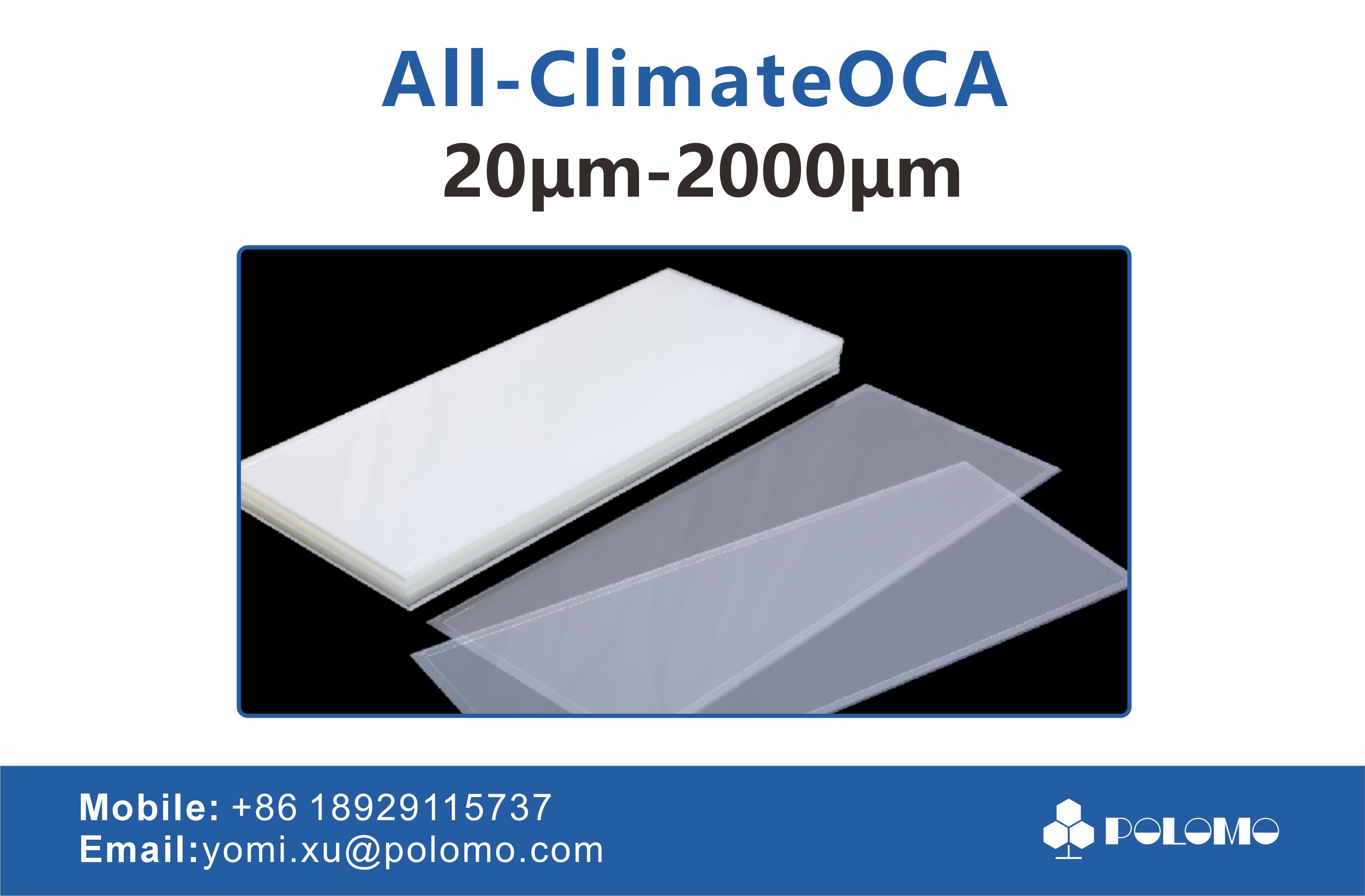
Silicone OCA is available in a range of thicknesses and sizes so that display programs can match the adhesive to the lamination design.
The Problem: Adhesive Choice Is a Reliability Decision
A laminated automotive display is more than a screen. The cover glass, touch panel layer, and display panel layer are joined by an optically clear adhesive that must preserve light transmission while absorbing mechanical and thermal stress. If the adhesive yellows, absorbs moisture, traps air, or becomes rigid at extreme temperatures, the display fails visually even when the electronics are still working.
Common concerns in automotive display lamination include yellowing over years of cabin exposure, bubble formation during lamination or in service, delamination after thermal cycling or vibration, and Mura — a visual non-uniformity that can appear on large curved displays under thermal stress.
Two practical consequences follow. First, buyers need a defined specification for optical, mechanical, and environmental performance instead of a vague category such as "OCA." Second, the supplier's quality system matters as much as the datasheet, because automotive supply chains operate under IATF 16949:2016, the mandatory global quality management standard for automotive suppliers, which is centered on zero-defect manufacturing.

Automotive display lamination is one of the most demanding applications for optically clear adhesives.
Industry Background: Why Silicone OCA Is Entering More Sourcing Conversations
Market data explains part of the growing interest. The global Optically Clear Adhesives market was valued at approximately USD 2.1 billion in 2024, and automotive displays accounted for roughly 20% of OCA revenue in that year (Verified Market Research). Industrial and rugged display systems represented about 15% of the global OCA market in 2024.
The wider automotive silicone market was valued at approximately USD 10.2 billion in 2024 (Grand View Research), and silicone-based adhesives in automotive applications are projected to grow at a CAGR of 8.8% between 2025 and 2032 (Fortune Business Insights). Asia Pacific led the automotive adhesives market in 2024 with a 51% revenue share (Precedence Research).
Material development is following the display design trend. Silicone OCA formulations for automotive use increasingly prioritize UV resistance and anti-yellowing properties for long-term cockpit durability (Dow, Display Week 2024). Low-modulus silicone OCA is specifically cited as a way to prevent Mura on large curved automotive displays under thermal stress (Cevians Optical Display Products). Liquid OCA currently holds a 40% share of the OCA segment and is increasingly used for curved and flexible displays (Optically Clear Adhesives Market Report 2026).
For context, advanced silicone materials used in optical bonding can be rated for temperature extremes from −55°C to +200°C (Rogers Corporation, BISCO Silicones), which shows why the silicone family is attractive for applications that combine optics with environmental exposure.
Dow Inc., Wacker Chemie AG, and Shin-Etsu Chemical are identified as global leaders in the automotive silicone and adhesives market (MarketsandMarkets). These companies set a high material-science benchmark. For display manufacturers, the practical task is to qualify a silicone OCA supplier that can combine material data, production capacity, and quality control — which is the focus of the next sections.
Detailed Solution: Polomo's Silicone OCA Product Family
Polomo's silicone OCA is classified as an all-climate OCA and is available under model designations TS107, TS108, and TS109. The material is intended for multiple industries — automotive, industrial control, medical, smart home appliances, consumer electronics, aerospace, and marine — with the same core goal: reliable optical bonding in demanding environments.
Reference Specifications
The following parameters are the values a buyer should record and compare when reviewing a silicone OCA datasheet:
| Parameter | Value |
|---|---|
| Thickness | 20–2000 μm |
| Product size | 3–50 inches |
| Appearance | Colorless transparent solid |
| Modulus | 22 ± 5 |
| Δb (yellowness change) | 0.03 |
| Haze | <0.3 |
| Water absorption | <0.3 |
| Dielectric constant (1 MHz) | 2.9 |
In practice, these values translate directly into display performance:
- Haze lower than 0.3 keeps the adhesive layer visually clear, which protects display readability.
- Δb of 0.03 indicates a low degree of yellowing, supporting long-term optical stability in a cockpit environment.
- Modulus of 22 ± 5 places the material in a low-modulus range, helping the adhesive absorb stress and improving yield when laminating large-size displays.
- Water absorption lower than 0.3 reduces the risk of dimensional change and optical defects under humid conditions.
- Dielectric constant of 2.9 at 1 MHz provides a stable electrical characteristic that display module designers can rely on.
Performance Attributes
Polomo documents five performance attributes for its silicone OCA:
- Excellent optical properties, including high transmittance and superior yellowing resistance;
- Low modulus and strong degassing capability, improving bonding efficiency and yield for large-size displays;
- Excellent weather resistance, maintaining outstanding optical and mechanical properties under harsh environments such as high and low temperature, high temperature and high humidity, high-altitude negative pressure, vibration, and strong UV resistance;
- Low odor and low VOC characteristics, with low volatilization at high temperature, providing a more environmentally friendly solution;
- Excellent adhesion to various substrates such as glass, PET, polarizers, and metals.
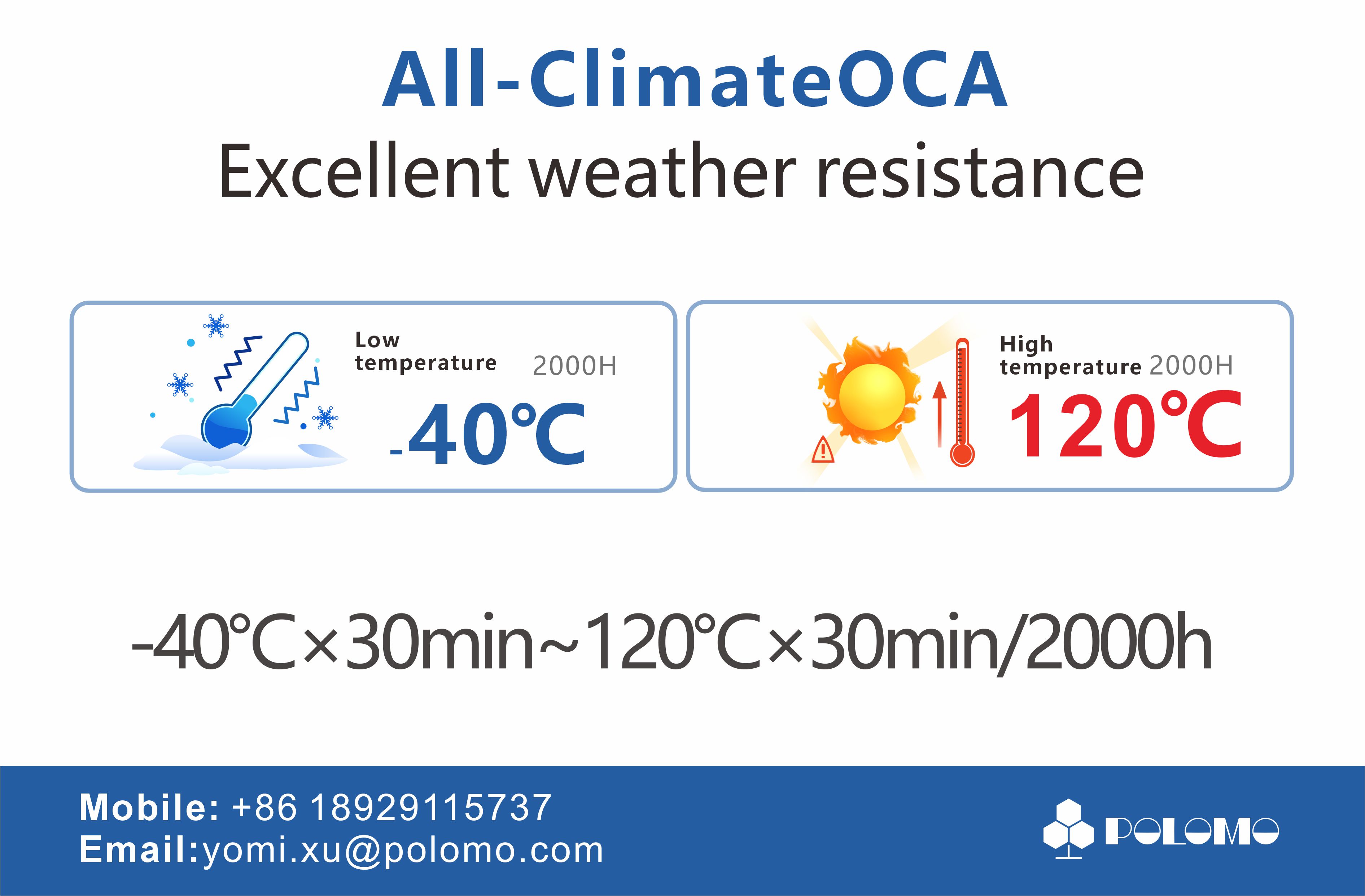
Weather resistance is a core requirement when a display must survive automotive environmental exposure.
Production and Quality Control Backing
Material data is meaningful only when the manufacturer can reproduce it at scale. Polomo's manufacturing facility covers 90,000 square meters and employs approximately 300 staff. The R&D team consists of 80 engineers, and annual production capacity reaches 10 million pieces. Approximately 30% of products are exported, and the main market is the global market.
The company provides adhesive and functional film solutions for advanced technology sectors including optoelectronic displays, semiconductor packaging, energy storage/batteries, and AI-enabled smart hardware. For silicone OCA specifically, storage and environmental control follow standardized measures: a temperature- and humidity-controlled clean warehouse, strict control of light exposure and dust contamination, shelf-life management, inventory aging alerts, and standardized opening and storage procedures to prevent adhesive layer contamination. FIFO management is used to keep inventory moving in order of age.
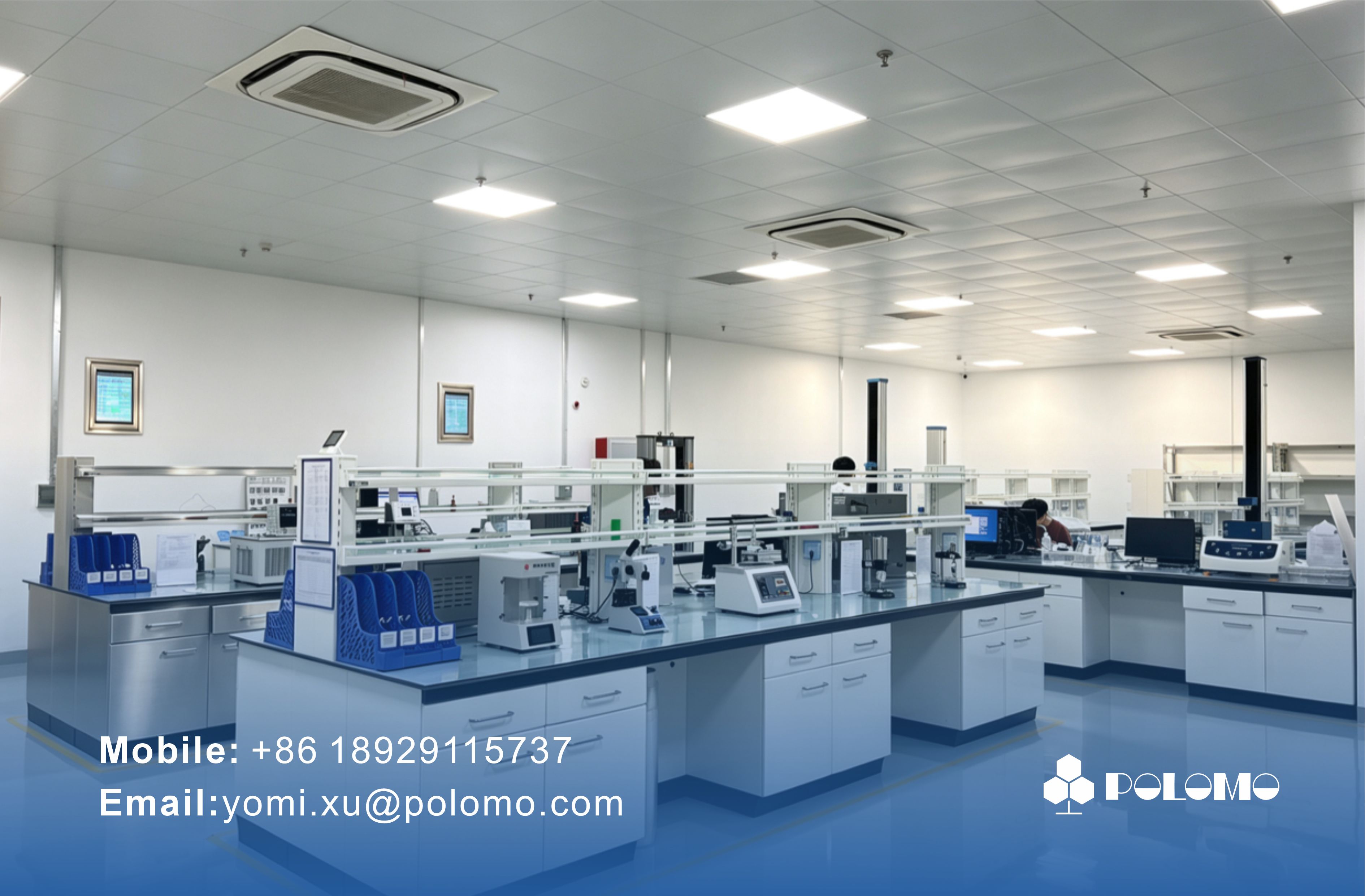
An 80-engineer R&D team supports material selection, testing, and program qualification.
Standardized storage, FIFO management, and inventory aging alerts help protect adhesive quality before lamination.
Step-by-Step: How Silicone OCA Is Applied and Qualified
Application in Display Full Lamination
Polomo's silicone OCA is used for display full lamination — the interlayer bonding between the display cover glass, the touch panel layer, and the display panel layer. The documented operation mode follows a defined sequence:
- Remove the light release liner, then perform the STH process step.
- Remove the heavy release liner, then perform the HTH process step.
- Complete the part in an autoclave.
The process is designed to run at room temperature and low pressure, using lamination equipment matched to the display program. This matters during yield engineering: a material that requires extreme process conditions is more difficult to bring into an existing production line.
Supplier Qualification Workflow
A practical qualification path for automotive programs has five stages:
- Define the operating envelope. Record the temperature range, humidity exposure, UV level, altitude conditions, and vibration profile of the target display location. Polomo's documented application scenario covers a wide temperature range from −40°C to 120°C, high temperature and high humidity, high-altitude negative pressure, vibration, and strong UV resistance.
- Verify the quality system. Ask the manufacturer about automotive quality management requirements, including IATF 16949:2016 certification, and request documentation that covers the site actually producing the material.
- Compare material data against the envelope. Evaluate haze, Δb, modulus, water absorption, dielectric constant, thickness, and size range against the drawing requirements.
- Audit manufacturing and storage controls. Confirm clean and climate-controlled warehousing, FIFO management, inventory aging alerts, and controlled opening and storage procedures.
- Sample and test. Run lamination trials, reliability tests, and visual inspections before approving series supply.
Use Cases: Where Silicone OCA Appears in Display Programs
Automotive Cockpit Displays
The primary use case for silicone OCA is the automotive cockpit. Center-stack displays, instrument clusters, and passenger displays operate in an outdoor-like environment inside the vehicle: wide temperature variation, cabin humidity, road vibration, and UV exposure through the glass. Polomo's product application conditions cover these cases — from −40°C to 120°C, high temperature and high humidity, high-altitude negative pressure, vibration, and strong UV resistance.
Large Curved and Narrow-Bezel Automotive Displays
Large curved displays create a thermal-stress challenge because the glass and the display panel move differently as temperature changes. Industry commentary identifies low-modulus silicone OCA as a solution for preventing Mura (visual distortion) under thermal stress. Low modulus allows the adhesive to absorb relative movement, while strong degassing supports bubble control on large parts — both are documented attributes of Polomo's silicone OCA.
PHUD and Head-Up Display Systems
For PHUD applications, optical clarity and haze control directly affect how clearly the projected information is perceived. Low haze, low Δb, and uniform bonding reduce light-scattering defects. Buyers evaluating PHUD programs should place haze and yellowing data at the top of their specification review.
Industrial Touch Displays
Industrial panels, HMI systems, and rugged displays are expected to run for long service lives in variable environments, and industrial and rugged display systems represent about 15% of the global OCA market in 2024. The same weather resistance and adhesion characteristics that support automotive parts apply to industrial equipment, where field replacement is expensive.
Medical Displays
Medical displays require stable optical performance and materials suited to health-sensitive environments. Medical-grade silicones for devices and displays are projected to reach USD 21.14 billion by 2034 (Dataintelo). Polomo's application scenario documentation includes health-certified applications, and the product's low odor and low VOC characteristics are relevant to environmentally sensitive settings.
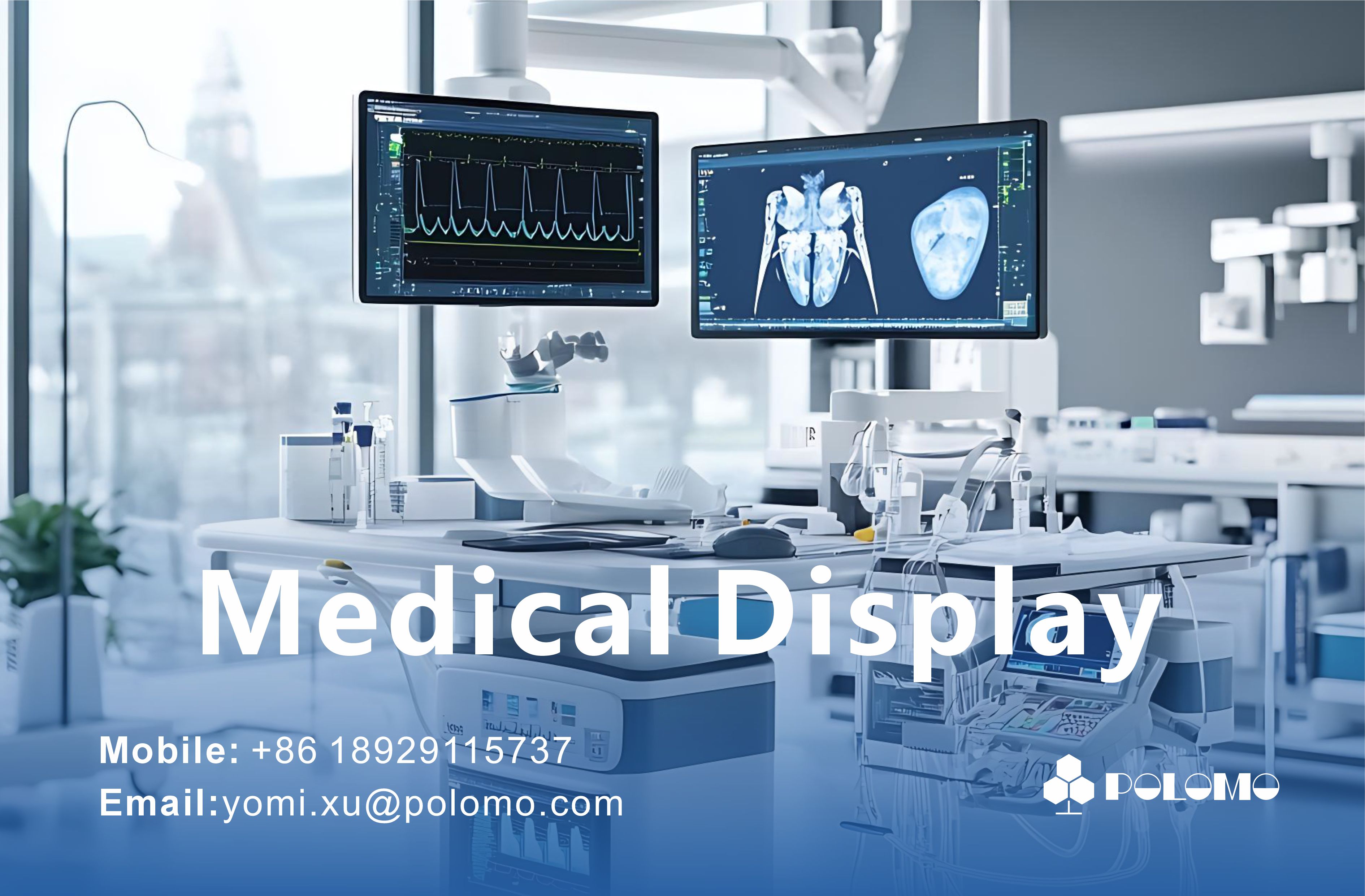
Medical display programs benefit from stable optical bonding and materials suited to health-certified environments.
Flexible and Foldable Display Programs
Curved and flexible display programs increasingly use liquid OCA, which holds a 40% share of the OCA segment. For film-based silicone OCA, the selection question is whether the material's modulus and thickness range (20–2000 μm) can accommodate the bending and stacking constraints of a specific design. Sourcing teams should share stack-up drawings early and ask the manufacturer to run bonding trials under realistic conditions.
Comparison Table: How to Evaluate a Silicone OCA Manufacturer
The table below converts the topics of this article into a practical evaluation framework. Each row lists an evaluation area, why it matters for an automotive display program, and the type of evidence a buyer should request. The third column uses Polomo's documented information as a reference example.
| Evaluation area | Why it matters | Evidence to request (Polomo reference) |
|---|---|---|
| Automotive quality management | IATF 16949:2016 is the mandatory global quality management standard for automotive suppliers, focused on zero-defect manufacturing. | Current certificate and scope covering the site that supplies the material. |
| Optical performance | Clarity and yellowing resistance determine long-term display quality in cockpit environments. | Haze <0.3 and Δb 0.03 in the TS107, TS108, and TS109 series. |
| Mechanical behavior | Low modulus helps prevent Mura and improves bonding yield on large or curved displays. | Modulus 22 ± 5; documented low-modulus and strong-degassing characteristics. |
| Environmental endurance | Automotive displays face temperature extremes, humidity, altitude effects, vibration, and UV. | Working-condition documentation from −40°C to 120°C, including high-temperature/high-humidity, high-altitude negative pressure, vibration, and strong UV resistance. |
| Process compatibility | The OCA must run on the display maker's existing lamination line. | Room-temperature, low-pressure operation: remove light release liner → STH → remove heavy release liner → HTH → autoclave. |
| Manufacturing and storage control | Adhesive quality can degrade before lamination if storage conditions are poor. | Temperature- and humidity-controlled clean warehouse, light and dust control, shelf-life management, inventory aging alerts, FIFO management. |
| R&D and supply capacity | Program qualification and series supply require engineering depth and stable capacity. | 80 R&D engineers, 90,000 m² facility, ~300 staff, and 10 million pieces annual capacity. |
FAQ: Questions Buyers Ask When Researching Silicone OCA Manufacturers
What certifications should a silicone OCA manufacturer for automotive displays hold?
Buyers should verify the manufacturer's automotive quality management status, starting with IATF 16949:2016, the mandatory global quality management standard for automotive suppliers, which focuses on zero-defect manufacturing. Because certification scope can vary, request the current certificate and confirm that it covers the site that actually produces the silicone OCA.
What silicone OCA specifications matter most for automotive display lamination?
The most decision-relevant parameters are haze, yellowness change (Δb), modulus, water absorption, and dielectric constant. In Polomo's TS107, TS108, and TS109 series, the reference values are haze lower than 0.3, Δb of 0.03, modulus of 22 ± 5, water absorption lower than 0.3, and dielectric constant of 2.9 at 1 MHz. These values cover optical clarity, yellowing resistance, stress absorption, humidity stability, and electrical consistency.
What quality control measures should a silicone OCA manufacturer have in place?
Relevant controls include temperature- and humidity-controlled clean warehousing, strict control of light exposure and dust contamination, shelf-life management, inventory aging alerts, standardized opening and storage procedures to prevent contamination of the adhesive layer, and FIFO management. Buyers can assess these controls through documentation and on-site audits.
How can silicone OCA affect the total cost of an automotive display program?
Material price is only one component. Low modulus and strong degassing improve bonding efficiency and yield for large-size displays, which reduces lamination waste. Weather resistance and UV resistance reduce the risk of field failures and warranty cost. In addition, the documented operation mode for Polomo's silicone OCA is room-temperature, low-pressure lamination, which fits standard lamination equipment. Compare material cost, process yield, reliability, and qualification effort together.
How can I request silicone OCA samples for an automotive display project?
Engineering and sourcing teams can contact Polomo directly to discuss target display requirements and request samples. The product brochure is publicly available, and the team can be reached by email or WhatsApp. Contact Yomi Xu at yomi.xu@polomo.com or WhatsApp +86 159-1833-2421. A useful starting point is to share the display size, stack structure, lamination equipment, and the environmental test conditions required by the program.
Conclusion: From Search Term to Specification
At the awareness and research stage, "silicone OCA" is a useful search term but not a complete specification. The material's value in automotive displays rests on measurable properties: low haze, low Δb, low modulus, low water absorption, stable dielectric behavior, weather resistance, and process compatibility. The supplier's quality system, storage controls, R&D depth, and production capacity determine whether those properties can be delivered consistently across a program lifecycle.
Polomo, established in 2002 and specializing in silicone OCA, is one example of a manufacturer built around this material class. Its product family — TS107, TS108, and TS109 — is supported by a 90,000-square-meter manufacturing facility, an 80-engineer R&D team, an annual production capacity of 10 million pieces, and documented storage and environmental control measures.
For the next step, download the Polomo product brochure or contact the team to discuss your display program's requirements and arrange sample evaluation.
Download the Polomo Product Brochure
Email: yomi.xu@polomo.com | WhatsApp: +86 159-1833-2421
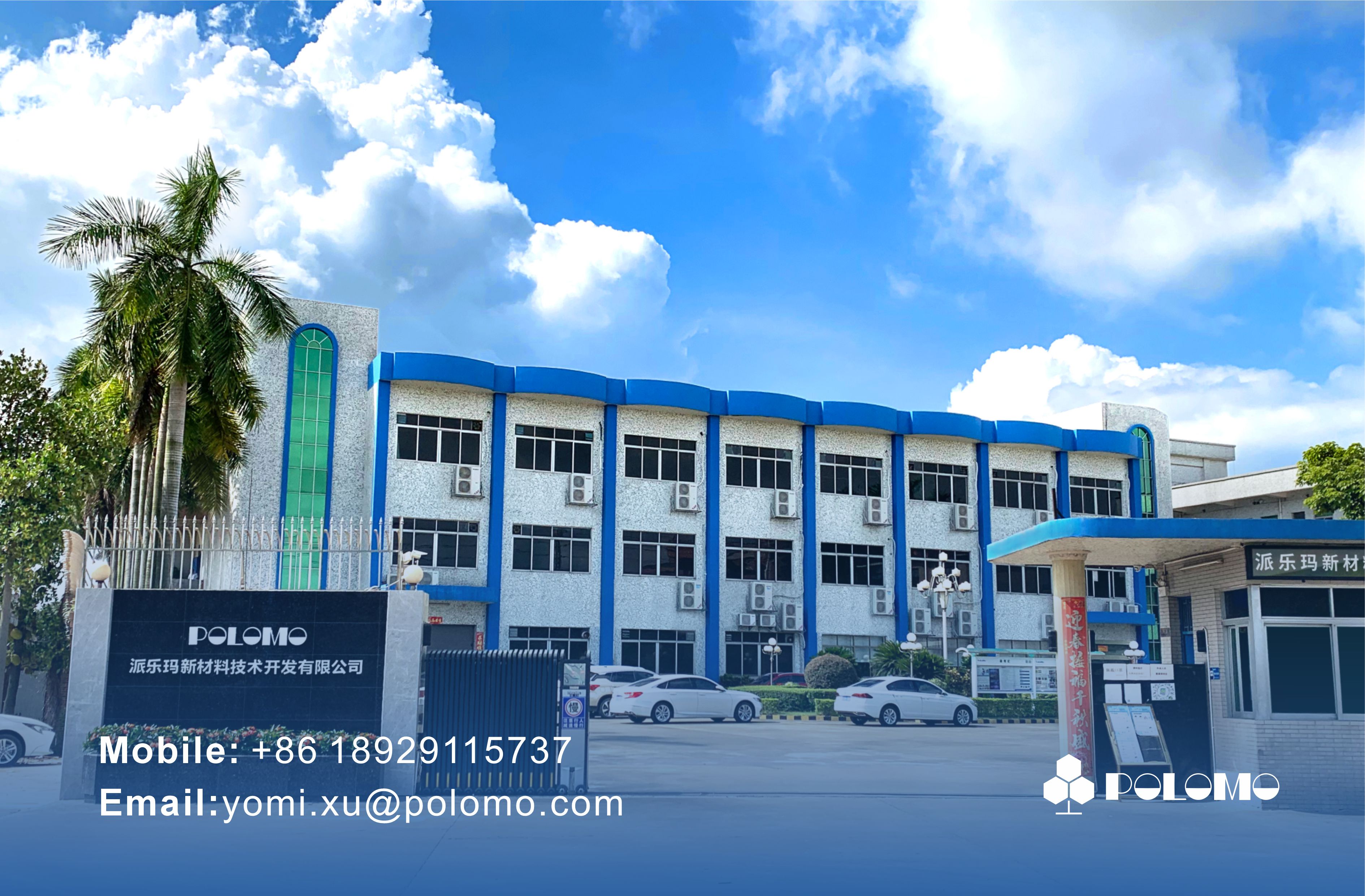
Polomo's adhesives R&D and manufacturing base in Dongguan supports silicone OCA development and series production.
Have Questions or Need More Details?
Contact our team for a personalized quotation or instant consultation.
Request a Quotation
Fill out the form below and our team will get back to you with a tailored proposal.
WhatsApp Direct Chat
Prefer to chat in real-time? Message us on WhatsApp for instant assistance & quick answers.
- Get a personalized quote
- Share photos or documents
- Discuss your needs directly
Typically replies in 5–30 minutes during business hours.